
Java Comparison Operators

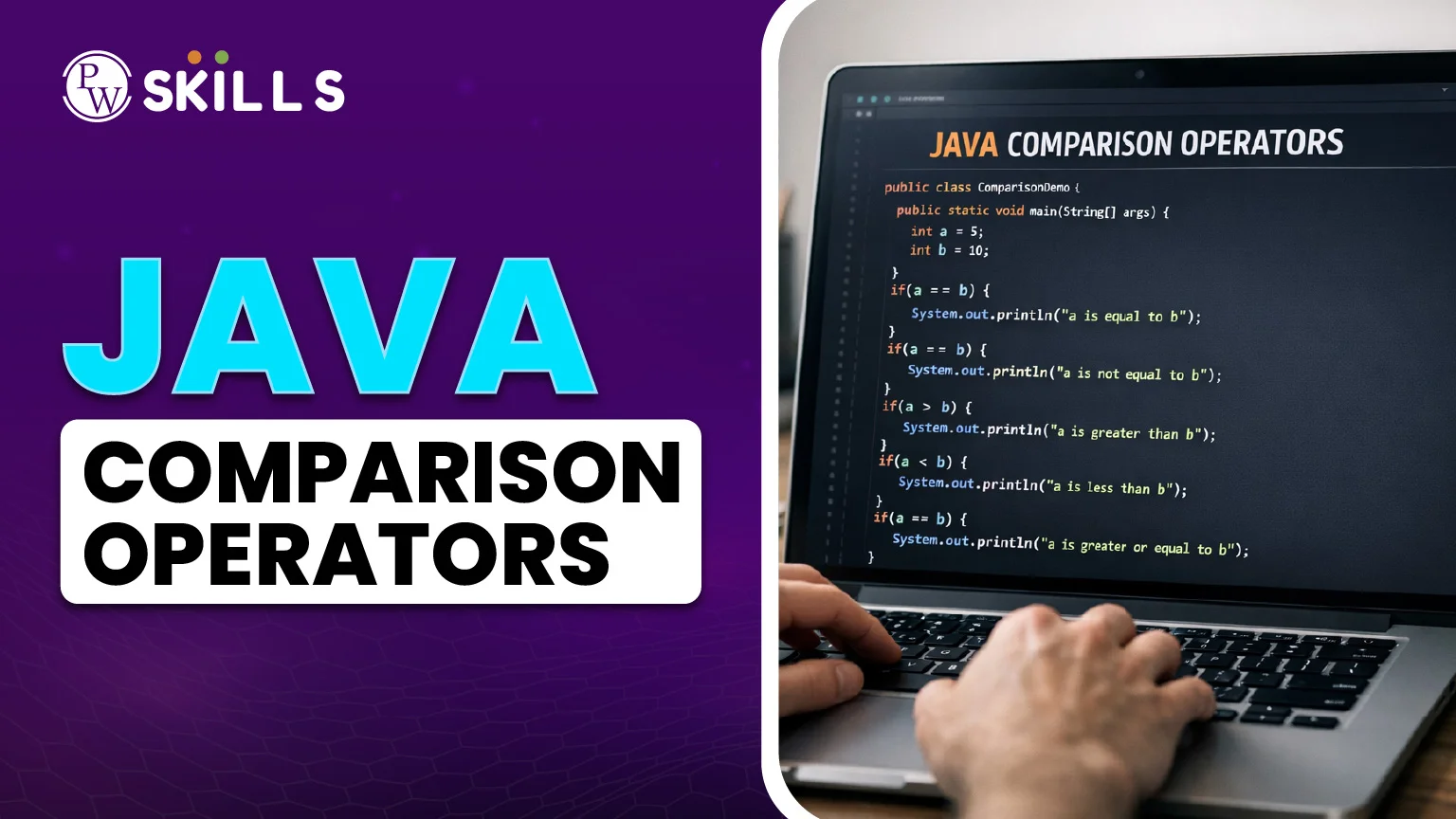
Writing code that can "think" and make choices is a big step in the career of a PW Skills Java Developer. Whether you are validating a user's password, checking if a player has enough health points, or sorting a list of prices, you rely on Java comparison operators. These operators don't conduct math; they function like a judge and look at how two pieces of data are related.
A lot of people who are just starting out get confused by the difference between "assigning" a value and "comparing" a value. Also, to make sophisticated, bug-free conditions, you need to know how Java comparison operators precedence works with Java logical operators. This guide will show you the most important operators and how to use them well in your work.
The 6 Essential Java Comparison Operators
There are six operators in Java that you can use to compare variables or constants. Each of these gives you a boolean value (true or false).| Operator | Name | Description | Example (x=10,y=5) |
| == | Equal to | Returns true if values are equal | $10 == 5 \rightarrow \text{false}$ |
| != | Not equal | Returns true if values are NOT equal | $10 != 5 \rightarrow \text{true}$ |
| > | Greater than | True if left is larger than right | $10 > 5 \rightarrow \text{true}$ |
| < | Less than | True if left is smaller than right | $10 < 5 \rightarrow \text{false}$ |
| >= | Greater than or equal | True if left is larger or same | $10 >= 10 \rightarrow \text{true}$ |
| <= | Less than or equal | True if left is smaller or same | $5 <= 10 \rightarrow \text{true}$ |
How to Use Java Comparison Operators String Logic
Things are a little different when it comes to using java comparison operators on strings. You can use == to compare basic types like int or boolean, but using it on Strings can give you outcomes you didn't expect.- The Problem: == compares the memory locations of the objects, not the text itself.
- The Solution: To compare the contents of two Strings, always use the .equals() method.
- && (Logical AND): Returns true if both conditions are true.
- || (Logical OR): Returns true if at least one condition is true.
- ! (Logical NOT): Reverses the result (true becomes false).
Java Comparison Operators Precedence
In an expression, comparison operators (like > or ==) are evaluated before logical operators (like && or ||). However, math operators ($+$, $-$, etc.) are evaluated before comparisons. Example: 5 + 2 > 6 && 10 < 20- Math first: 7 > 6 && 10 < 20
- Comparison second: true && true
- Logical last: true
Java Comparison Operators Example in Code
A Java Developer might utilise these operators in a real-world "Age Verification" system like this: Java int userAge = 20; int minimumVotingAge = 18; if (userAge >= minimumVotingAge) { System.out.println("You can vote."); } else { System.out.println("You are not old enough to vote."); } If the user's age is less than 13 or more than 19, then they are not a teenager.Frequently Asked Questions (FAQs)
1. Can I use comparison operators on different data types?
Yes, you can compare an int with a double (e.g., 5 == 5.0 is true). Java will automatically promote the smaller type to the larger type before comparing.2. Why is my String comparison returning false even when the words look the same?
This happens because you are likely using ==. As mentioned in the java comparison operators string section, == checks if the objects are the same in memory. Use .equals() to check the actual letters.3. What is the difference between > and >=?
> (Greater than) returns true only if the left number is strictly larger. >= (Greater than or equal to) returns true if the number is larger or exactly the same as the right number.4. How does Java comparison operators precedence affect my if statements?
It determines the order of evaluation. For example, 10 > 5 + 8 is evaluated as 10 > 13, resulting in false, because the addition happens before the comparison.5. What are the three main Java logical operators?
The three main operators are && (AND), || (OR), and ! (NOT). They are used to group multiple comparison expressions together into a single decision.Read More Java Topics
🔹 Java Introduction & Fundamentals |
🔹 Java Basics & Syntax |
🔹 OOPS Concepts |
🔹 Collections & DSA |
🔹 Exception & Multithreading |
🔹 JVM & Architecture |
🔹 Frameworks & Backend |
🔹 Java Programs & Practice |
🔹 Java Career & Jobs |
🔹 Other / Unclassified Java Topics |
| 502 Bad Gateway |
| 502 Bad Gateway |





Talk to a counsellorHave doubts? Our support team will be happy to assist you!



Get Free Counselling Today
and Clear up all your Doubts
Talk to Our Counsellor just by filling out the form.
Join 15 Million students on the app today!
 Live & recorded classes available at easeDashboard for progress trackingLakhs of practice questions

