
Recursion Javascript: A Complete Guide For Beginners
Recursion in Javascript follows a function which calls itself repeatedly until a base condition is reached. It is a better alternative to loops in function. In this article, let us explore more about recursion javascript functions.
 Varun Saharawat30 Oct, 2025
Recursion Javascript is a popular function used widely in programming and web development. We can easily create recursive functions with our Javascript language and make our frontend game strong. The clear and concise code structure of Javascript is one of the best advantages it offers.
All you need to know is the logic and the base condition to start executing your function. In this article, we will get familiar with the Recursion in Javascript and how to make the function possible and execute the desired result on the screen.
What is Recursion In Javascript?
Recursion Javascript is used to perform a specific set of tasks aimed to solve a logical problem. Recursion in Javascript works normally like the other recursive algorithms in programming. In recursion javascript a function calls itself repeatedly until it reaches a base condition and removes any more repeated calling. Recursion in Javascript can be used to divide a complex problem into a series of smaller and simpler problems. For example, when solving a factorial problem you can start with the number and keep breaking it into parts until it reaches the base class and you will get an answer in the end. The recursive function looks like f(n) x f(n-1) where we keep on decreasing the value of n by 1 repeatedly.
Recursion Javascript Key Takeaways
- Make sure you provide the base case to prevent infinite recursion in your Recursion javascript function.
- Ensure that your Recursive function calls the function with a reduced problem size effectively than the previous one.
- If the function does not reach the base case then there might be a case of stack overflow error in the program.
- You can use methods such as memoization and tail recursion to improve the performance and efficiency of our recursion javascript function.
Syntax of Recursion In Javascript
It is important to be familiar with the syntax of Javascript recursive functions to execute a simple task with the help of recursion. Recursion Javascript follows a simpler structure as a traditional function. However, we need to be aware of certain terms and commands to successfully execute the Recursion javascript function.| function recursiveFunction(parameter) { // Base condition: Stops the recursion if (baseCondition) { return result; } return recursiveFunction(newParameter); } |
| function factorial(n) { if (n === 0) { return 1; } return n * factorial(n - 1); } console.log(factorial(5)); |
Why Use Recursion with Javascript?
If you are someone who loves Javascript programming and is addicted to solving complex problems with recursion then it can do wonders for you. Let us learn some of the benefits of Recursion with Javascript.- Recursion works best for problems which can be broken down into smaller subproblems. Some of the popular problems using recursion are DOM Traversal, factorial, fibonacci series, merge sort, quick sort, etc.
- It can be used to simplify readability and overhead caused by using loops providing you with more confined and understandable structure.
- You can easily complete the entire program in two lines that consists of a base case and the logic of repeated function calling.
- Recursion works best in problems while implementing divide and conquer algorithms such as binary search, merge sort, quick sort and more.
- It works best for backtracking and problem solving such as N-Queens problem, Tower of Hanoi, Permutations, combination, and more.
Tail Recursion Using Javascript
Tail recursion is a specialised recursive function where the function call is attempted at the end of the function. Javascript modern engines provide Tail Call Optimisation (TCO) to optimise memory usage and hence cutting the stack growth by a significant amount. The two most important points you must keep in mind while using Tail recursion javascript function.- Make sure that you make the function call at the end of the function.
- You can use an accumulator to pass the result as an argument in these recursive calls.
| function factorial(n, acc = 1) { if (n === 0) return acc; return factorial(n - 1, acc * n); // Tail recursive call } console.log(factorial(6)); |
Components of Recursion Javascript Function
There are three major components inside a recursive function which must be kept in mind while building the function.- Definition of the Function
- Base Condition
- Recursive Call of the Function
Why Do We Need Base Condition for a Recursive Function?
A base condition in a recursive function is a must because it ensures that the function will stop calling itself after a point is reached. However, in the absence of base condition your function will keep calling itself again and again without stopping. Let us understand the working of the base condition with a simple example.Without Base Condition [Infinite Function Calling]
Without the base condition the function kept on calling and reached the maximum size of the call stack and hence we got the error as represented in the output.| function factorial(n) { return n * factorial(n - 1); } console.log(factorial(6)); |
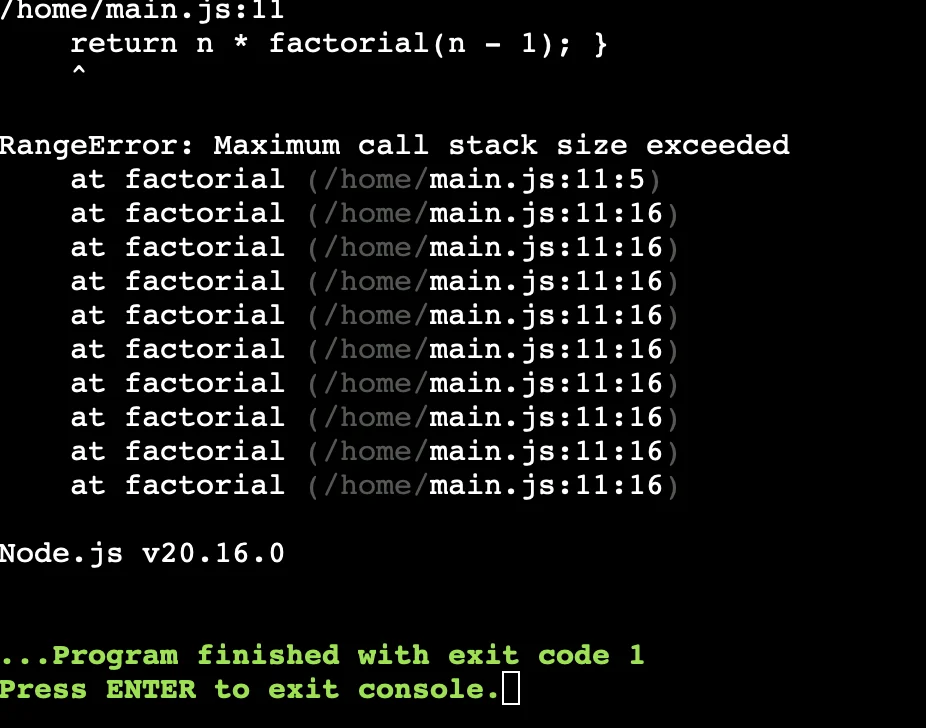
With Base Condition
As we are having a good base condition our function will easily stop calling once it reaches the base criteria and we will get our output on the screen.| function factorial(n) { if (n === 0) { return 1; } return n * factorial(n - 1); } console.log(factorial(6)); |
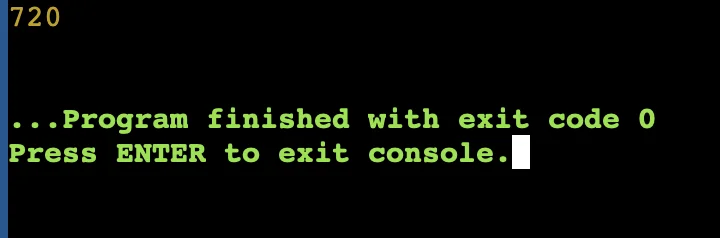
What is a Recursive Call?
Recursive call is a logic inside the function which is the main character as it handles the function calling itself and executing a task again and again. The recursive call in a function is responsible for taking the function ahead and executing the task it is supposed to do. In factorial recursive function, we can easily find the recursive call function, check below.| n * factorial(n - 1); |
Learn Java Programming Language With PW Skills
Become familiar with the Java programming language and data structures with PW Skills Decode DSA With Java Course. This complete self paced course provides you with in-depth knowledge and practice exercises to help you build your strength in Java programming. You will be able to prepare for the competitive programming and build a strong portfolio over the subject. Get complete guidance and doubt support on our platform. Become a certified Java developer only at pwskills.com



Recursion Javascript FAQs
Q1. Is Recursion possible with Javascript language?
Ans: Yes we can easily build and run a recursive function with javascript following the syntax and guidelines of the language.
Q2. Do we need to provide a base case for recursion javascript?
Ans: Yes, base condition is important for a function to stop calling itself again and execute the overall result and return it as a value.
Q3. Why does Recursion fail?
Ans: Recursion fails because of the overhead generated due to repeated function calls, the stack size grows and it sometimes becomes more than the actual size or space in the memory.
Q4. What is Recursion in Javascript?
Ans: Recursion Javascript is used to perform a specific set of tasks aimed to solve a logical problem. Recursion in Javascript works normally like the other recursive algorithms in programming.


Talk to a counsellorHave doubts? Our support team will be happy to assist you!



Get Free Counselling Today
and Clear up all your Doubts
Talk to Our Counsellor just by filling out the form.
Join 15 Million students on the app today!
 Live & recorded classes available at easeDashboard for progress trackingLakhs of practice questions

