
What Type of Data Is Generative AI Most Suitable for in 2026?
 Hardik Gupta25 Sept, 2026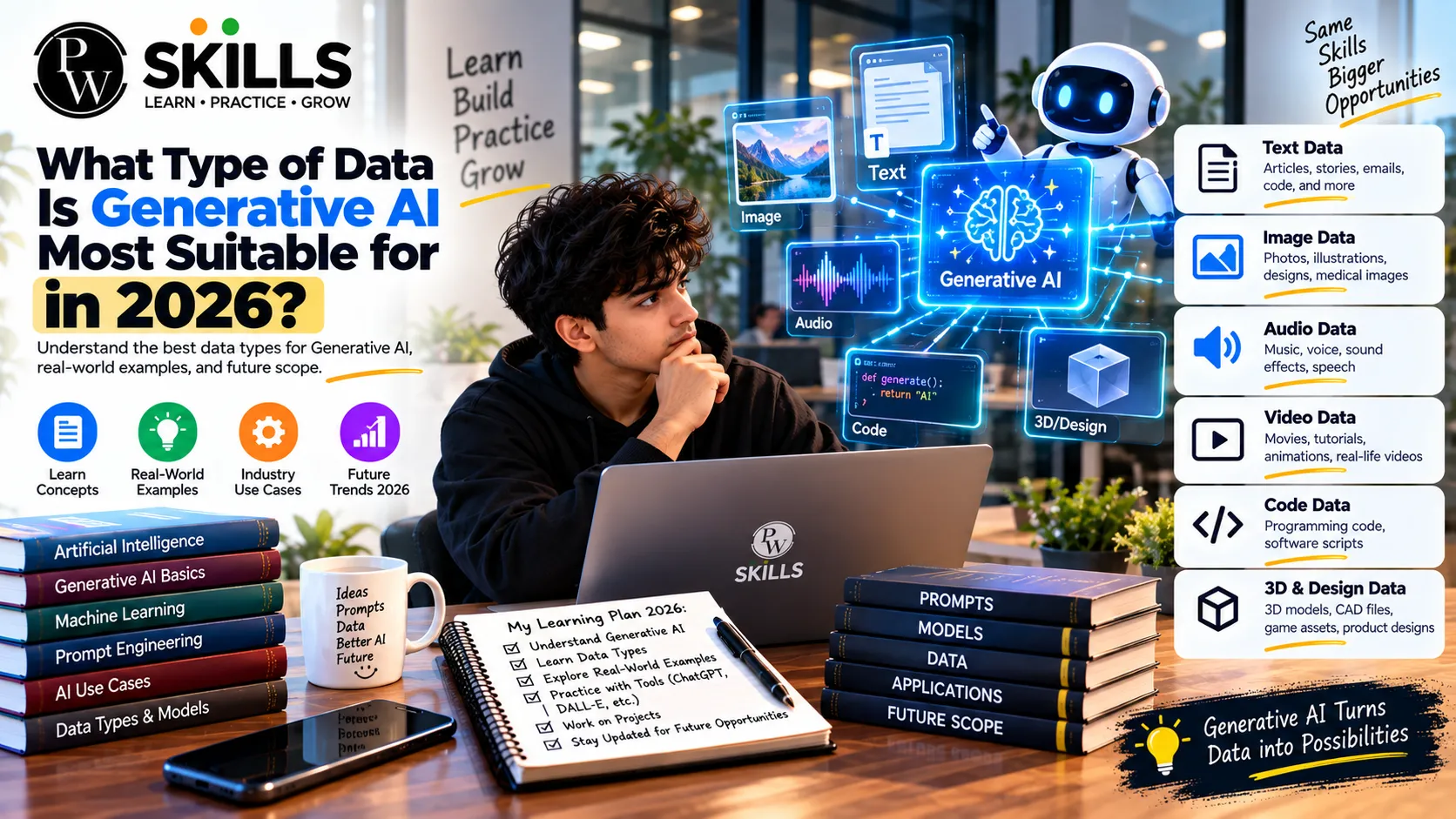
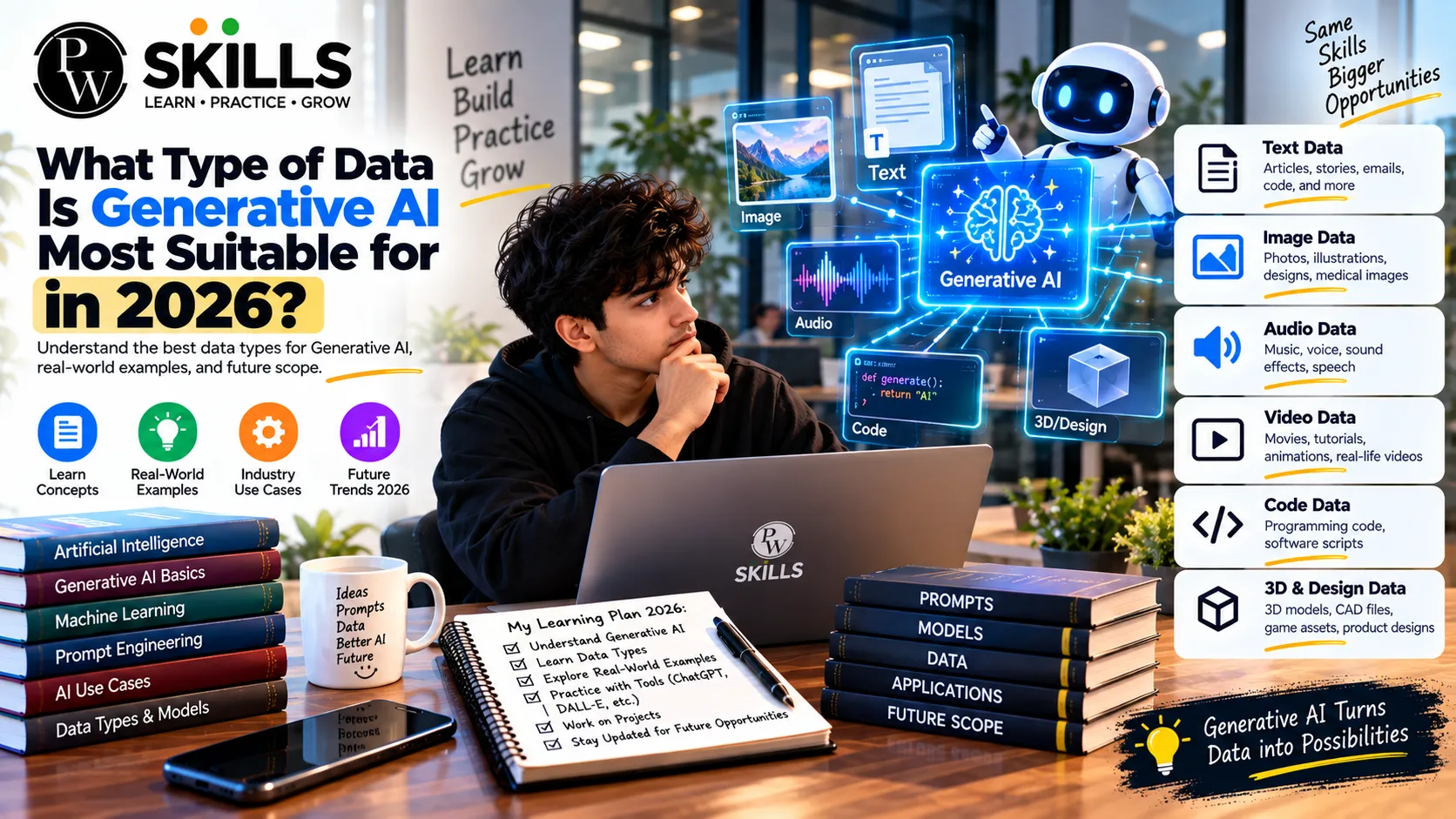
Generative AI can work with different types of data, but its strengths are especially visible when handling text, images, audio, video, and code. Knowing what type of data is Generative AI most suitable for helps developers select the right models and tools for different applications. Understanding these data types also makes it easier to design useful AI solutions for real-world tasks.
What Type of Data Is Generative AI Most Suitable for Text?
The basic base of the contemporary generative models is the text in natural language. In terms of determining what type of data generative AI is most suited for, text files, documentation, code repositories and chat logs are always at the top of the list. Then , large language models take the tokenized sequences , and learn semantic meaning , context and syntax . These text models are used by developers for automatic summarization, machine translation, sentiment analysis and conversational agents.
It needs solid AI data, millions of books, papers, and online forums, to understand text inputs. This varied corpus helps models to generalize grammar rules and facts effectively. Students interested in structured Generative AI data types frequently start with text because the text pretreatment pipelines are clearly described in the frameworks like LangChain and contemporary LLM workflows.
Text-based Generative artificial intelligence systems use embeddings to map words into high dimensional vector spaces. This approach encodes semantic associations, allowing applications to retrieve important sections in Retrieval-Augmented Generation workflows. Learning to modify text data is a basic skill taught in professional programs such as the PW Skills AI/ML Engineering course that trains learners to design production-ready apps driven by big language models.
What Type of Data Is Generative AI Most Suitable for Images and Video?
Visual media represents another dominant domain where generative algorithms thrive. Pixel grids, raster graphics, video frames, and vector designs serve as primary visual inputs for diffusion models and generative adversarial networks. When discussing what type of data generative AI is most suitable for, multidimensional visual arrays stand out due to their rich spatial hierarchies.
Visual data is not like classical databases with static tabular entries. Models have to deal with edges, textures, lighting and semantic layouts. Examples in practice include text to picture synthesis, style transfer, frame interpolation for video editing and automatic image upscaling. The models are trained on huge datasets of captioned images to learn the distribution of probabilities over visual attributes.
|
Data Category |
Primary Format |
Typical Processing Technique |
Common Real-World Application |
|
Text Data |
Strings, Tokens, Documents |
Tokenization, Embeddings, Attention Mechanisms |
Chatbots, Code Generation, Summarization |
|
Visual Data |
Pixels, Frames, Raster Arrays |
Convolutional Layers, Diffusion Processes |
Image Synthesis, Video Interpolation |
|
Audio Data |
Waveforms, Spectrograms |
Fourier Transforms, Neural Vocoders |
Voice Cloning, Speech Synthesis |
|
Structured Data |
Tables, CSV Files, Relational Rows |
Tabular Transformers, Autoencoders |
Fraud Detection, Synthetic Data Generation |
Handling visual data efficiently demands specialized hardware accelerators such as Graphics Processing Units and Tensor Processing Units. Engineers must manage memory limits when processing high-resolution image batches during model training and inference phases.
What Type of Data Is Generative AI Most Suitable for Audio and Speech?
Audio streams, acoustic waveforms, and raw sound recordings represent specialized input categories for modern generative systems. Determining what type of data generative AI is most suitable for often leads developers toward temporal audio sequences, which require models to capture rhythm, pitch, cadence, and phoneme transitions over time.
Modern audio models convert raw sound into spectrograms or discrete audio tokens. This transformation allows neural networks to synthesize realistic human speech, generate musical compositions, perform voice cloning, and remove background noise from archival recordings. High-quality AI training data for audio tasks includes hours of multi-speaker voice samples recorded under diverse acoustic conditions.
Those that develop with audio data use frameworks that can handle packets of streaming data with low latency. We bridge the gap between human users and intelligent speech agents by bringing audio generation to online and mobile platforms, enabling digital interactions that feel natural and responsive.
What Type of Data Is Generative AI Most Suitable for Structured Data?
While generative models traditionally dominate unstructured domains, they are increasingly adapted for structured formats. Contrasting structured vs unstructured data highlights distinct challenges; structured data resides in rigid rows and columns within relational databases, whereas unstructured data lacks a predefined data model.
Despite this fundamental difference, generative AI plays a vital role in tabular environments by generating synthetic records for data augmentation, filling missing database entries, and predicting rare event outliers in financial logs. Utilizing types derived from tabular sources helps organizations train robust downstream machine learning models without compromising sensitive user privacy.
-
Tabular Augmentation: Creating synthetic customer profiles to test database scalability and application performance.
-
Missing Value Imputation: Predicting and filling incomplete cells in enterprise resource planning spreadsheets.
-
Anomaly Identification: Generating baseline operational patterns to isolate fraudulent transactions in financial systems.
Adopting synthetic data generation safeguards sensitive consumer identities while providing data science teams with ample volume to train high-performance predictive classifiers.
Also Check : Gen AI Engineering Course
What Type of Data Is Generative AI Most Suitable for Code?
Source code files, abstract syntax trees, and configuration scripts constitute critical data formats for software development assistants. Investigating what type of data is Generative AI most suitable for reveals that programming code offers unique advantages because it possesses strict syntactic rules coupled with logical structure.
Generative models trained on massive code repositories can autocomplete functions, translate legacy codebases from one programming language to another, write automated unit tests, and debug complex runtime errors. Practical Generative AI examples in software engineering include coding assistants integrated directly into modern integrated development environments.
Understanding code generation workflows requires a solid grasp of software design principles, version control systems, and deployment pipelines. Comprehensive training programs like those offered through PW Skills equip students with hands-on experience in building, testing, and deploying intelligent applications using industry-standard tools.



FAQs
What type of data is Generative AI most suitable for handling in production?
How do structured vs unstructured data influence generative AI model selection?
What role does AI training data play in generative model performance?
Can you provide practical Generative AI examples for enterprise business workflows?
Why are Generative AI data types important for modern software developers?





Get Free Counselling Today
and Clear up all your Doubts
 Live & recorded classes available at easeDashboard for progress trackingLakhs of practice questions

