
What Is the Main Goal of Generative AI in 2026?
 Hardik Gupta25 Sept, 2026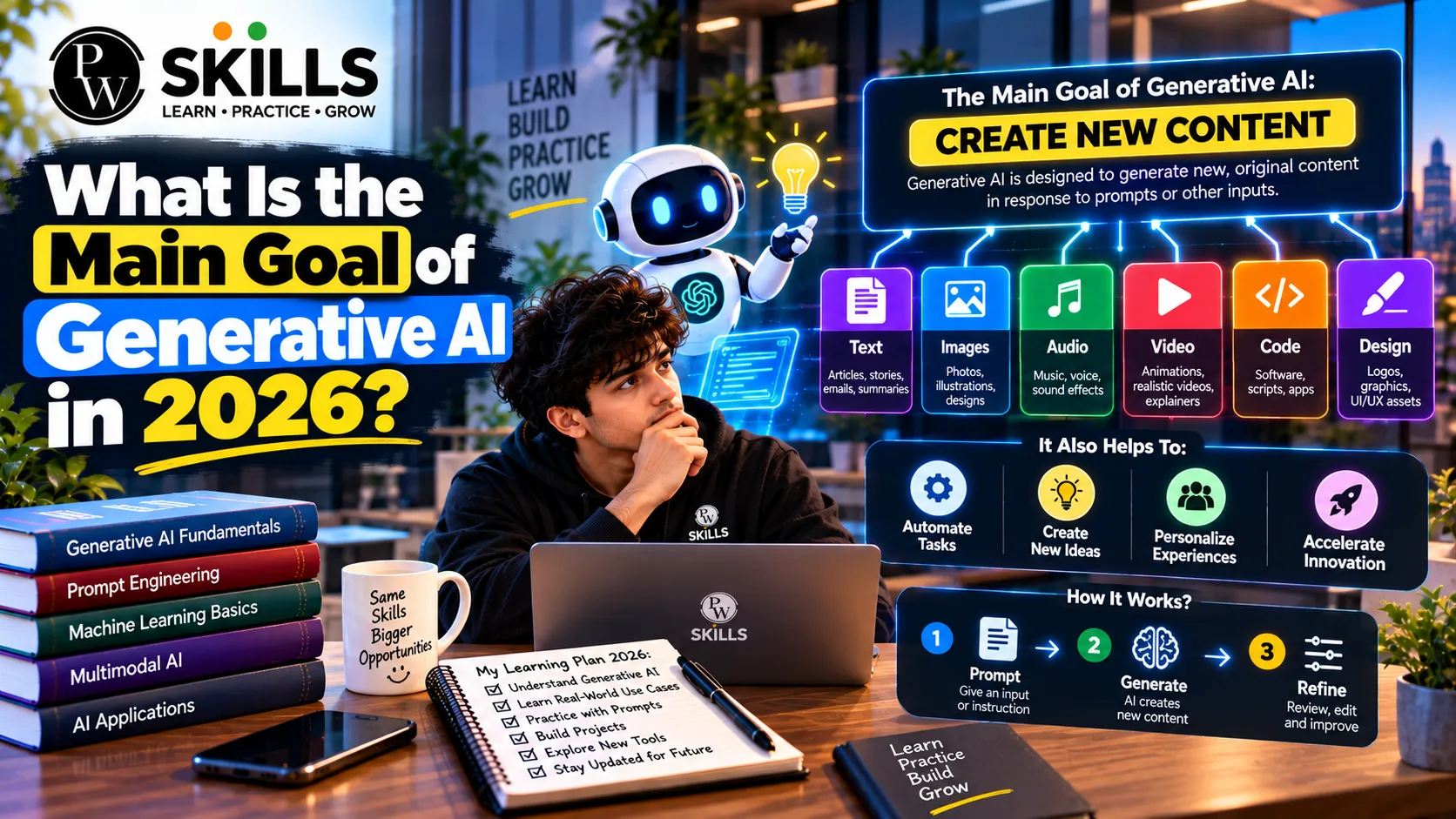
Understanding what is main goal of Generative AI helps learners see how modern AI systems create new content instead of only analysing existing data. Generative AI can produce text, images, code, audio, and other outputs based on learned patterns. As its use expands across industries, learning its purpose and applications can help students build a stronger foundation in modern AI technologies.
What Is Main Goal of Generative AI and How Does It Work?
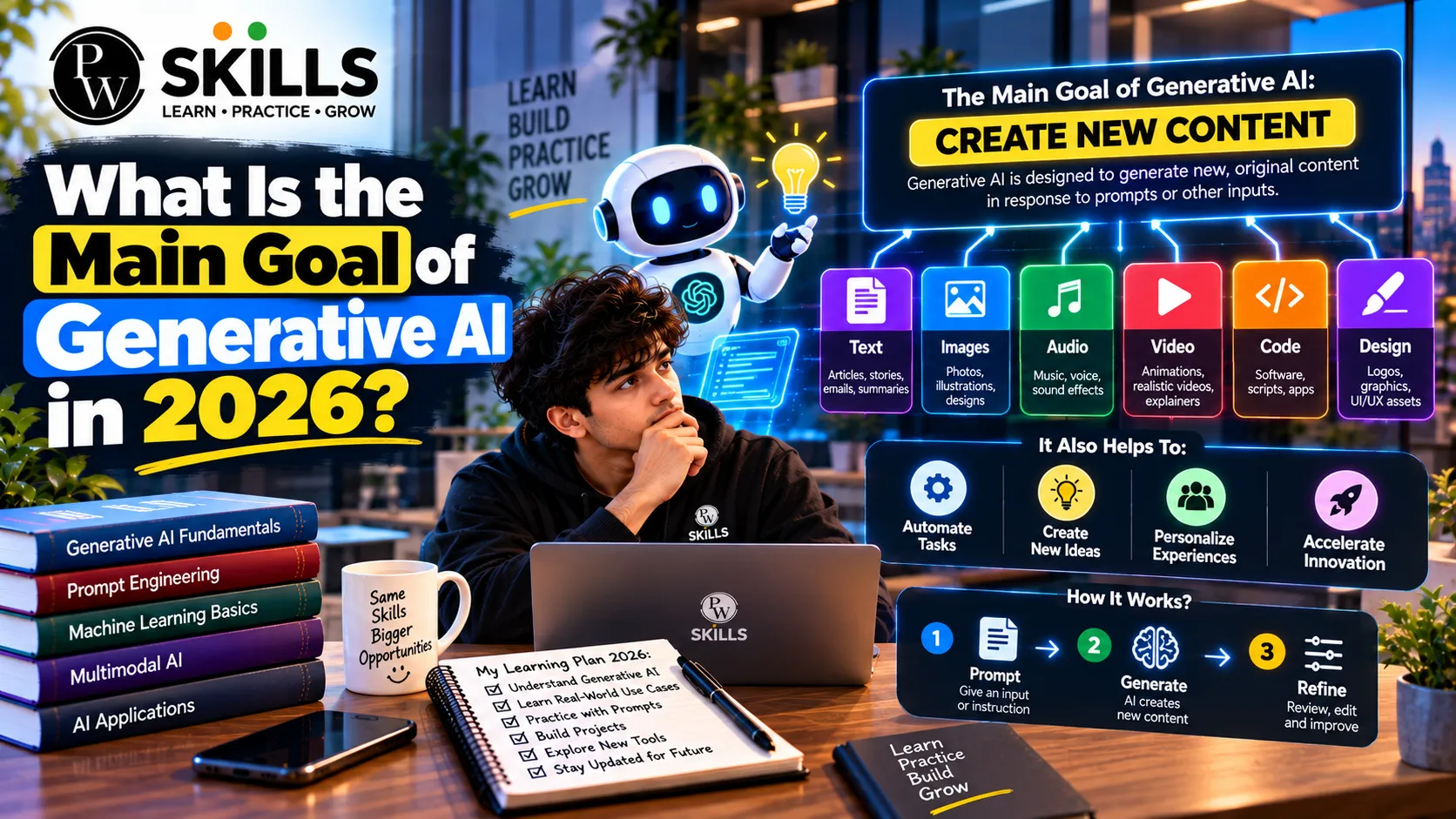
The fundamental use of Generative AI is to move beyond analysing, classifying, or predicting existing data and create new content based on learned patterns. Understanding the main goal of Generative AI helps explain why these systems are used for content creation, coding, design, data generation, and other creative tasks.
Modern AI models learn relationships and patterns from large datasets. They then use this learned information to generate new outputs based on a user's prompt or specific requirements. This allows businesses and developers to automate parts of creative and technical workflows while keeping human input involved where needed.
The main objectives include:
-
Content Creation: Generating new text, images, audio, video, and code from user inputs.
-
Pattern Learning: Identifying complex relationships in training data and using them to create relevant outputs.
-
Workflow Automation: Reducing manual effort in repetitive content, coding, and documentation tasks.
-
Problem Solving: Supporting users with ideas, drafts, summaries, code suggestions, and other task-specific outputs.
These objectives show how generative AI extends traditional AI capabilities by focusing not only on understanding existing information but also on producing new and useful content.
How Does Generative AI Support Creative Workflows?
Generative AI is changing creative workflows by helping professionals move from an initial idea to a usable draft or prototype more quickly. The purpose of Generative AI is not limited to replacing manual work; it can also support human creativity by providing ideas, variations, drafts, and technical assistance.
Designers, writers, marketers, and software developers can use generative tools to explore different approaches, test concepts, and refine their work. This makes it easier to handle repetitive tasks while allowing professionals to focus more on decisions that require human judgment and creativity.
|
Industry Sector |
Traditional Approach |
Generative AI Approach |
|
Manual code writing line by line |
Automated boilerplate generation and debugging |
|
|
Content Creation |
Hours of manual drafting and research |
Instant multi-format layout and text generation |
|
Design & Marketing |
Sketching physical mockups iteratively |
Rapid digital asset synthesis and variation |
By combining human direction with AI-generated outputs, these workflows can support faster experimentation and make creative processes more flexible across different industries.
What Is the Main Goal of Generative AI Across Different Industries?
Generative AI is being applied across different industries to support content creation, automation, research, software development, and customer interaction. Understanding what is main goal of Generative AI also helps explain why these systems can be adapted to different tasks based on the type of output required.
Businesses and developers use generative AI apps to reduce repetitive work, create new digital content, and support employees with faster access to useful information. The exact use case depends on the industry, available data, and the specific requirements of the organisation.
-
Text and Dialogue Management: Powering virtual assistants, chatbots, document drafting, summarisation, and conversational applications.
-
Visual Asset Creation: Generating images, videos, design concepts, and other digital assets for creative and marketing workflows.
-
Code Generation: Assisting developers with code suggestions, documentation, debugging, and routine programming tasks.
-
Synthetic Data Creation: Generating artificial datasets that can support testing, development, and selected machine learning workflows.
-
Research and Information Support: Summarising large amounts of information and helping users organise or analyse textual content.
These applications show how generative AI can extend beyond content creation and support a wider range of business and technical workflows.
How Do Generative AI Models Support Automation at Scale?
Advanced models provide the technical foundation for many automated applications. These models use neural networks and transformer-based architectures to process large amounts of information and generate outputs based on user instructions. Understanding what is main goal of Generative AI helps developers see how these models can be adapted to support different business and technical requirements.
Modern systems can also combine generative models with technologies such as Retrieval-Augmented Generation (RAG) and vector databases. These approaches allow applications to retrieve relevant information from external sources before generating a response, which can improve context and usefulness for specific tasks.
-
Contextual Awareness: Using available information to maintain relevant and consistent responses across longer inputs.
-
Fine-Tuning Capabilities: Adapting models or their behaviour for specific domains, tasks, or organisational requirements.
-
Retrieval-Augmented Generation: Connecting models with external knowledge sources to provide more relevant responses.
-
Scalable Deployment: Integrating Generative AI applications with cloud platforms, APIs, and other software infrastructure.
Together, these technologies help developers build generative AI systems that can support larger workflows while remaining adaptable to different use cases.
How Can Generative AI Content Support Business Growth?
AI-generated content is becoming a useful part of enterprise workflows, helping organisations create and adapt digital content at scale. Understanding what is main goal of Generative AI helps explain how businesses can use these systems to improve productivity while keeping human review involved where required.
Enterprises can apply generative AI to customer communication, marketing, product development, software documentation, and other content-heavy processes. Instead of handling every task manually, teams can use AI-generated drafts and variations as a starting point and then review or refine the final output.
-
Personalisation at Scale: Creating tailored content and experiences for different users or customer groups.
-
Cost and Time Savings: Reducing the manual effort required for repetitive drafting, editing, and content generation.
-
Faster Prototyping: Creating early versions of product ideas, designs, and content for quicker testing.
-
Content Adaptation: Repurposing existing information into different formats, languages, or communication styles.
These applications can help organisations use generative AI as a productivity tool while allowing human teams to remain involved in quality checks, creative decisions, and final approvals.
What to Remember About the Main Goal of Generative AI
Understanding what is main goal of Generative AI comes down to its ability to create new content, support problem-solving, and automate parts of complex workflows. Unlike traditional AI systems that mainly analyse or classify existing information, generative AI can produce text, images, code, audio, and other outputs based on learned patterns.
Its value extends across creative work, software development, business operations, research, and customer support. Technologies such as transformer architectures, large language models, RAG, and vector databases further expand what these systems can do.
For learners and developers, understanding both the purpose and practical applications of generative AI provides a useful foundation for building and working with modern AI-powered systems.



FAQs
What is main goal of Generative AI in modern technology?
How does the purpose of Generative AI impact daily software development?
What role do generative AI applications play in enterprises?
How do advanced Generative AI models improve output quality?
Why is creating AI-generated content important for businesses?





Get Free Counselling Today
and Clear up all your Doubts
 Live & recorded classes available at easeDashboard for progress trackingLakhs of practice questions

