
What Is a Key Feature of Generative AI in 2026? Explained with Examples
 Hardik Gupta25 Sept, 2026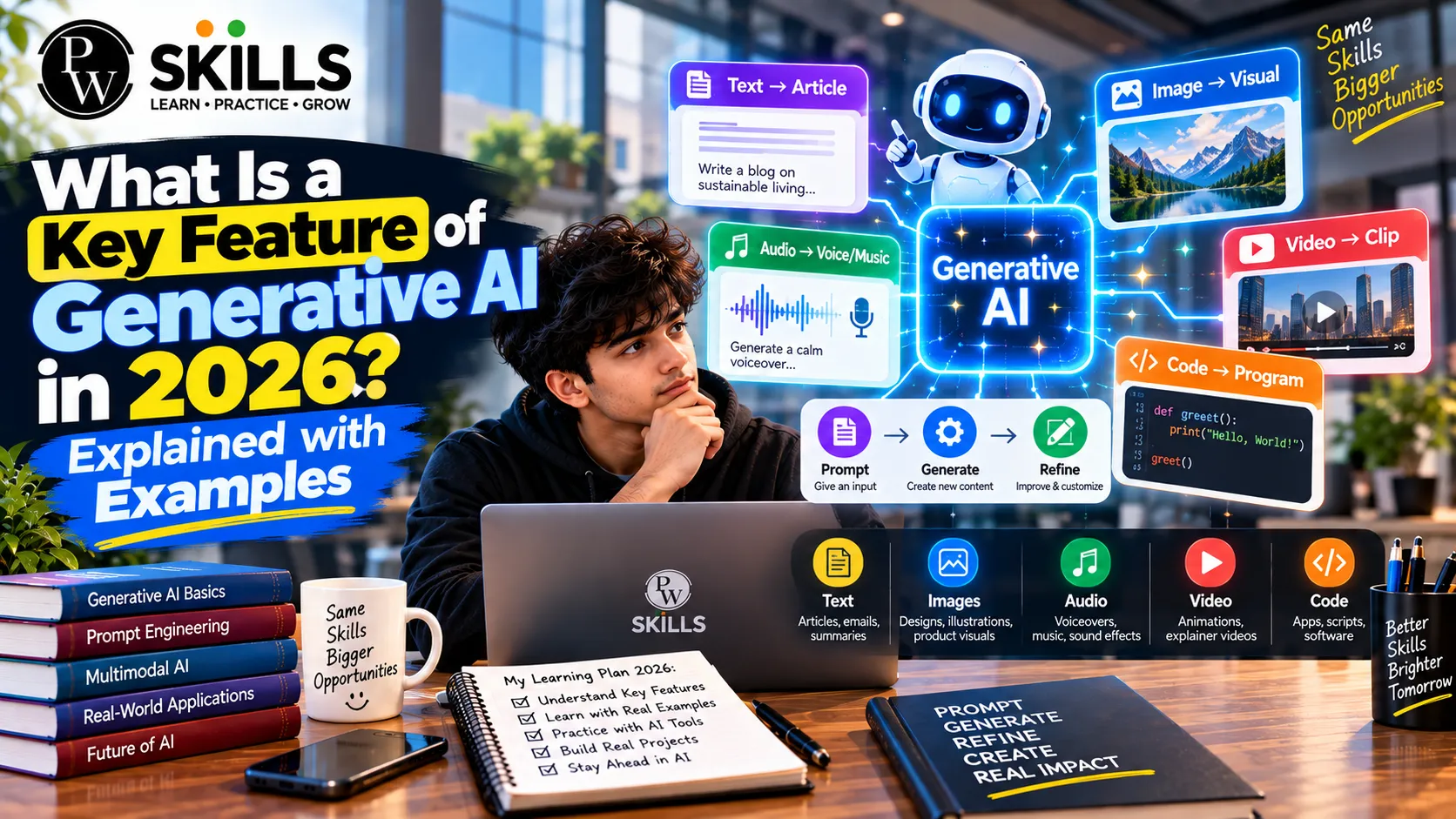
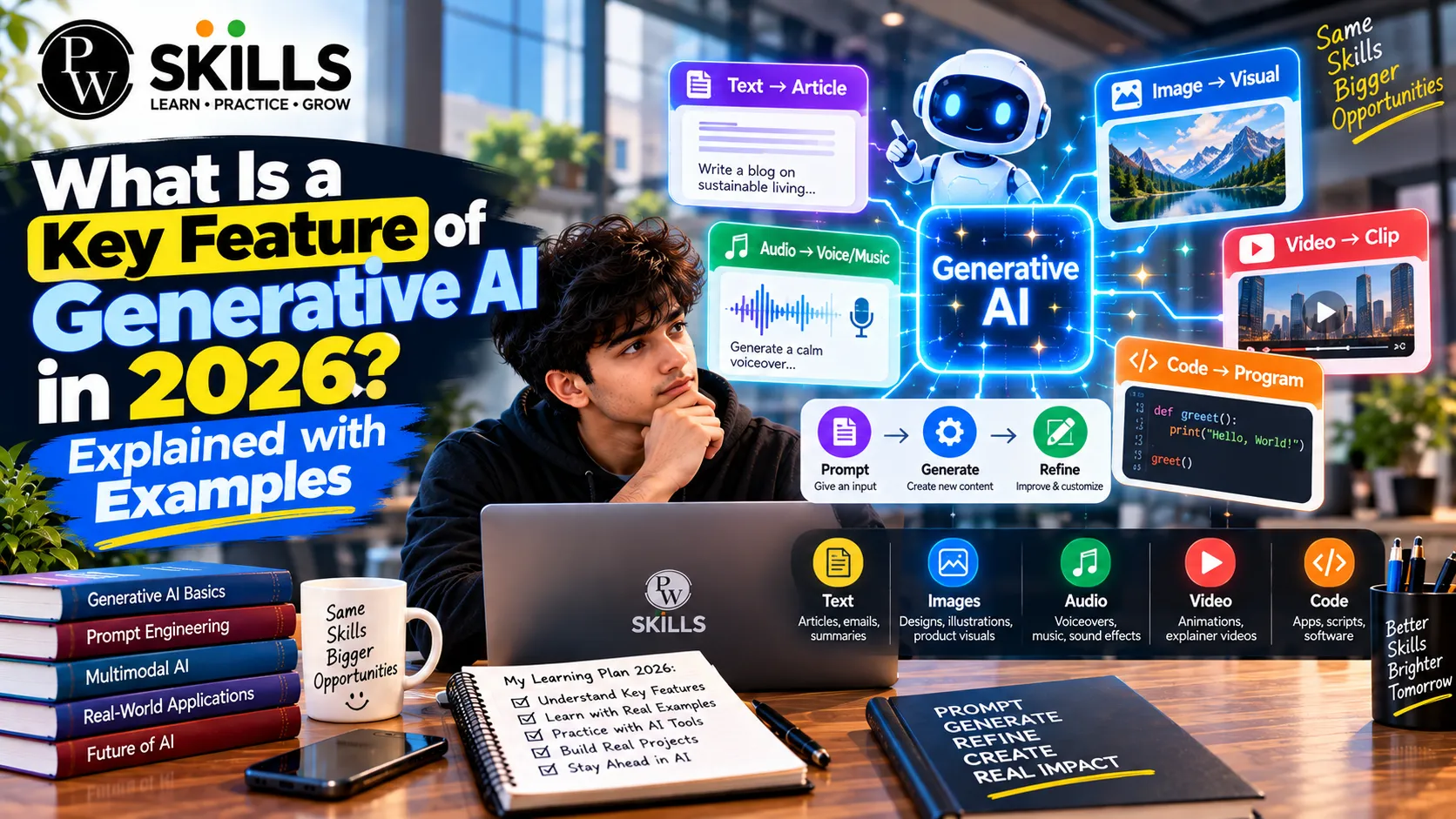
If you are wondering what is a key feature of Generative AI, the defining capability lies in its power to learn complex underlying data distributions and synthesize brand-new, original context-aware outputs. Whether you are analyzing automated text generation, neural code synthesis, or autonomous agents, understanding how these systems generate value is critical for modern technical careers. This article provides a comprehensive breakdown of the core mechanics, capabilities, architectural patterns, and practical applications defining the current AI ecosystem.
What Is a Key Feature of Generative AI and How Does It Work?
The foundational answer to what is a key feature of Generative AI is the capacity to synthesize novel, high-fidelity content rather than simply classifying or scoring existing input datasets. Traditional artificial intelligence models focus on discrimination—determining whether an image contains a cat or predicting a numeric target. Conversely, generative systems utilize complex probabilistic architectures to construct realistic multi-modal outputs ranging from source code to natural language.
Key aspects of modern generative output synthesis include:
-
Original Content Creation: Generating coherent text, structural code, visual media, and synthetic audio streams from multi-modal prompts.
-
Contextual Adaptation: Utilizing attention mechanisms to track long-range dependencies across complex documents or conversational threads.
-
Unsupervised Latent Learning: Extracting underlying structural patterns, semantic styles, and abstract relationships directly from unlabelled training sets.
-
Zero-Shot and Few-Shot Adaptability: Executing specialized tasks based on natural language instructions without explicit fine-tuning.
How Do Generative AI Features Work Across Different Architectures?
Understanding what is a key feature of Generative AI requires analyzing its operational foundation. Modern generative systems move beyond basic probabilistic word matching, combining neural architectures with operational pipelines to deliver enterprise-grade performance.
1. Transformer Architecture and Self-Attention Mechanisms
Modern Generative AI relies heavily on transformer networks. Self-attention mechanisms enable them to process input vectors concurrently rather than sequentially. This architecture evaluates relative weights between every token in a dataset, allowing deep context retention across massive token windows.
2. Retrieval-Augmented Generation (RAG)
Retrieval-Augmented Generation bridges static parameter memory and real-world database access. By coupling large language models with vector storage systems such as FAISS or ChromaDB, RAG allows generative engines to query internal knowledge bases, eliminate hallucinations, and deliver factually accurate answers.
3. Agentic Workflows and Multi-Agent Orchestration
Modern deployments leverage autonomous agent structures built on frameworks like LangGraph. Instead of generating static single-turn responses, agentic systems use Model Context Protocol (MCP) integrations, breaking complex objectives into structured sub-tasks, executing external tool calls, and iteratively correcting intermediate steps.
Also Check : Gen AI Engineering Course
The table below illustrates how traditional AI workflows contrast with modern generative capabilities:
|
Functional Area |
Traditional Machine Learning |
Modern Generative AI Systems |
|
Primary Goal |
Pattern classification, label prediction, statistical regression |
Original content generation, code synthesis, agent execution |
|
Output Type |
Numeric scores, categorical classes, probability values |
Natural language text, source code, images, audio, structured JSON |
|
Data Interaction |
Task-specific labelled inputs supervised by humans |
Self-supervised learning across vast unlabelled data corpora |
|
Context Handling |
Limited feature vectors and fixed-size sliding windows |
Transformer-based multi-thousand token context windows |
|
Knowledge Extension |
Requires complete model retraining for new datasets |
Dynamic expansion via Retrieval-Augmented Generation (RAG) |
What Is a Key Feature of Generative AI in Real-World Applications?
Analyzing what is a key feature of Generative AI becomes straightforward when reviewing direct deployment across engineering, enterprise operations, and interactive systems. The versatility of AI capabilities is best observed in real-world technical use cases.
Automated Code Generation and Software Refactoring
Software engineering teams use Generative AI examples, such as neural code completion tools, to enhance their development workflows. Generative systems analyze the environment of a code base to generate modular functions, write unit tests, optimize existing algorithmic procedures, and convert scripts from one modern programming language to another such as Python to TypeScript.
Dynamic Conversational Agents and Customer Automation
Enterprise platforms implement AI capabilities to deploy context-aware assistant tools. Rather than using fixed decision trees, modern conversational systems maintain state memory over extended interactions, integrate directly with internal API endpoints, and execute refund or scheduling workflows autonomously.
Multi-Modal Data Synthesis and Design Workflows
Visual synthesis engines combine natural language processing with diffusion models to convert standard text prompts into technical diagrams, photorealistic mockups, or custom user interface assets. Designers and content teams utilize these tools to rapidly prototype concepts and speed up iteration loops.
How Are Generative AI Features Used in Different Industries?
The broad adoption of modern intelligent systems stems from diverse features of Generative AI that target specific operational bottlenecks. Organisations implement these generative mechanisms to scale output without increasing proportional overhead costs.
Core operating capabilities are as follows:
-
Document Summarization and Information Extraction: Summarize hundreds of technical pages into short summaries, essential points, or structured tables.
-
Synthetic Data Generation: Developing secure, anonymised datasets to train secondary prediction algorithms without compromising confidential consumer information.
-
Automated Workflow Orchestration: Linking language models to enterprise databases, internal tools, and external APIs via standard containerized deployment stacks.
-
Hyper-Personalized Content Adaptation: Customizing educational modules, marketing text, and software interface tutorials to individual user learning styles.
What Technology Supports Modern Generative AI Systems?
The next step from basic prompt engineering to robust system design is the key to building production-ready generative solutions. The developers need to understand the important parts of the end-to-end lifecycle:
-
Application Orchestration: Frameworks such as LangChain and LangGraph organize multi-step reasoning chains, dynamic routing logic, and state management.
-
Vector Indexing and Storage: High-performance stores such as FAISS and ChromaDB convert raw documentation into high-dimensional vector embeddings for low-latency similarity search.
-
Operational Management (LLMOps): Deployment environments utilize Docker containerization, AWS hosting, FastAPI server endpoints, and evaluation platforms like LangSmith to monitor latency, trace system calls, and ensure production reliability.



FAQs
What is a key feature of Generative AI that distinguishes it from basic automation?
How do modern Generative AI capabilities handle factual accuracy?
What tools are essential for engineering production-ready generative systems?
Can Generative AI models autonomously write executable software code?
How do multi-agent workflows expand Generative AI capabilities?





Get Free Counselling Today
and Clear up all your Doubts
 Live & recorded classes available at easeDashboard for progress trackingLakhs of practice questions

