

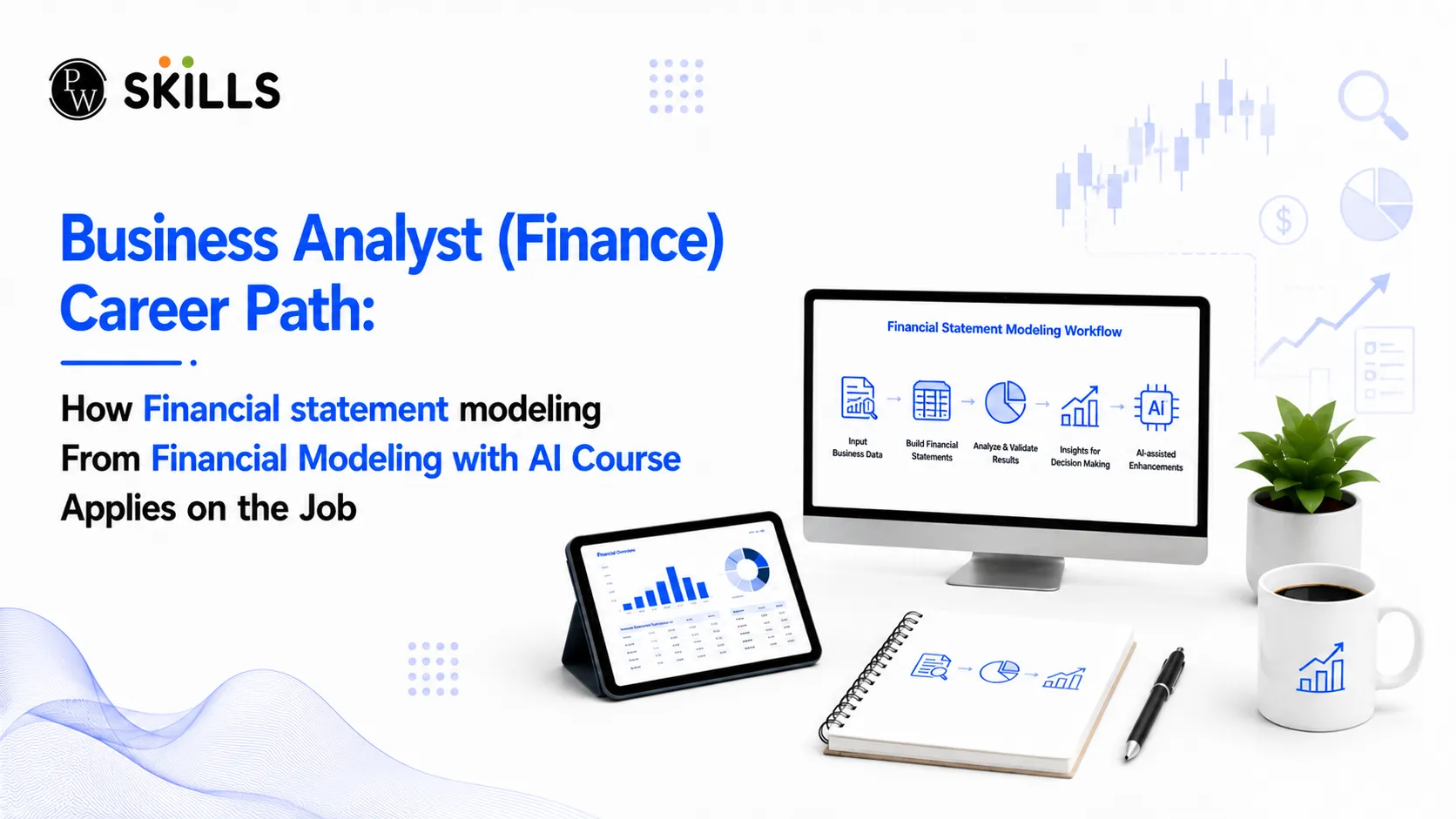
How Financial statement modeling From Financial Modeling with AI Course Applies on the Job
 Hardik Gupta31 Jul, 2026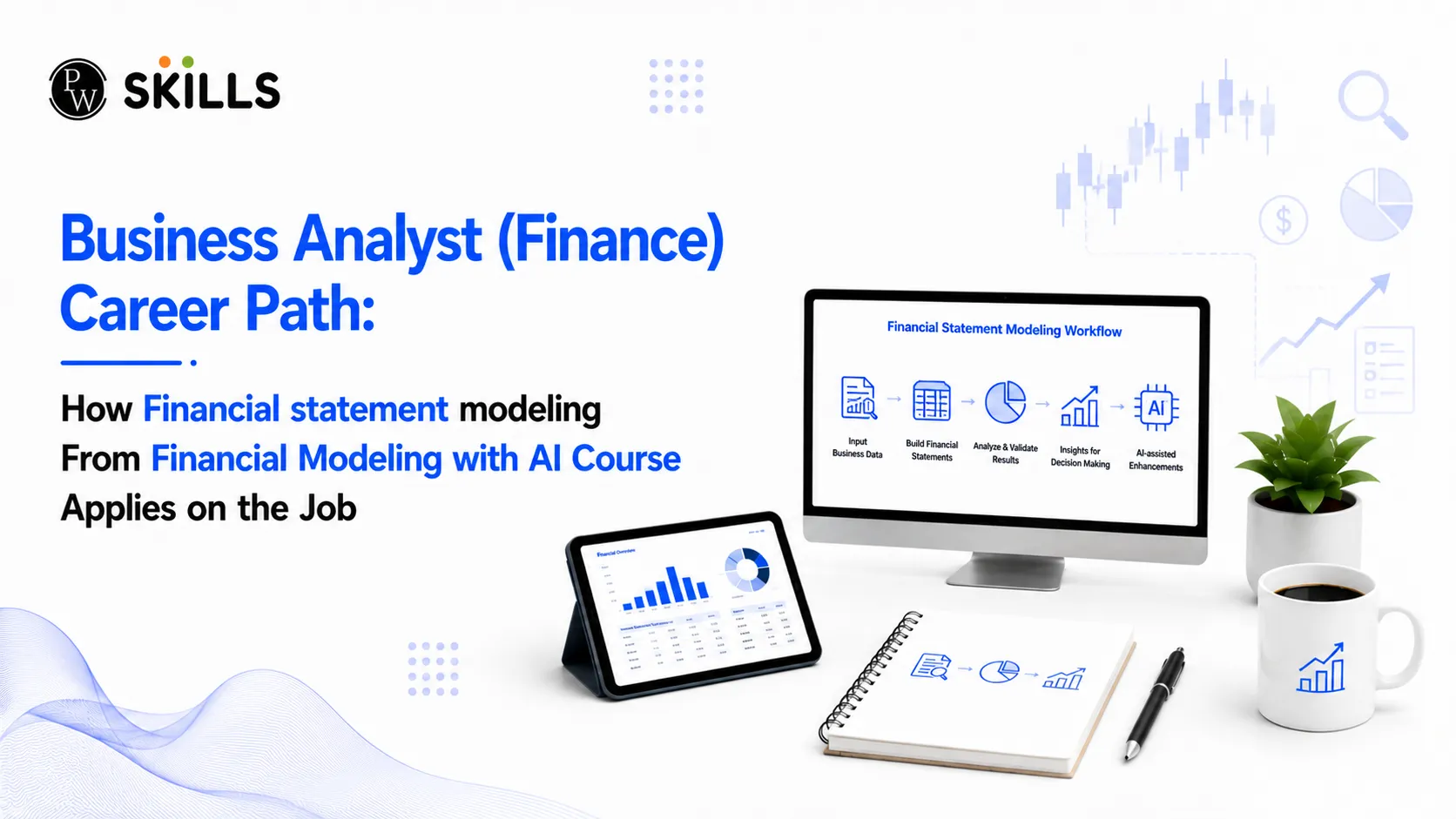
Traditional academic programs teach accounting formulas, yet they rarely demonstrate how those figures guide actual corporate strategy or investment decisions. When financial reports fail to provide actionable forward-looking insights, business analysts struggle to demonstrate their value to executive leadership teams.
Learning practical dynamic valuation and statement linking through a structured Financial Modeling with AI Course solves this exact problem by transforming static accounting data into interactive corporate decision-making tools.
Overview of Financial Modeling with AI Course
Modern corporate finance demands skills that extend well beyond manual data entry and basic arithmetic. A specialized Financial Modeling with AI Course provides a structured learning environment where candidates learn to build clean, flexible, and fully integrated corporate models from scratch.
The curriculum focuses on linking financial statements, conducting valuation analyses, and applying intelligent automation to speed up complex calculations.
Instead of spending days manually updating cell references or copying numbers from company filings, analysts learn to construct dynamic systems that update instantly when new data becomes available.
Why Is Financial Modeling with AI Course Important for Business Analysts?
Finance business analysts serve as the operational bridge between raw accounting data and strategic corporate decisions. Without dynamic models, business analysts risk becoming basic back-office data reporters rather than strategic advisors.
Companies actively seek professionals who can evaluate growth opportunities, assess capital investments, and reduce operational risk using modern analytical techniques.
|
Traditional Financial Analysis |
AI-Enhanced Financial Modeling |
|
Manual data extraction from annual reports |
Automated parsing of financial filings |
|
Static single-case forecasting spreadsheets |
Dynamic multi-case scenario simulations |
|
High risk of human error in complex formulas |
Algorithmic error detection and formula validation |
|
Reactive historical performance reporting |
Proactive forward-looking predictive analysis |
By completing a Financial Modeling with AI Course, analysts gain a competitive edge in today's technology-driven corporate landscape. They shift their daily work focus from mechanical spreadsheet maintenance to high-level strategic interpretation.
Financial Statement Modeling in Financial Modeling with AI Course
At the center of any financial business analyst's workload is financial statement modeling. Building an integrated three-statement model requires a firm grasp of accounting mechanics alongside spreadsheet architecture.
1. The Income Statement
The income statement reflects operational performance over a specific period. Analysts learn to project revenue drivers, operating expenses, depreciation schedules, and tax obligations dynamically.
2. The Balance Sheet
The balance sheet provides a snapshot of company assets, liabilities, and equity at a specific point in time. A properly built model ensures that assets always equal liabilities plus equity across every projected forecast year.
3. The Cash Flow Statement
The cash flow statement reconciles net income back to actual cash generated across operating, investing, and financing activities. It eliminates non-cash accounting items such as depreciation and tracks changes in working capital.
Learning these mechanics enables analysts to understand how a single change in sales volume flows through the entire financial structure of an enterprise.
How Financial Modeling with AI Course Helps Analyse Business Performance
Evaluating corporate health requires looking past historical summaries to identify underlying trends, operational margins, and cash flow stability. A practical Financial Modeling with AI Course shows analysts how to extract meaningful operational metrics from financial models.
-
Working Capital Dynamics: Monitoring accounts receivable, inventory, and accounts payable to ensure smooth operational liquidity.
-
Profitability Ratios: Assessing Gross Margin, Operating Margin (EBITDA Margin), and Net Margin to measure operational efficiency over time.
-
Return Metrics: Calculating Return on Invested Capital (ROIC) and Return on Equity (ROE) to evaluate management's capital allocation ability.
-
Leverage and Debt Service: Analyzing Interest Coverage Ratios and Net Debt-to-EBITDA to evaluate financial stability under stressed economic conditions.
Real-World Business Analyst Tasks with Financial Modeling with AI Course
In day-to-day operations, business analysts are handed open-ended commercial questions rather than neat textbook problems. The practical skill set built through a Financial Modeling with AI Course directly mirrors real workplace requirements.
-
Budgeting and Forecasting: Partnering with department leads to build rolling quarterly revenue and expense projections based on historical growth rates and market data.
-
Capital Expenditure (CapEx) Evaluation: Assessing whether purchasing new factory machinery or expansion facilities delivers a net positive return on capital over a five-year horizon.
-
Mergers and Acquisitions Support: Evaluating potential acquisition targets by modeling synergy benefits, transaction structures, and post-merger cash flow projections.
-
Variance Analysis: Comparing actual monthly operational outputs against budgeted baselines to isolate cost overruns and revenue shortfalls early.
By mastering these real-world analytical tasks, candidates position themselves for high-demand corporate finance roles, including Financial Modeling with AI Course + Investment Banking Analyst (Entry-Level) Jobs where structured technical expertise is mandatory from day one.
Practice Projects in Financial Modeling with AI Course
Hands-on experience is essential for turning theoretical finance concepts into job-ready analytical skills. Practical training emphasizes project-based learning using real corporate datasets.
Project 1: Three-Statement Valuation of a Public Company
Learners select a publicly listed enterprise, import historic financial filings automatically, and construct a dynamic five-year forecast model. The project concludes with a Discounted Cash Flow valuation establishing an intrinsic share value.
Project 2: Corporate Buyout and Debt Capacity Analysis
Students model an acquisition scenario financed through a mixture of senior debt and equity capital. The model measures cash flow availability for debt service schedules and projects investor returns across various exit multiples.
Project 3: Financial Modeling with AI Course + Scenario & sensitivity analysis
Analysts construct dynamic stress-testing dashboards that evaluate corporate cash positions under changing macroeconomic conditions, such as rising interest rates, raw material inflation, or sudden sales drops.
These completed portfolio projects serve as concrete proof of technical capability during competitive corporate interview processes.
Common Mistakes to Avoid in Financial Modeling with AI Course
Building complex financial models requires meticulous attention to detail. Even small formula errors or structural oversights can lead to incorrect business decisions.
-
Hardcoding Inputs in Calculation Cells: Entering fixed numbers directly into formulas prevents automatic updates. Keep assumption inputs completely separate from active calculations.
-
Unbalanced Balance Sheets: Failing to verify that assets match liabilities plus equity across all forecast periods. Use automated alert checks to identify balancing errors immediately.
-
Ignoring Non-Cash Working Capital Shifts: Assuming net income equals cash growth. Always account for inventory accumulations and payment delays in receivables.
-
Overcomplicating Spreadsheet Layouts: Creating overly complex formula chains that colleagues cannot audit. Maintain simple, modular sheet design across all model tabs.





FAQs
What technical skills are taught in a Financial Modeling with AI Course?
How does financial statement modeling help a business analyst on the job?
Is prior programming knowledge required to take this financial modeling course?







Get Free Counselling Today
and Clear up all your Doubts
 Live & recorded classes available at easeDashboard for progress trackingLakhs of practice questions

