

Investment Banking Analyst (Entry-Level) Pay Movement and What It Signals
 Hardik Gupta19 Sept, 2026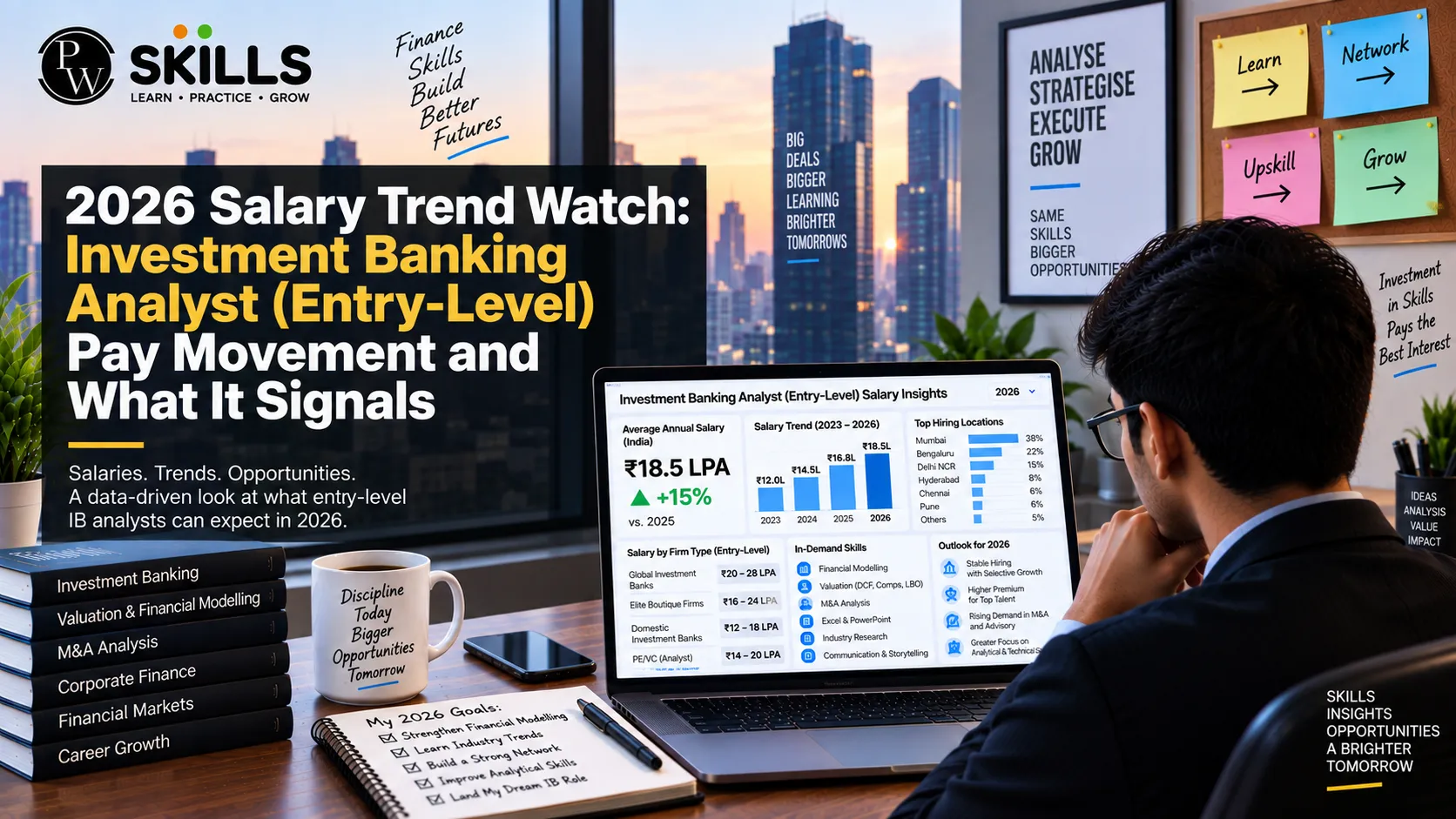
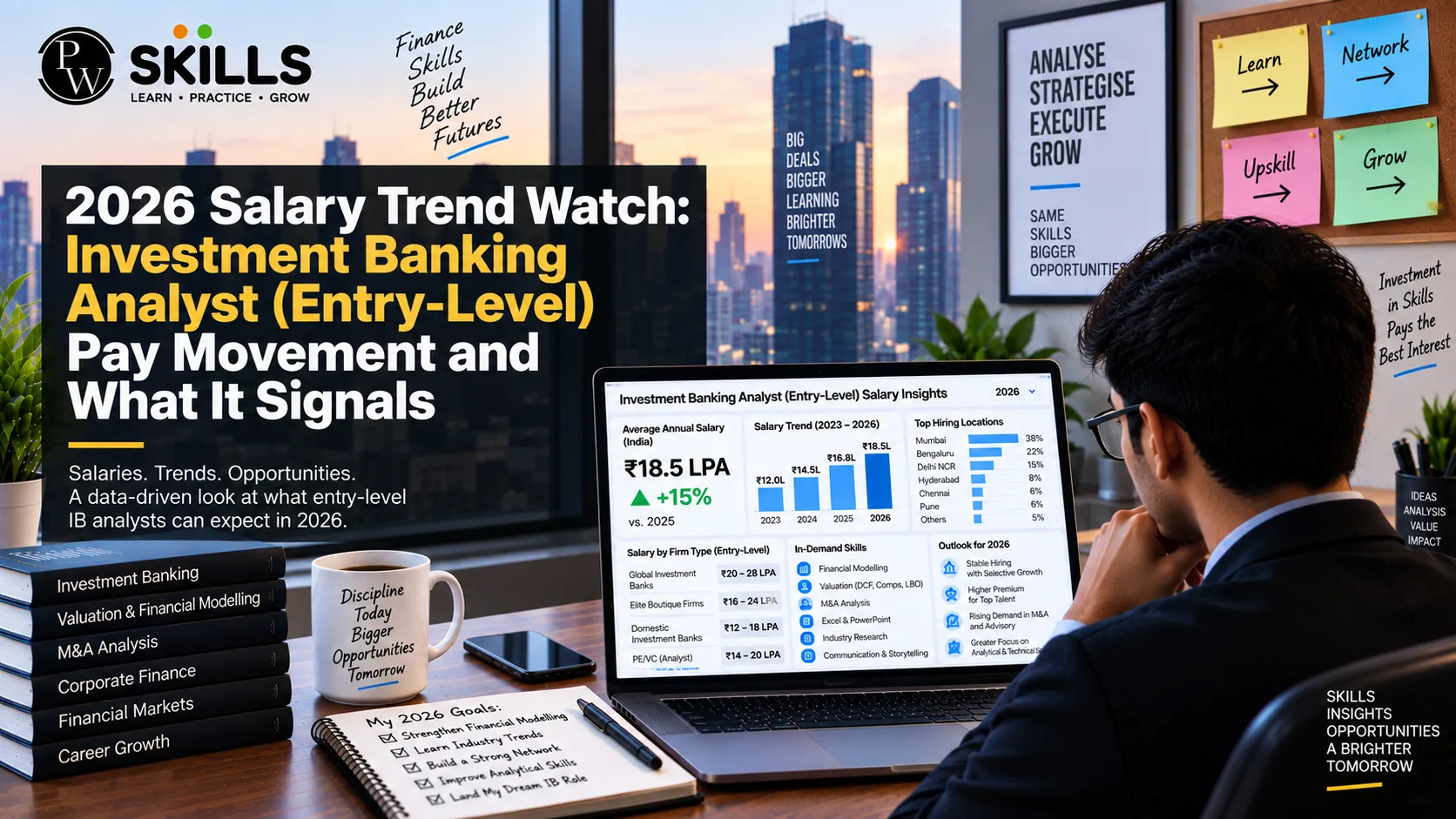
Being aware of entry-level pay trends helps candidates better navigate the evolving financial sector. Fresh graduates are competing against tough competition for junior roles, but employers are increasingly looking for technical skills and adaptability. According to the PwC India Workforce Report, compensation is not the only important factor anymore, continuous upskilling and career growth are also gaining importance. A Financial Modeling with AI Course can help candidates develop relevant skills
How Financial Modeling with AI Course Helps With Investment Banking Jobs
Technology is rapidly transforming conventional financial roles. Financial institutions are moving away from managing spreadsheets manually. “Now firms expect junior analysts to use automated scripts and predictive logic. Taking this course helps fill the growing skill gap. Employers want professionals who combine domain knowledge and technical skills. Entry-level analysts familiar with the new tool kits can demand better starting packages.
-
Automation Mastery: Junior staff can handle larger data sets more quickly.
-
Error Reduction: Automated validation reduces costly spreadsheet mistakes.
-
Strategic Focus : Less time in manual data entry and more in forecasting for analysts.
Market dynamics show that pay movement is directly affected by analytical efficiency. Automation can help companies streamline their operations and free up their budgets for the most valuable talent. This results in different pay scales in the major financial centers.
Financial Modeling with AI Course Skills for Business Analyst Jobs
Industry updates highlight a massive surge in hybrid roles. Recent Business Analyst (Finance) Jobs News points to an unprecedented demand for professionals who understand both software workflows and traditional asset valuation. Financial institutions no longer view data science as a separate department. Instead, they expect core financial analysts to handle baseline data analytics.
-
Cross-Functional Skills: Analysts develop dashboards and forecasts simultaneously.
-
Real-Time Tracking : Integrated systems allow teams to track cash flow indicators.
-
Market Responsiveness: Organizations adapt to economic shifts faster using real-time predictive models.
Professionals tracking industry publications note that hiring managers screen resumes for technical keywords. Candidates who complete a specialized course stand out immediately. Organizations validate these skills during technical rounds, directly influencing initial compensation offers and onboarding tiers.
Investment Banking Salary-hook and Benefits With Financial Modeling with AI Course
The compensation packages for entry-level positions have grown from just offering a monthly salary. The current salary outlook features variable bonuses according to measures of productivity and technical skills. The investment banks design these incentives to reward analysts for simplifying repetitive processes.
-
Performance Bonuses: Tied directly to deal execution speed and accuracy.
-
Skill Allowances: Extra remuneration for certified technical proficiencies.
-
Retention Incentives: Structured payouts designed to curb early attrition among junior staff.
Similar workforce insights reflected in the reports show that the desire for environments that foster innovation and ongoing learning is widespread among professionals. Financial institutions are responding with competitive base pay and structured internal upskilling programs. The entire reward strategy helps companies attract the best graduates from top business schools.
PwC India Workforce Report and Career Growth With Financial Modeling with AI Course
Data from the reports emphasizes that modern professionals value organizational purpose and growth opportunities. Upskilling has become a central pillar for career resilience. In the financial sector, learning advanced technical stacks is no longer optional.
-
Talent Scarcity: Specialized skills command premium market rates.
-
Continuous Learning: Firms invest heavily in internal technical training.
-
Workplace Adaptability: Cross-functional training ensures long-term career security.
Analysts who align their skill development with institutional priorities position themselves for faster promotions. Employers notice when a junior professional takes the initiative to learn complex forecasting methods independently. This proactive stance alters individual career trajectories and long-term earning potential.
Skills to Build With this Course
This course can help entry-level candidates build a mix of finance, analytical, and technology skills. These skills can make it easier to handle modern investment banking tasks and adapt to changing workplace expectations.
|
Skill Area |
What Candidates Learn |
Practical Industry Application |
|
Financial Modelling |
Build and analyse financial models |
Constructing three-statement models, DCF valuations, and scenario-testing templates. |
|
Data Analysis |
Work with financial data and identify trends |
Processing large transaction sets, identifying cost leakages, and uncovering variance patterns using SQL and advanced spreadsheets. |
|
Use AI for analysis and repetitive tasks |
Deploying LLMs and automated scripts for rapid data cleaning, routine reconciliation, and text parsing. |
|
|
Forecasting |
Support business and financial projections |
Building rolling budgets, predictive revenue models, and growth simulations. |
|
Reporting |
Present financial insights in a clear format |
Designing dynamic Power BI dashboards and executive summary decks for C-suite decision-making. |
Building these skills can help candidates move beyond basic spreadsheet work. It also prepares them to handle tasks that require faster analysis, better data handling, and practical use of technology.
How to Prepare for Investment Banking Jobs With Financial Modeling with AI Course
Getting an entry-level investment banking role requires more than academic knowledge. Candidates should focus on building practical skills, working on finance-based projects, and becoming comfortable with modern analytical tools.
This course can support this preparation by giving learners opportunities to practise financial modelling, forecasting, data analysis, and AI-assisted workflows. Candidates can further improve their readiness by:
-
Practising financial models using real-world business scenarios
-
Building projects that demonstrate analytical and financial skills
-
Learning how AI tools can support routine finance tasks
-
Improving Excel and data interpretation skills
-
Preparing for technical and finance-based interview questions
-
Keeping up with changing investment banking job requirements
This combination of practical learning and interview preparation can help fresh graduates present a stronger profile when applying for competitive entry-level finance roles.
Future of Investment Banking Jobs With Financial Modeling with AI Course
Entry-level compensation trends point toward stabilization driven by performance and verified skills. As automation transforms everyday banking tasks, baseline salaries will reflect a candidate's ability to drive efficiency. Completing this course serves as a proven catalyst for securing upper-quartile starting pay.
-
Higher Starting Tiers: Technologically adept graduates bypass standard entry brackets.
-
Faster Promotions: Core competency in automation accelerates mid-level transitions.
-
Job Security: Versatile skill sets protect professionals against industry-wide market corrections.
Job seekers must look beyond basic salary numbers and focus on comprehensive skill acquisition. Aligning educational pursuits with current market demands ensures sustained career growth and competitive compensation in the financial sector.





FAQs
What is the primary benefit of taking a Financial Modeling with AI Course?
How do modern firms approach the traditional Salary-hook in recruitment?
Why are Financial Modeling with AI Course + Business Analyst (Finance) Jobs News highlighting technical skills?
What does the Report on PwC India Workforce suggest about employee priorities?
How does technological proficiency impact entry-level investment banking pay?





Get Free Counselling Today
and Clear up all your Doubts
 Live & recorded classes available at easeDashboard for progress trackingLakhs of practice questions

