

Cloud Application Development Services in 2026: Types, Benefits, Process and Use Cases

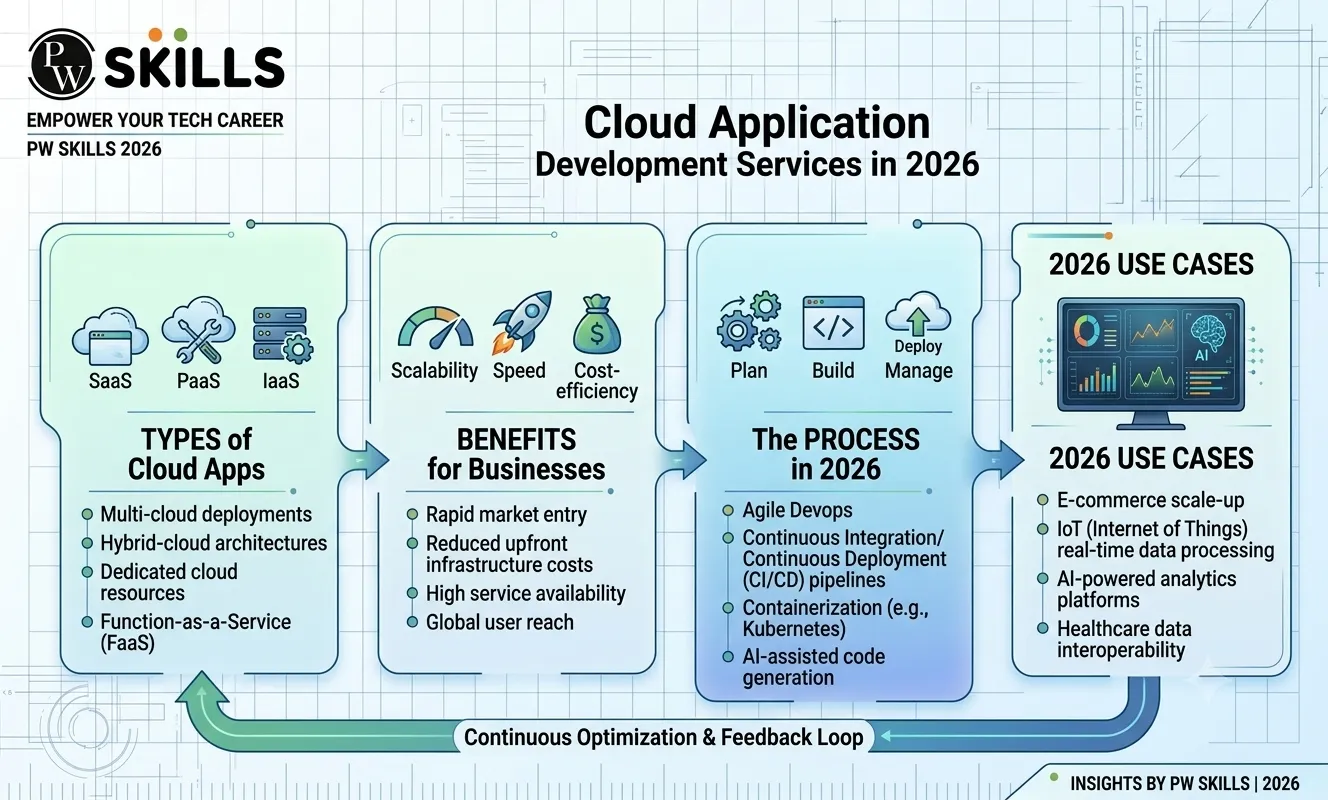
Businesses increasingly use cloud-based technologies to build applications that can respond to changing demands without relying heavily on physical infrastructure. Cloud application development services bring together cloud platforms, development tools, and technical expertise to support application creation and deployment. This approach gives development teams greater flexibility while helping organizations modernize their software environments and respond more efficiently to evolving business requirements.
What Are Cloud Application Development Services?
Companies often ask how to modernize inflexible monolithic software architectures without interrupting day-to-day business. Professional cloud application development services include the development, testing, and deployment of software for distributed cloud platforms. These services allow organizations to overcome the limitations of physical machines and offer the flexibility to scale computing power based on actual user demand.
Generally, organizations have to hire outside experts or internal engineering teams to build these complicated systems from the ground up. Engineering teams can focus on writing core business logic instead of worrying about physical servers or OS patches by utilizing dedicated cloud application development services. This change reduces the operational overhead and speeds up the software delivery schedules for all departments.
Traditional on-premises infrastructure can hamper organizational agility, as it takes weeks or months of procurement approvals to provision new physical servers. Today, cloud application development services offer near-instant access to near-infinite computing power through automated application programming interfaces. This means businesses can be quick to respond to shifts in the market without worrying about hardware capacity.
In addition, these technical frameworks enable seamless collaboration among geographically distributed engineering squads by providing common development environments. Code repositories are wired into automated test pipelines so software updates happen seamlessly without unexpected regression errors in production. A key priority for engineering managers remains ensuring security compliance is stringent across distributed cloud nodes. Architectural reviews help to identify potential vulnerabilities before code reaches public release stages.
What Are the Types of Cloud Application Development Services?
Technology leaders need to pick the right architectural model that fits their organization’s specific goals and technical needs. The projects have different delivery models providing different degrees of control, cost-effectiveness, and operational management responsibility.
Here are the core types of cloud development services used across the industry today:
- Infrastructure as a Service provides raw computing, storage, and networking blocks for complete architectural control.
- Platform as a Service offering pre-built environments and tools that speed up coding and deployment cycles.
- Software as a Service delivers ready-to-use applications hosted remotely and accessed via standard web browsers.
- Function as a Service executes discrete pieces of code in response to specific events without server management.
The choice of tier depends a lot on internal engineering bandwidth and budget constraints. Infrastructure-level options are often chosen by organizations with deep technical expertise, because they want to be able to control every networking parameter. In contrast, smaller teams often choose platform-level offerings to reduce infrastructure maintenance overhead and speed up product launches.
With the evolution of technology, hybrid models combining public and private cloud infrastructure have become hugely popular amongst large enterprises. These hybrid approaches provide the ability to keep sensitive customer data on secure private servers and scale public compute resources during peak traffic periods. Hybrid approaches require intelligent network orchestration to enable low-latency data transfer across different environments.
What Is the Cloud Application Development Services Process?
Software engineering teams often encounter project delays due to poor planning and lack of structured lifecycle management frameworks. Establishing a clear, repeatable methodology ensures that software projects stay on schedule and meet strict security standards.
The following chronological steps outline the typical lifecycle for building scalable cloud software:
- Requirements gathering and architectural design planning to define system boundaries and select appropriate technology stacks.
- Containerisation and database configuration to ensure code portability across multiple deployment environments.
- Continuous integration and continuous deployment pipeline setup for automated testing and rapid code releases.
- Security hardening, identity management implementation, and performance monitoring setup to safeguard user data.
Monitoring after launch is still a vital part of the life cycle, as it ensures that applications perform optimally under changing workloads. Engineering teams use automated logging tools to detect anomalies and fix performance bottlenecks before they affect end users. Frequent updates to the code help keep the system safe from new cyber-attacks.
Stakeholder feedback loops woven throughout each development sprint guarantee the final product is a perfect fit for changing business objectives. The iterative approach allows for the reduction of costly re-work and guarantees a high level of user satisfaction at public release. Quality assurance testing should be run alongside feature development to catch vulnerabilities early.
How Do Cloud Application Development Services Benefit Businesses?
Firms frequently experience high capital expenditures when maintaining on-premises hardware infrastructure that depreciates rapidly over time. Comprehensive cloud app development eliminates these heavy upfront hardware costs by operating on a flexible pay-as-you-go consumption model.
The table below outlines the primary advantages and operational impacts of transitioning to cloud-based software architectures.
|
Benefit Category |
Traditional Infrastructure |
Cloud-Based Solutions |
|
Capital Expense |
High upfront hardware purchases |
Low operational utility model |
|
Scalability |
Slow manual server procurement |
Instant automated resource scaling |
|
Reliability |
Vulnerable to single hardware failures |
Distributed redundancy across zones |
|
Deployment Speed |
Weeks or months for physical setup |
Minutes via automated pipelines |
Apart from cost savings, cloud-based architectures improve disaster recovery capabilities by automatically replicating data across geographically dispersed data centers. If one regional server cluster suffers an unexpected outage, traffic is routed automatically to an operational zone, without service interruption. This high availability protects sources of income and brand image among customers.
In addition, built-in analytics tools enable engineering teams to track resource consumption patterns continuously. Organizations can dynamically optimize the allocation of servers, avoiding unnecessary spending on idle computing power while still having the best performance for applications during quiet hours. By continuously tracking their costs, financial controllers are able to predict their monthly cloud costs with impressive precision.
Which Industries Use Cloud Application Development Services?
Organizations across various sectors struggle to process massive influxes of real-time data using traditional on-premises data centres. Building cloud-native applications allows enterprises to process high-velocity transactions seamlessly while maintaining strict regulatory compliance standards.
Financial institutions use scalable cloud architectures to detect fraudulent transactions instantly across millions of global user accounts. Healthcare providers deploy these systems to securely manage electronic patient records while enabling remote telemedicine consultations without latency issues. E-commerce platforms leverage distributed cloud systems to handle massive traffic spikes during seasonal shopping events without crashing.
Educational technology platforms also utilize these flexible architectures to deliver interactive video streaming and automated assessment grading to millions of concurrent students worldwide. By harnessing distributed computing power, institutions ensure a smooth learning experience regardless of geographical location or device type.
Logistics enterprises harness real-time tracking data across global supply chains to optimize delivery routes and reduce fuel consumption significantly. These industry-specific transformations demonstrate the immense versatility of modern distributed software systems across diverse commercial landscapes. Regulatory compliance frameworks require careful data governance implementation across all deployed sector solutions. Furthermore, emerging sectors such as autonomous vehicle manufacturing and smart grid energy management rely heavily on low-latency cloud infrastructure to process billions of telemetry events daily.
How to Choose the Right Cloud Application Development Services?
Decision-makers often struggle to evaluate multiple technology vendors and platform features when starting a digital transformation project. Selecting appropriate cloud application services requires a careful assessment of security protocols, pricing models, and vendor lock-in risks.
Companies must evaluate whether a multi-cloud or single-vendor strategy best aligns with their long-term technical roadmap and internal skill sets. Relying on a single vendor simplifies management but can create operational dependencies. Conversely, a multi-cloud approach enhances redundancy and negotiating leverage while increasing architectural complexity.
Working with experienced technical partners helps mitigate deployment risks and accelerates time-to-market for complex enterprise software solutions. Organizations should assess vendor compliance certifications, data residency guarantees, and customer support responsiveness before committing to long-term service level agreements.
Leadership teams must also conduct thorough total cost of ownership analyses factoring in data egress fees, storage tiers, and migration expenses. Careful financial planning prevents unexpected budgetary overruns during advanced deployment phases. Ongoing vendor performance reviews ensure alignment with evolving business requirements. Establishing clear key performance indicators for cloud adoption success enables executives to measure return on investment accurately over multi-year technology lifecycles.




FAQs
What skills are required for cloud application development services?
How long does a typical cloud development project take?
Are cloud development services secure for sensitive financial data?
What is the difference between traditional software and cloud application services?
How do businesses reduce costs using cloud application development?





Get Free Counselling Today
and Clear up all your Doubts
 Live & recorded classes available at easeDashboard for progress trackingLakhs of practice questions

