Which Statement Describes a Benefit of DevOps? Key Advantages Explained for 2026

Modern software teams need to balance delivery speed, software quality, and operational reliability. DevOps brings development and operations practices closer together, creating a more collaborative approach to building, testing, deploying, and maintaining software. Which statement describes a benefit of DevOps is a common question because DevOps offers benefits across multiple stages of the software development lifecycle.
DevOps is not simply a collection of tools or a single deployment method. It represents a combination of practices, processes, automation, and collaboration that can help teams deliver and operate software more effectively.
Which Statement Describes a Benefit of DevOps?
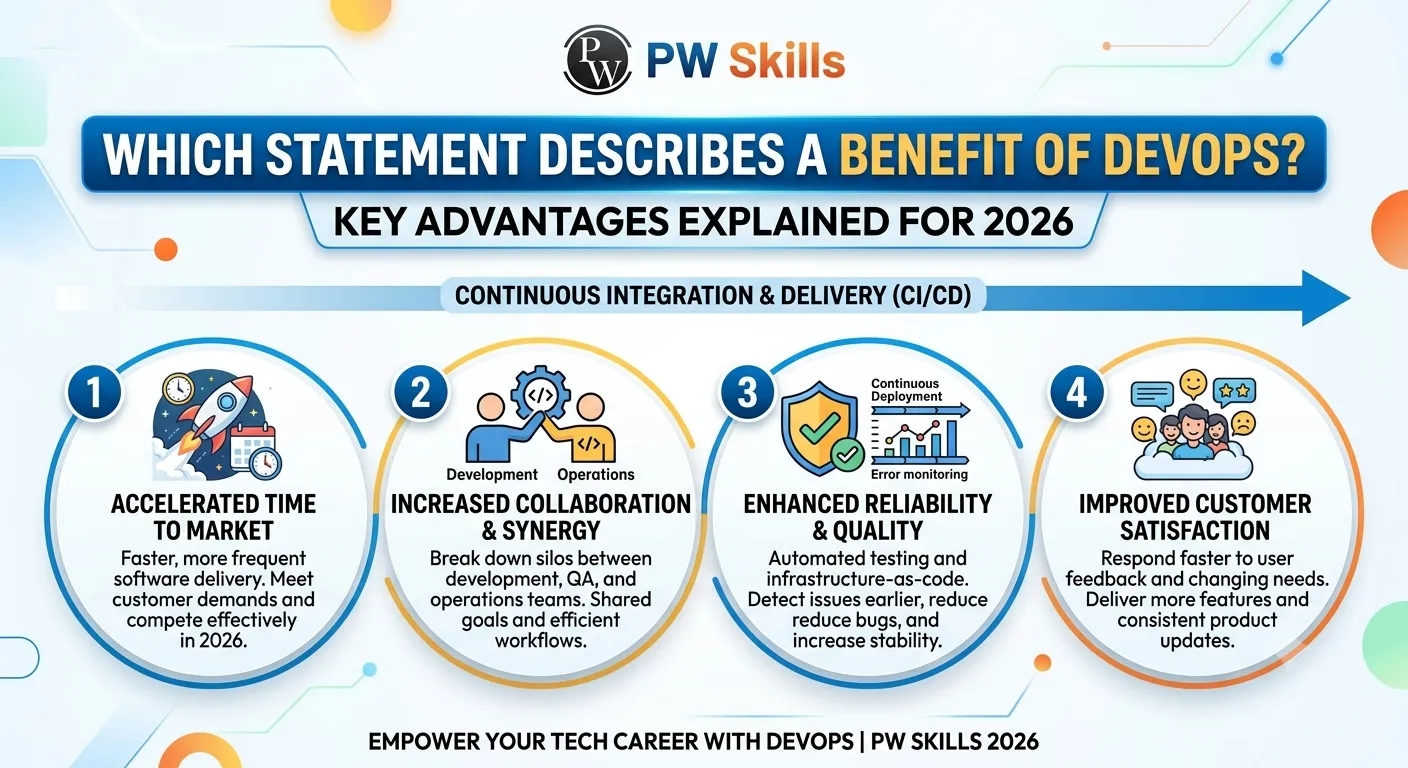
A key benefit of DevOps is better collaboration between development and operations teams. Traditional software workflows can separate these teams, which may result in communication gaps and delays when applications move from development into testing, deployment, and ongoing maintenance.
DevOps encourages shared responsibility for the software lifecycle. Developers and operations professionals can work together on development, deployment, monitoring, and incident response instead of treating these activities as completely separate responsibilities.
Other commonly associated benefits include:
-
More frequent and reliable software releases
-
Greater automation of repetitive development and operational tasks
-
Faster identification and resolution of software issues
-
Improved communication between cross-functional teams
-
More consistent development, testing, and production environments
-
Continuous feedback that supports iterative improvement
Therefore, if a question asks which statement describes a benefit of DevOps, a statement about improved collaboration, automation, faster delivery, or continuous improvement can describe a genuine DevOps benefit.
How Does a DevOps Benefit Improve Software Delivery?
One of the main benefits identified when considering which statement describes a benefit of DevOps is improved software delivery. DevOps practices can streamline activities such as building, testing, and deploying applications.
Continuous integration allows developers to integrate code changes into a shared repository regularly. Automated tests can then help identify defects and integration problems earlier in the development process.
Continuous delivery extends this approach by keeping software in a state that can be released through an automated or controlled deployment process.
Key benefits include:
-
Automated testing can identify defects earlier.
-
Frequent integration can reduce the complexity of combining large numbers of changes.
-
Automated deployment processes can reduce repetitive manual work.
-
Feedback from testing and monitoring can help teams address problems sooner.
DevOps does not automatically guarantee faster or more reliable delivery. The results depend on how effectively an organisation implements its practices, tools, processes, and team structures.
Which Statement Describes a DevOps Benefit of Automation?
When evaluating which statement describes a benefit of DevOps, automation is an important area to consider. DevOps teams commonly automate repetitive tasks across development, testing, infrastructure management, and deployment.
Manual processes can introduce inconsistencies and require significant time, particularly when the same task needs to be repeated across multiple environments. Automation allows teams to define and repeat processes more consistently.
For example:
-
Automated builds can create application packages whenever code changes are integrated.
-
Automated tests can run as part of a continuous integration pipeline.
-
Infrastructure as Code can define infrastructure configurations using files that can be version controlled.
-
Deployment automation can reduce the amount of manual work required to release applications.
-
Automated monitoring can help teams detect certain application or infrastructure problems.
These practices can improve consistency and reduce repetitive work, allowing engineers to spend more time on development, optimisation, and problem-solving.
What Are the Key DevOps Benefits for Businesses?
Several business benefits can help answer which statement describes a benefit of DevOps. By improving collaboration and automating parts of software delivery and operations, DevOps practices can support organisations that need to release and maintain applications efficiently.
Some commonly associated business benefits include:
-
Faster delivery: Automated development and deployment workflows can shorten parts of the software delivery process.
-
Improved reliability: Automated testing and standardised processes can help reduce certain types of errors.
-
Better resource utilisation: Automation can reduce the amount of time teams spend on repetitive tasks.
-
Faster issue resolution: Monitoring and established incident-response processes can help teams identify and address problems more efficiently.
-
Continuous improvement: Feedback from users, testing, and production monitoring can inform future development work.
The specific results vary between organisations because DevOps implementation depends on factors such as team structure, application architecture, tooling, and existing processes.
Which Statement Describes a Benefit of DevOps for Teams?
A useful answer to which statement describes a benefit of DevOps can also focus on team collaboration and shared responsibility.
DevOps encourages development and operations professionals to communicate throughout the software lifecycle. Instead of handing an application from one department to another, teams can collaborate on development, testing, deployment, monitoring, and maintenance.
This approach can support:
-
Shared responsibility: Teams can work together toward application availability, performance, and delivery goals.
-
Improved communication: Cross-functional collaboration can reduce misunderstandings during development and deployment.
-
Faster feedback: Developers can receive operational information that helps them identify issues and improve applications.
-
Knowledge sharing: Team members can gain a better understanding of both development and operational processes.
-
Continuous learning: Teams can use project results, incidents, and feedback to improve future workflows.
DevOps therefore involves cultural and organisational practices as well as technical automation. Tools can support DevOps processes, but collaboration and shared ownership are also important components.
How Does Continuous Improvement Explain a Benefit of DevOps?
Continuous improvement is another important concept when considering which statement describes a benefit of DevOps. DevOps encourages teams to use feedback from development, testing, deployment, monitoring, and users to improve software and processes over time.
Instead of relying only on large, infrequent releases, teams can use smaller and more frequent changes where appropriate. Automated testing and monitoring can provide feedback throughout this process.
Continuous improvement can help teams:
-
Identify recurring problems and address their underlying causes.
-
Use monitoring data to investigate application performance.
-
Improve automated testing and deployment processes.
-
Incorporate user feedback into future development.
-
Review incidents and update processes to reduce the likelihood of similar issues.
This feedback-driven approach allows software teams to refine both their technical systems and their delivery processes over time.
How Can Businesses Adopt DevOps Benefits Successfully?
Understanding which statement describes a benefit of DevOps is only the first step. Organisations also need an appropriate implementation strategy to gain practical value from DevOps practices.
A gradual approach can help teams identify problems and introduce changes without disrupting critical systems.
Common steps include:
-
Assess existing processes: Identify bottlenecks, manual tasks, communication gaps, and deployment challenges.
-
Define measurable objectives: Establish goals related to delivery speed, reliability, automation, or operational efficiency.
-
Build cross-functional collaboration: Encourage development and operations teams to work together throughout the software lifecycle.
-
Introduce automation gradually: Start with suitable areas such as automated testing, builds, deployments, or infrastructure provisioning.
-
Monitor performance: Track relevant delivery and operational metrics to understand whether the changes are producing the intended results.
-
Improve continuously: Use the collected feedback to refine tools, processes, and team practices.
Successful DevOps adoption generally involves changes to both technology and organisational processes rather than simply installing new tools.
How Can You Measure the Benefits Described by DevOps?
After identifying which statement describes a benefit of DevOps, organisations can use measurable indicators to evaluate the effects of their DevOps practices.
Common software delivery and operational metrics include:
|
Metric |
What It Measures |
Why It Matters |
|
Deployment Frequency |
How often an organisation deploys changes |
Indicates the pace of software delivery |
|
Lead Time for Changes |
Time between a change being committed and its deployment |
Helps evaluate delivery efficiency |
|
Change Failure Rate |
Percentage of deployments that require remediation, rollback, or other corrective action |
Provides insight into release quality |
|
Mean Time to Recovery |
How quickly a service or system is restored after an incident |
Helps assess recovery performance |
These metrics should be interpreted in context rather than used as universal targets. A high deployment frequency, for example, does not necessarily indicate better performance if releases create reliability problems.
Using several metrics together provides a more balanced view of how DevOps practices affect software delivery and operations.




FAQs
Which statement describes a benefit of DevOps regarding feedback loops?
How does continuous integration support a DevOps benefit?
Why is collaboration considered a benefit of DevOps?
What role does Infrastructure as Code play in DevOps benefits?
Does DevOps only benefit software development teams?





Get Free Counselling Today
and Clear up all your Doubts
 Live & recorded classes available at easeDashboard for progress trackingLakhs of practice questions