Web Services in Cloud Computing in 2026: Types, Architecture, Examples and Benefits

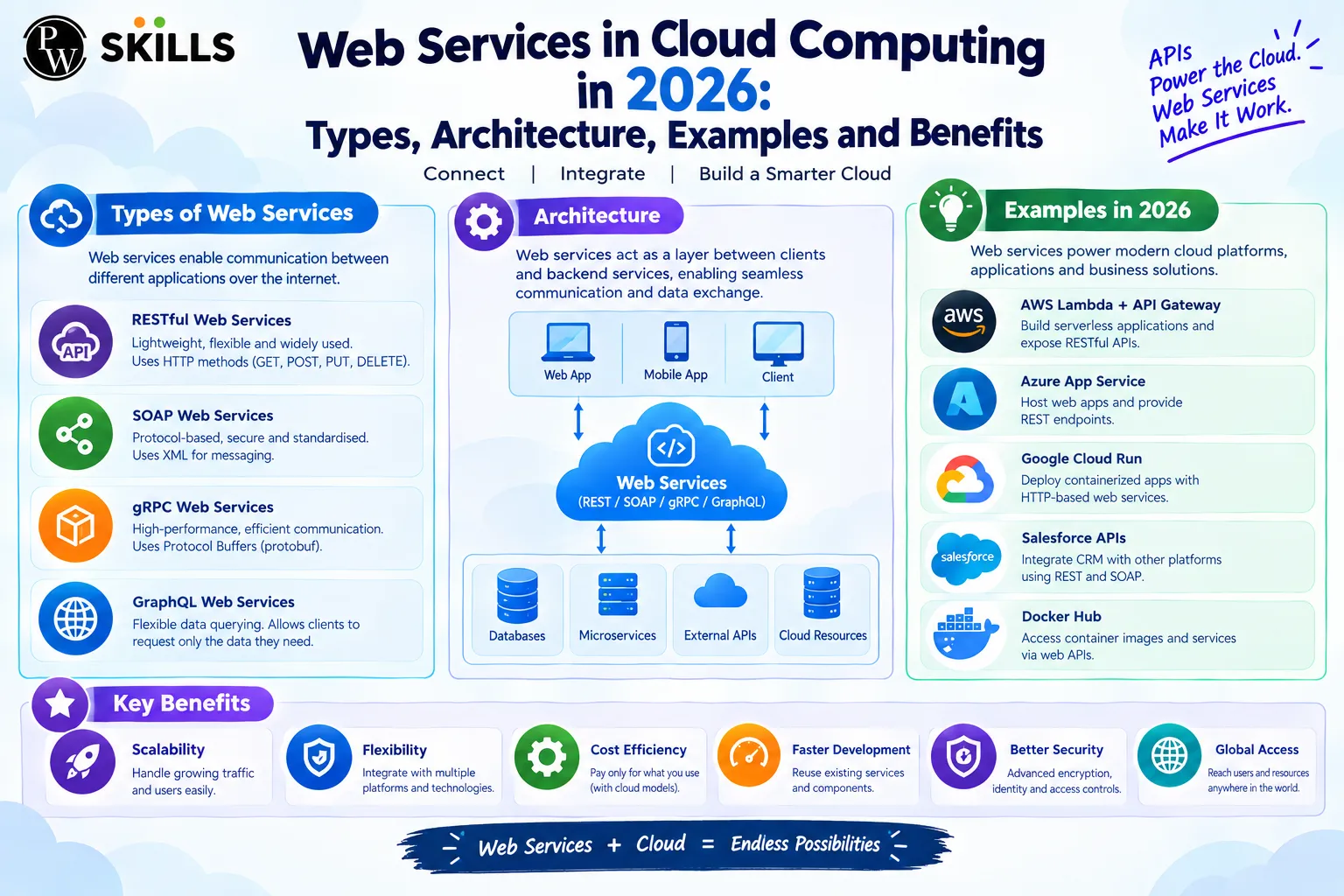
Modern applications rarely operate as completely independent systems. They often need to exchange information with databases, external platforms, APIs, and other applications across different environments. web services in cloud computing provide the communication layer that allows these systems to interact without requiring them to use the same programming language, platform, or physical infrastructure.
This approach is particularly relevant as businesses build distributed applications and move workloads to cloud environments. Instead of keeping every function within a single system, organisations can connect specialised services and allow them to communicate through established protocols and data formats.
Overview of Web Services in Cloud Computing
Modern digital infrastructure often struggles with disparate software applications that cannot easily communicate or share data across different operating systems. Developers face major integration bottlenecks when legacy programs run on isolated servers without standard communication channels.
The major solution is to use web services in cloud computing. These software components are standard bridges that let different applications send messages to each other and perform functions over the internet securely.
Cloud platforms host these services on centralized server farms and data centers. So when a client application needs data, it requests it in an orderly fashion through standard networking protocols. The cloud server checks the payload and responds in real time with the desired information.
This model removes local hardware dependencies. Organizations can scale their backend resources dynamically based on live user traffic patterns.
Understanding the foundational mechanisms requires looking at how disparate software systems interact over standard network layers. Several foundational protocols and data interchange formats make this interoperability possible:
- Extensible Markup Language (XML) structures data into hierarchical tag-based documents for safe transfer.
- JavaScript Object Notation (JSON) provides a lightweight alternative format favoured by modern web applications for speed.
- Hypertext Transfer Protocol (HTTP) serves as the core communication foundation for transmitting web traffic securely.
These technologies let a Python application query a database managed by a Java service hosted on a remote cloud cluster. Interoperability is still the foundation of distributed computing architectures.
What Are the Main Types of Web Services in Cloud Computing?
Students and developers often get confused while categorizing the cloud capabilities and application frameworks. Clear classifications help engineers build cleaner software architectures and choose the best deployment models for enterprise workloads.
Cloud computing web services are typically architected in multiple operational tiers that perform different functional layers of the application lifecycle. The wider ecosystem is heavily dependent on established cloud service models that define management responsibilities between the provider and the consumer.
To get a better understanding of these operational layers, let’s review the main cloud delivery models used in modern software engineering:
|
Cloud Model |
Core Management Responsibility |
Typical Use Case |
|
Infrastructure as a Service (IaaS) |
Provider manages hardware; consumer manages OS and applications |
Virtual machines and data backup storage |
|
Platform as a Service (PaaS) |
Provider manages runtime and tools; consumer manages application code |
Web application development and mobile backends |
|
Provider manages the entire application stack and infrastructure |
End-user collaboration tools and customer portals |
Developers also build specific types of web services within these deployment categories, according to protocol design and communication styles. SOAP and REST are the two major architectural styles in today’s enterprise deployments.
How is Web Service Architecture Structured in Cloud Computing?
Designing resilient distributed systems requires a clear blueprint of how software components interact within a cloud ecosystem. Poorly structured backends often lead to tight coupling, making maintenance difficult and scaling expensive.
An effective web service architecture relies on a decoupled design pattern where service consumers and providers operate independently. This structural separation ensures that changes in internal database schemas do not break client-facing user interfaces.
The standard framework relies on three distinct functional roles that interact dynamically over a network:
- Service Provider creates the application logic, hosts it on cloud infrastructure, and publishes its interface definition.
- Service Registry maintains a searchable directory of available services so clients can locate them easily.
- Service Consumer sends requests to invoke the published functions and parses the returned data payloads.
Besides this architecture, cloud providers add automated load balancers, API gateways, and microservices orchestrators. API gateways handle traffic, manage authentication tokens, and route requests to the right container instances on the backend.
Engineers can scale individual components horizontally with this modular design, rather than replicating an entire monolithic application stack. If a user authentication module has more load, then the cloud cluster will spin up containers only for that service.
The architecture also features caching layers and content delivery networks to reduce latency and minimize direct database load during peak usage hours.
What Are Some Examples of Web Services in Cloud Computing?
Real-world applications demonstrate how cloud-hosted components solve complex integration challenges across global industries. Organizations rely on these implementations to deliver responsive digital experiences to millions of concurrent users.
Modern software products rarely run as isolated monolithic blocks. Instead, they leverage third-party APIs and cloud-native building blocks to accelerate feature delivery and reduce engineering overhead.
Payment gateway integration represents one of the most common operational examples in production environments today. E-commerce platforms invoke remote payment processing APIs hosted in secure cloud zones to handle credit card transactions safely without storing sensitive financial data locally.
Weather forecasting applications provide another clear illustration of distributed data exchange. Mobile front-ends query cloud-hosted meteorological web services that aggregate real-time sensor data from satellites and radar stations worldwide.
Map and navigation applications rely extensively on geospatial cloud APIs. These services process coordinate requests instantly, calculating optimal routing paths and rendering vector graphics back to the user device within milliseconds.
Enterprise resource planning systems also utilize cloud-hosted modules to synchronize inventory, human resources, and customer relationship data across multiple regional office locations in real time.
What Are the Benefits of Web Services in Cloud Computing?
Organizations migrating legacy software portfolios to modern cloud environments look for measurable operational improvements. Building applications with distributed web interfaces delivers substantial technical and financial advantages.
The primary advantage lies in unmatched operational flexibility and resource optimization. Teams can innovate faster by leveraging pre-built cloud components instead of configuring physical server hardware from scratch.
To highlight the core advantages of these technologies, consider the following operational improvements:
- Cost Efficiency eliminates heavy capital expenditure on physical data centre hardware through flexible pay-as-you-go pricing models.
- Global Scalability allows systems to handle massive traffic surges automatically by provisioning extra compute instances on demand.
- Enhanced Security provides automated threat intelligence, encrypted data transmission, and centralized identity access controls.
- High Availability ensures continuous uptime through automated geographic redundancy and instant disaster recovery failover mechanisms.
These capabilities empower modern engineering teams to focus entirely on writing business logic rather than managing server racks and routine network patches. The resulting boost in developer productivity accelerates time-to-market for new digital products significantly.




FAQs
What is the main difference between SOAP and REST web services?
How do cloud computing web services ensure data security?
Can web services built on different programming languages communicate?
What does statelessness mean in cloud web service design?





Get Free Counselling Today
and Clear up all your Doubts
 Live & recorded classes available at easeDashboard for progress trackingLakhs of practice questions