

Random Forest Algorithm in Machine Learning
 Nivedita Dar22 Apr, 2026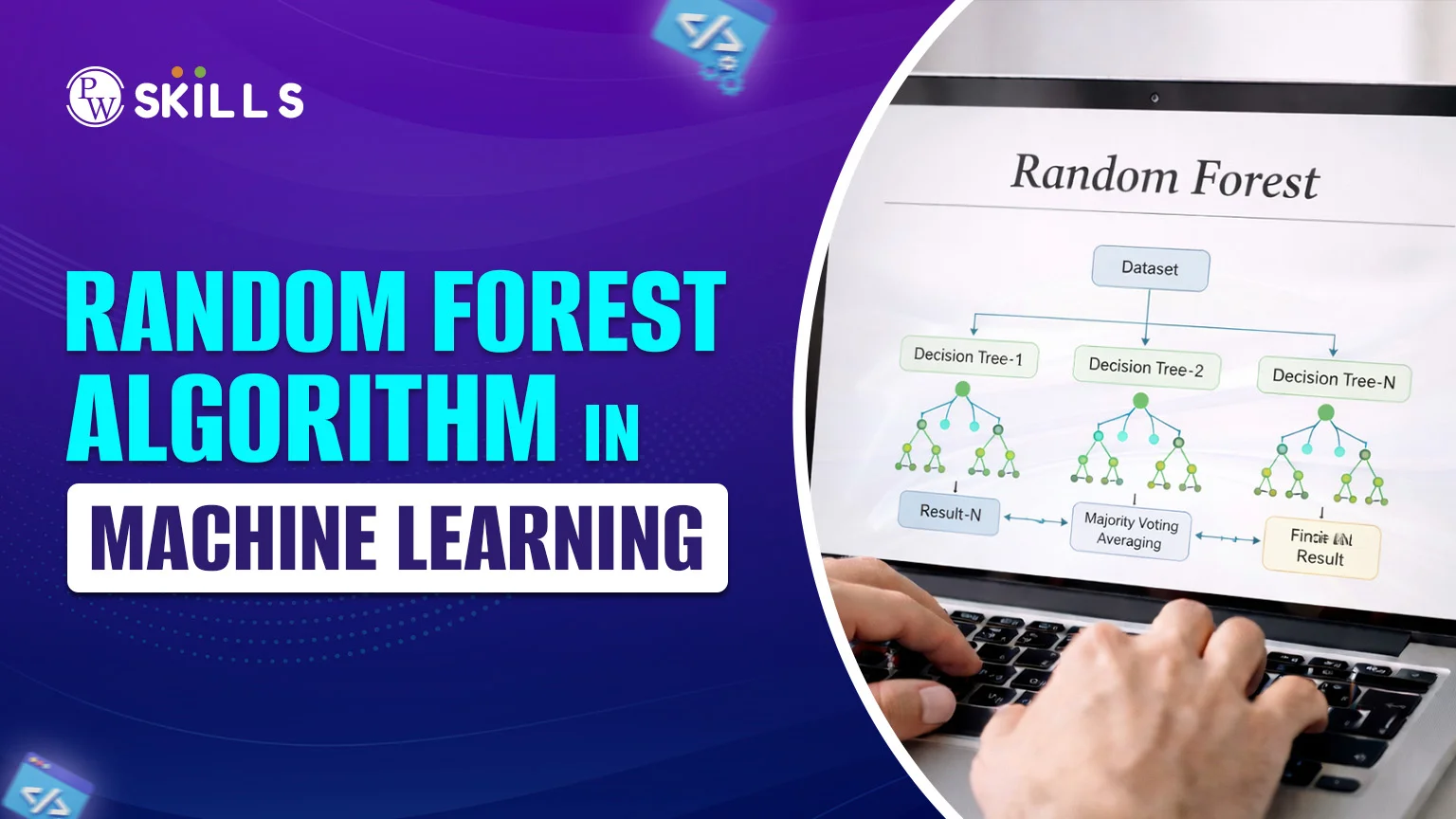
One decision tree in machine learning is easy to follow, but it can be biased or too sensitive to certain data points. In random forest algorithm in machine learning is like a "committee of experts" because it has many trees that vote on an outcome and the one with the most votes wins. When students first start learning about data science, the switch from a single tree to a random forest algorithm in a machine learning model is when their predictions go from being "okay" to being very strong and trustworthy.
Random Forest Algorithm in Machine Learning Meaning
The random forest algorithm is an ensemble technique that falls under the category of supervised learning. It is built upon the concept of "bagging" (Bootstrap Aggregating). Instead of relying on one massive tree to find the answer, this algorithm builds a multitude of decision trees during the training phase. When you use a random forest algorithm in machine learning model, you are essentially creating a forest of trees. The forest outputs the class chosen by the majority of the trees for classification tasks. For regression tasks, it typically takes the average of the outputs from all the individual trees.How Random Forest Algorithm in Machine Learning Works?
To understand why the random forest algorithm in machine learning working so well, you need to know how it works in machine learning. The process has these main steps::- Step 1: Random Sampling: The algorithm picks random samples from the data set. This is called "bootstrapping." Each tree gets a different piece of the data.
- Step 2: Building Trees: A decision tree is constructed for every sample. However, there is a twist - at each node, only a random subset of features is considered for splitting.
- Step 3: Individual Prediction: Based on the information provided, every tree in the forest makes an independent prediction.
- Step 4: Voting/Averaging: In a random forest algorithm in machine learning classification, the model takes a majority vote.
- In regression, it calculates the mean of all results.
Random Forest Algorithm in Machine Learning Features
What makes this algorithm stand out among other learners? Several random forest algorithm in machine learning features contribute to its popularity in the industry:- Diversity: Because each tree uses different data and different features, the forest captures a wide variety of patterns.
- Robustness to Outliers: Since it relies on a majority vote, a few "weird" data points won't easily sway the final result.
- Feature Importance: It can automatically tell you which variables in your dataset are the most important for making a prediction.
- No Scaling Required: Like decision trees, you don't usually need to scale your numerical data (like age or salary) before feeding it into the model.
Random Forest Algorithm in Machine Learning Example
Let’s look at a practical random forest algorithm in machine learning example to see it in action. Suppose you want to predict if a movie will be a hit.- Tree 1 might look at the lead actor and the budget. It predicts: Hit.
- Tree 2 might look at the genre and the release month. It predicts: Flop.
- Tree 3 might look at the director and the budget. It predicts: Hit.
Random Forest Algorithm in Machine Learning Python
If you are ready to build this yourself, the random forest algorithm in the Python machine learning implementation is very accessible through the Scikit-Learn library. The typical code structure looks like this:- Importing: from sklearn.ensemble import RandomForestClassifier (or RandomForestRegressor).
- Initialisation: You define the number of trees using the n_estimators parameter. Usually, 100 trees is a good starting point.
- Fitting: You use the .fit(X_train, y_train) command to train your forest on your training data.
- Predicting: Use .predict(X_test) to see how well your forest handles unseen information.
Random Forest Algorithm in Machine Learning Benefits
There are several advantages of the random forest in machine learning that make it a preferred choice for high-stakes competitions and real-world applications:- Reduced Overfitting: By averaging the results, the forest smooths out the "noise" that often trips up individual decision trees.
- High Accuracy: It is generally much more accurate than a single decision tree on complex datasets.
- Handles Missing Values: It can maintain accuracy even when a significant amount of data is missing.
- Versatility: It works equally well for predicting categories (classification) and numbers (regression).




🔥 Trending Blogs
FAQs
What is the random forest in machine learning?
It is a supervised learning method that builds several decision trees and combines their results to make a more accurate and stable prediction.
How does the random forest in machine learning working process handle errors?
It works by having most people vote. Even if a few trees make a mistake, most of them will probably point to the right answer, which will lower the overall error.
What are the primary advantages of a random forest in machine learning?
The main benefits are that it can stop overfitting, is very accurate, and can work with large datasets that have a lot of features.
Can I use the random forest in machine learning model for predicting stock prices?
Yes, you can use the regression version of the algorithm to guess things like the price of a house or the price of a stock.
Is it hard to implement a random forest in machine learning Python?
No, you can build and train a random forest model in just a few lines of code with libraries like Scikit-Learn.