

Support Vector Machine (SVM) Algorithm
 Nivedita Dar2 May, 2026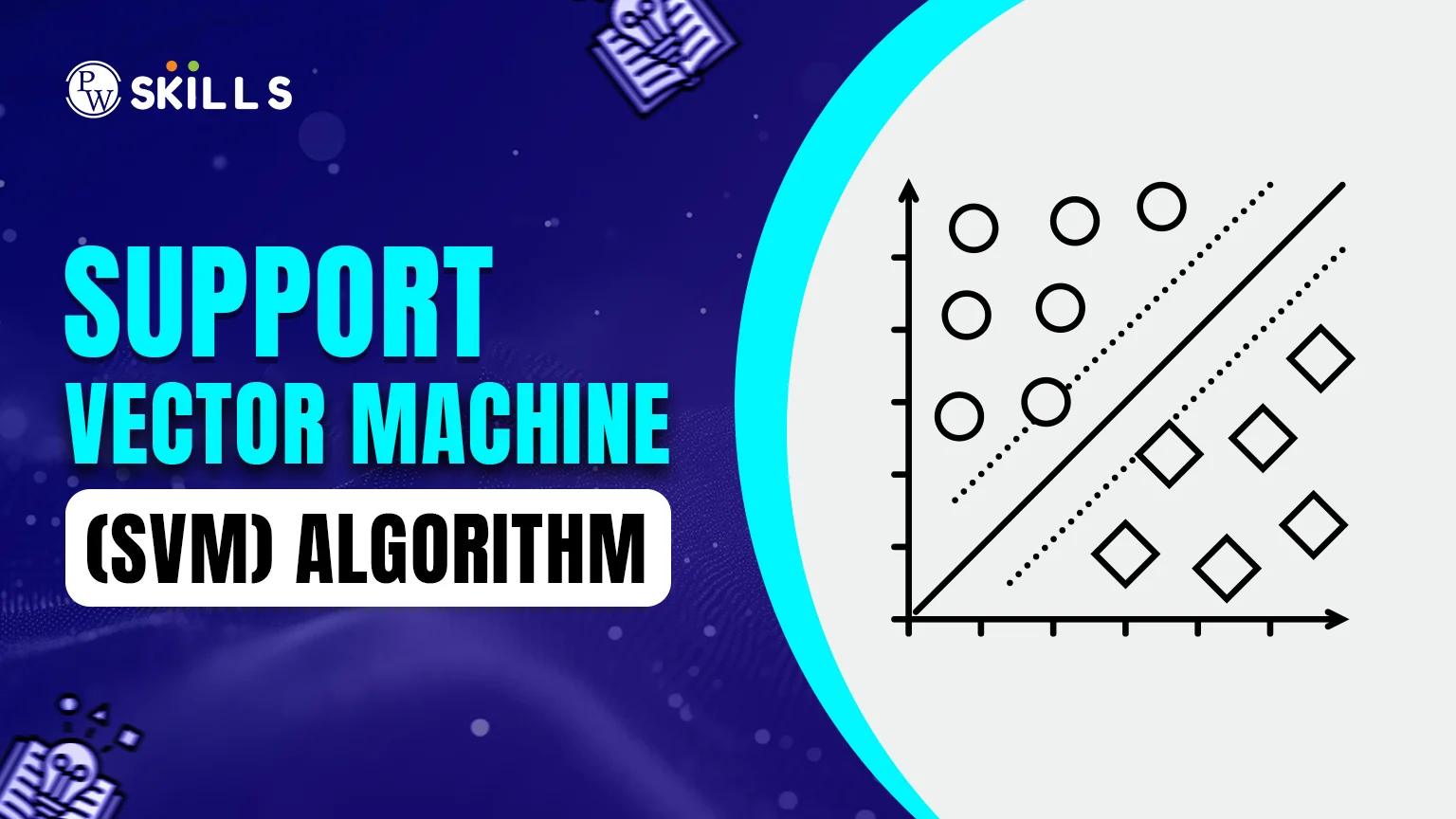
The Support Vector Machine (SVM) algorithm is a powerful supervised learning algorithm used to separate data into distinct classes. It works by finding the optimal boundary (hyperplane) that maximises the margin between data points.
In this article, we’ll break down how SVM works, including the role of support vectors, the use of the kernel trick for non-linear data, a simple example, and its implementation in Python. We’ll also look at why SVM performs well in high-dimensional classification tasks.
What is the Support Vector Machine (SVM) Algorithm?
The support vector machine algorithm is a supervised machine learning model primarily used for salgorithm classification tasks. Its objective is to find a boundary (known as a hyperplane) that separates data points of one class from another. What makes it unique is that it focuses on the "extreme" points. These points, which sit closest to the boundary, are called Support Vectors. They are the pillars that hold up the boundary. If you moved these specific points, the boundary would move too. This is why the support vector machine algorithm model is known for being extremely robust; it ignores the "easy" points far away and focuses on the tricky ones near the border.How Does the Support Vector Machine Algorithm Work?
The support vector machine algorithm working logic is built on the idea of "Maximum Margin." Here is a breakdown of the process:- Identify the Hyperplane: In a 2D space, this is a line. In 3D, it’s a plane. The algorithm looks for a hyperplane that separates the classes.
- Calculate the Margin: The margin is the distance between the hyperplane and the nearest data points from either class.
- Maximising the Gap: SVM aims to widen this margin as much as possible. A wider "no-man's land" between classes reduces the chance of misclassification.
- Handle Outliers: Sometimes, data points are messy. SVM uses a "soft margin" approach to allow a few mistakes if it means the overall boundary is stronger.
Purpose of Support Vector Machine (SVM) Algorithm Kernel
What happens if your data cannot be separated by a straight line? Imagine a circle of blue dots surrounded by a ring of red dots. A straight line won't work here. This is where the support vector machine algorithm kernel trick comes in. The "Kernel Trick" allows the algorithm to map your data into a higher-dimensional space where a linear separation becomes possible.- Linear Kernel: Used when data is already linearly separable.
- Polynomial Kernel: Useful for curved boundaries.
- RBF (Radial Basis Function): The most popular choice, used when there is no clear linear relationship. It can handle complex, overlapping data by treating points based on their distance from a centre.
Support Vector Machine (SVM) Algorithm Example
Let’s look at a real-world support vector machine algorithm example. Imagine you are building a filter to separate "Spam" emails from "Important" emails based on two features: the number of links and the length of the email.- Most spam emails have many links and are short.
- Most important emails have few links and vary in length.
- The SVM plots these on a graph. Some "tricky" emails might be important but still have many links.
- The support vector machine algorithm identifies these tricky emails (the Support Vectors) and draws a wide boundary that keeps them on the "Important" side while pushing the clear spam far into the other side.
Support Vector Machine (SVM) Algorithm in Python
For those ready to code, the support vector machine algorithm Python implementation is streamlined via the Scikit-Learn library. The typical workflow includes:- Importing: from sklearn import svm.
- Defining the Model: You can specify your kernel here, for example: clf = svm.SVC(kernel='linear').
- Training: Using clf.fit(X_train, y_train) to find the optimal hyperplane.
- Predicting: Using clf.predict(X_test) to classify new data.
Advantages of the Support Vector Machine (SVM) Algorithm
There are several support vector machine algorithm advantages that make it a staple in the data science community:- Effective in High Dimensions: It works incredibly well even when the number of features is greater than the number of samples.
- Memory Efficient: Since it only cares about the Support Vectors (a small subset of the data), it doesn't need to keep the whole dataset in memory during the prediction phase.
- Versatility: Thanks to different kernels, it can adapt to almost any shape of data distribution.
- Accuracy: It is less prone to overfitting than many other algorithms, especially in high-dimensional spaces.




🔥 Trending Blogs
FAQs
What is the support vector machine algorithm?
It is a supervised learning algorithm that finds the best possible boundary (hyperplane) to separate different classes of data by maximising the margin between them.
What are support vectors in a support vector machine algorithm model?
Support vectors are the data points that are closest to the hyperplane. They are the most critical points because they determine the position and orientation of the boundary.
When should I use a support vector machine algorithm kernel?
You should use a kernel when your data is "non-linearly separable",a meaning you cannot draw a straight line to separate the classes in their current form.
What are the major support vector machine algorithm advantages over other models?
It is exceptionally effective in high-dimensional spaces and is memory-efficient because it only relies on support vectors to make predictions.
Is it necessary to scale data for the support vector machine algorithm Python implementation?
Yes, scaling is vital. Since SVM relies on measuring distances between points, features with larger numerical ranges can unfairly influence the hyperplane if not normalised.


Talk to a counsellorHave doubts? Our support team will be happy to assist you!



Get Free Counselling Today
and Clear up all your Doubts
Talk to Our Counsellor just by filling out the form.
Join 15 Million students on the app today!
 Live & recorded classes available at easeDashboard for progress trackingLakhs of practice questions

