

Frequent Pattern Growth Algorithm
 Nivedita Dar28 Apr, 2026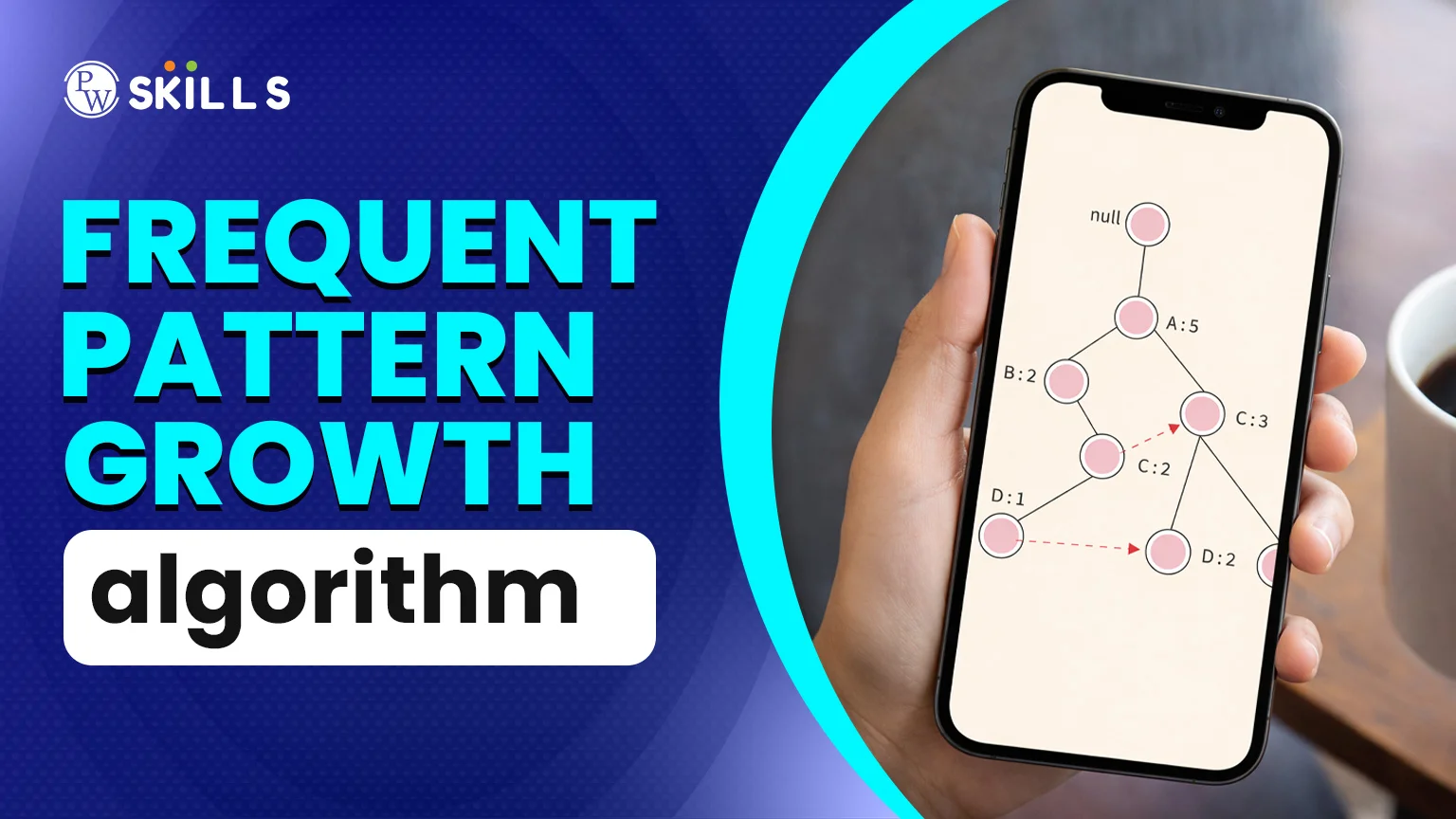
The hard part for students and data scientists is finding patterns rapidly without using up too much RAM on the machine. This is where the Frequent Pattern Growth Algorithm becomes a game-changer. This method is smarter than older ones that repeatedly search databases. It uses a "divide and conquer" strategy. In this post, we'll look at how the FP-growth algorithm works, what makes it structurally strong, and why it remains a key part of many applications today.
What is the FP-Growth Algorithm?
It is an improvement over the Apriori algorithm used for finding frequent item sets. In data science, a "frequent pattern" is simply a set of items, sequences, or substructures that appear in a dataset with a frequency no less than a user-specified threshold (support). The brilliance of the FP-Growth approach lies in its ability to compress the database into an FP-Tree. This tree retains all essential association information while eliminating the need to generate thousands of "candidate" itemsets, a primary bottleneck in older data mining techniques.Frequent Pattern Growth Algorithm Working Steps
To understand how it works, we need to break it down into two key parts: creating the FP-Tree and finding patterns in the tree.Phase 1: Making the FP-Tree
The algorithm initially checks the database to see how much support each item has. Things that don't meet the minimum support level are discarded. The other things that happen a lot are listed in order of frequency, from most to least. The second scan generates the FP-tree. You can use a path in the tree to find each transaction. When two or more transactions contain identical elements, their routes cross, reducing the data. There is also a "Header Table" that keeps track of each item's position in the tree structure.Phase 2: Mining Frequent Patterns
The algorithm works from the bottom up once the tree is formed. It finds a Conditional Pattern Base for each item in the header table. This is the set of all paths that lead to that item. This method continues until there are no more items to extract, yielding all possible frequent itemsets.Frequent Pattern Growth Algorithm Example
Let's look at a real-world scenario to show how the logic works. Step 1: If we have a tiny set of transactions:| Transaction ID | Items Sorted by Frequency |
| T1 | Milk, Bread, Butter |
| T2 | Bread, Butter |
| T3 | Milk, Bread |
| T4 | Milk, Butter |
| Items | Support Count |
| Milk | 3 |
| Bread | 3 |
| Butter | 3 |
- {Milk, Bread} -> 1 time
- {Bread} -> 1 time
- {Milk} -> 1 time
- {Milk}
- {Bread}
- {Butter}
- {Milk, Bread}
- {Milk, Butter}
- {Bread, Butter}
Frequent Pattern Growth Algorithm vs Apriori
You need to understand this discussion to choose the right tool for your project. Their methods are very different, even though they both try to uncover common patterns.| Feature | Apriori Algorithm | FP-Growth Algorithm |
| Strategy | Uses a "generate and test" approach. | Uses a "divide and conquer" approach. |
| Database Scans | Scans the database for every level of frequent itemsets. | Typically requires only two full scans of the database. |
| Candidate Generation | Generates a massive number of candidate itemsets. | No candidate generation is required. |
| Memory Usage | High memory consumption due to candidate storage. | Low memory consumption due to tree compression. |
| Speed | Slower, especially with large datasets. | Significantly faster and more efficient. |
Frequent Pattern Growth Algorithm in Machine Learning
It is mostly used for mining association rules. It helps models understand how variables in a dataset are related to one another. Some such uses are:- Market Basket Analysis: Finding out which products people normally buy together so that they may be placed on shelves in the best way.
- Recommendation systems: Suggest movies or songs to people based on what others with similar viewing habits have watched.
- Bioinformatics: Finding recurring sequences in DNA or protein structures.
- Log Analysis: Detecting frequent sequences of events that lead to system failures.
Frequent Pattern Growth Algorithm Python
While you can write the logic from scratch, most professionals use Python libraries like mlxtend or PyFPGrowth. These libraries provide optimised functions to handle the heavy lifting. A typical workflow in Python involves:- Preprocessing the data into a transaction list.
- Encoding the transactions into a one-hot format using a TransactionEncoder.
- Applying the fpgrowth function from the library to extract frequent itemsets.
- Setting the min_support parameter to filter results.
Frequent Pattern Growth Algorithm Advantages
Why should you choose this method over others? The advantages are quite clear:- Efficiency: It requires only two passes over the database, saving significant I/O time.
- Compression: The FP-Tree structure significantly reduces the memory footprint of the data.
- No Candidate Generation: By avoiding the creation of candidate sets, it avoids the "state-space explosion" that plagues Apriori.
- Scalability: It performs exceptionally well even as the number of transactions and items grows.
Why the FP-Growth Algorithm is Important
It works well because it was designed well:- It typically requires only two full database scans, which helps reduce I/O operations and improves performance.
- It doesn't generate unnecessary combinations of itemsets.
- The FP-Tree combines repetitive transaction patterns into shared pathways.
- Instead of searching with brute force, conditional FP-Trees let you mine in a focused, recursive way.
FP-Growth Algorithm Limitations
The frequent pattern growth algorithm model has some problems, even though it has some good points:- Compared to simpler algorithms like Apriori, it can be hard to use.
- If the dataset doesn't have many shared patterns, the FP-Tree could use a lot of RAM.
- Building several conditional FP-Trees can take a lot of computer power.
- It doesn't work well with datasets that are very sparse or lack much overlap.
FP-Growth Algorithm Short Summary
The FP-Growth Algorithm is efficient because it is mathematically simple. It finds hidden linkages between things by turning a flat database into a hierarchical tree, allowing you to follow basic paths. For any student who wants to learn about data science, knowing this algorithm is a great way to get started with efficient computers and pattern recognition. Also Read - Types of Agents in AI Types of AI Based on Capabilities AI in Transportation Backtracking Search Explained for AI Types of AI Based on Functionality



FAQs
Is the FP-Growth Algorithm superior to the Apriori algorithm?
Yes, in most circumstances where there is a lot of data. Apriori is easier to grasp, but FP-Growth is considerably faster because it doesn't need to generate candidates and just needs to search the database twice.
What does an FP-Tree look like?
A Frequent Pattern Tree (FP-Tree) is a smaller version of the input database. It keeps track of common items and their relationships in a tree structure, where shared routes show how items are related across transactions.
What are the major benefits of the FP growth algorithm?
The main benefits include high speed, low memory usage through data compression, and the ability to find frequent itemsets without generating huge numbers of candidate combinations.
How is the FP growth algorithm used in Python?
In Python, the algorithm is typically implemented using the mlxtend library. It allows data scientists to find associations in transactional data with just a few lines of code by defining a minimum support threshold.
What is the conditional pattern base?
The conditional pattern base is a "sub-database" consisting of the prefix paths in the FP-Tree that co-occur with a specific suffix (item). It is used to mine frequent patterns for that specific item recursively.