
EY Python Developer Interview Questions 2026: Technical Questions and Preparation Tips
 Hardik Gupta26 Sept, 2026
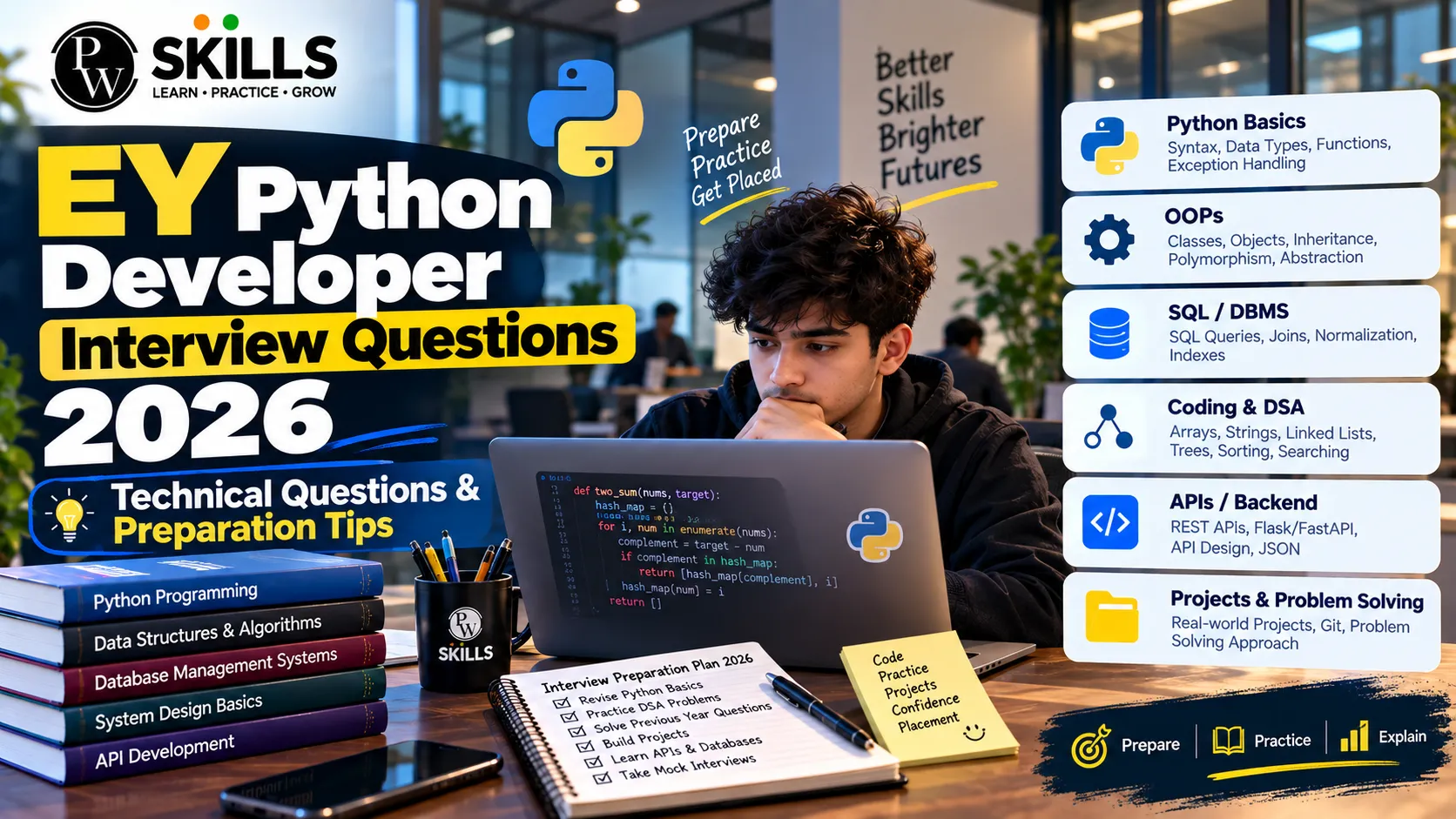
Unknowns may be daunting, and the prospect of a significant business IT assessment might be daunting. One of the important things for candidates who want to complete tough technical rounds is finding the correct guidance. Studying typical EY Python developer interview questions is a great way to bridge the gap between theoretical understanding and actual application while preparing for a software engineering career. This will ensure you tackle coding examinations with perfect confidence and an organized logical thinking.
Core EY Python Developer Interview Questions
Understanding foundational programming principles is the absolute bedrock of clearing initial screening rounds. Interviewers evaluate how deeply you understand data types, memory handling, and mutable versus immutable structures. When candidates look into interview questions, they frequently encounter queries regarding primitive data types like integers, floats, strings, and booleans.
-
Mutable vs Immutable Structures: You should know which objects may be edited in situ (lists and dictionaries), and which cannot (tuples and strings). Understanding this distinction is important for state management in applications.
-
Collections and Control Flow: Mastery over lists, sets, tuples, and dictionaries allows developers to choose the right data structure for specific operational tasks. Loops and conditional statements form the structural core of algorithmic problem-solving.
-
Functions and Scope Management: Interviewers often test your grasp of default arguments, variable-length arguments like args and kwargs, recursion patterns, and the distinction between local and global scope variables.
-
List Comprehensions: Writing concise, readable code using list comprehensions instead of traditional for-loops demonstrates fluency and optimization mindset.
-
Big-O Notation: Being able to analyze the time and space complexity of your algorithms ensures your code scales efficiently under production loads.
Practising fundamental interview questions about Python builds the necessary muscle memory for writing clean, efficient scripts under strict time constraints. When solving problems involving string manipulation, array rotation, or finding duplicate elements, keeping your code clean and readable prevents runtime errors and logic flaws.
EY Python Developer Interview Questions on OOP
Enterprise applications rely heavily on object-oriented programming to maintain clean modular structures, making OOP a staple topic during any EY technical interview. Software engineers must know how to design reusable components, manage data encapsulation, and implement inheritance cleanly.
-
Classes and Objects: You should be completely comfortable defining custom classes, instantiating objects, and understanding the role of constructors like init methods.
-
Inheritance and Polymorphism: Single, multiple, and multilevel inheritance structures allow code sharing across modules, while polymorphism lets uniform interfaces handle diverse underlying data types.
-
Encapsulation and Abstraction: Protecting internal state using private and protected attributes showcases professional software engineering discipline, while abstract classes use the abc module to enforce interface contracts.
-
Method Resolution Order (MRO): Understanding how Python resolves method calls in complex multiple inheritance hierarchies prevents unexpected runtime bugs.
During a typical Python coding interview, structural design choices matter just as much as syntax correctness. Interviewers look closely at how you partition logic into logical classes and how you handle object states. Reviewing EY Python interview questions 2026 helps candidates map out typical software design scenarios they will encounter on the job.
Also Check : Python Bootcamp For AI
EY Python Developer Interview Questions on Data Handling
Many technical roles require handling large datasets, performing data manipulation, and building robust processing pipelines. Proficiency in third-party libraries like NumPy and Pandas is frequently tested. When evaluating candidates through Python interview questions, technical panels often check familiarity with tabular data structures.
-
NumPy Arrays: Understanding vectorised operations, array slicing, reshaping, reversing arrays in a single line, and why NumPy arrays perform faster than standard Python lists is essential.
-
Pandas DataFrames: Knowing how to add new columns, handle missing values, perform reindexing, create series from dictionary objects, and combine distinct dataframes forms a major part of data-centric technical evaluations.
-
Database Interaction: Connecting Python scripts to relational databases like MySQL, SQLite, or PostgreSQL using libraries like sqlite3 or SQLAlchemy, executing raw SQL queries, and managing transactions safely are core expectations.
-
Static Analysis Tools: Knowing how to identify bugs using static analysis tools and understanding package management via PIP helps maintain code quality.
Let us look at a quick comparative overview of popular data structures and their operational traits:
|
Structure Type |
Mutability |
Primary Use Case |
Performance Tradeoff |
|
List |
Mutable |
Ordered collections of items |
Dynamic resizing overhead |
|
Tuple |
Immutable |
Fixed records and coordinates |
Memory efficient, immutable |
|
Dictionary |
Mutable (Keys immutable) |
Key-value mapping and lookups |
Fast O(1) average lookups |
|
Set |
Mutable |
Unique element tracking |
Unordered, fast membership checks |
This clear breakdown highlights structural differences that frequently appear during technical screenings, ensuring you can justify your choice of collection type during cross-examination.
Advanced EY Python Developer Interview Questions and Coding Rounds
Moving past basic syntax, senior and mid-level assessments dive deep into advanced mechanics. To excel in a comprehensive Python interview preparation strategy, you must understand how Python manages execution under the hood and how to implement robust error management.
-
Global Interpreter Lock (GIL): Explaining the GIL, its impact on multi-threading, and how multi-processing bypasses it for CPU-bound tasks is a classic technical hurdle.
-
Decorators and Generators: Writing custom decorators to modify function behavior dynamically and utilizing yield statements in generators for memory-efficient iteration show advanced expertise.
-
Exception Handling: Properly utilizing try, except, else, and finally blocks ensures your applications fail gracefully and handle unexpected errors without crashing.
-
Deep vs Shallow Copy: Understanding the difference between copying references and duplicating underlying objects prevents subtle data corruption bugs in large systems.
-
API Development and Frameworks: Familiarity with building lightweight services using Flask or FastAPI, handling REST API design principles, and structuring backend services.
Being able to articulate these advanced concepts clearly sets exceptional candidates apart from average applicants. Interviewers appreciate engineers who understand not just how a feature works, but why it was implemented that way in the language specification.
Preparation Tips for EY Python Developer Interview Questions
Cracking technical evaluations requires more than just memorising code snippets. A structured approach to your overall preparation plan ensures you remain composed during live coding sessions. When preparing for interview questions, focus heavily on your communication and debugging methodology.
-
Explain Your Logic Out Loud: Technical panels evaluate your problem-solving journey, not just the final output. Verbalising your assumptions and edge-case considerations is crucial.
-
Practice Mock Coding: Simulate live coding environments where you write algorithms, build basic APIs, and write unit tests to check your software testing and CI/CD awareness.
-
Understand Debugging Skills: Knowing how to read stack traces, use logging modules, and systematically isolate bugs under pressure demonstrates professional maturity.
-
Align with Consulting Mindsets: Because firms operate in client-facing environments, showing adaptability, clear stakeholder communication, and business context awareness adds immense value.
-
Review Real-World Projects: Be ready to discuss automation scripts, web development tasks, or data analysis workflows you built in past roles.
By following a disciplined practice routine, you transform abstract technical concepts into reliable problem-solving reflexes. Ensure you review past project work thoroughly, as interviewers will frequently ask you to explain design trade-offs, architecture decisions, and challenges you overcame in real-world scenarios.







FAQ
Q1. What core topics are most common in EY Python developer interview questions?
Q2. How can I structure my Python interview preparation effectively?
Q3. Are database questions included in an EY technical interview?
Q4. What is the best way to tackle live coding rounds during a Python coding interview?
Q5. Where can I find relevant study resources for EY Python interview questions 2026?
 Live & recorded classes available at easeDashboard for progress trackingLakhs of practice questions


