
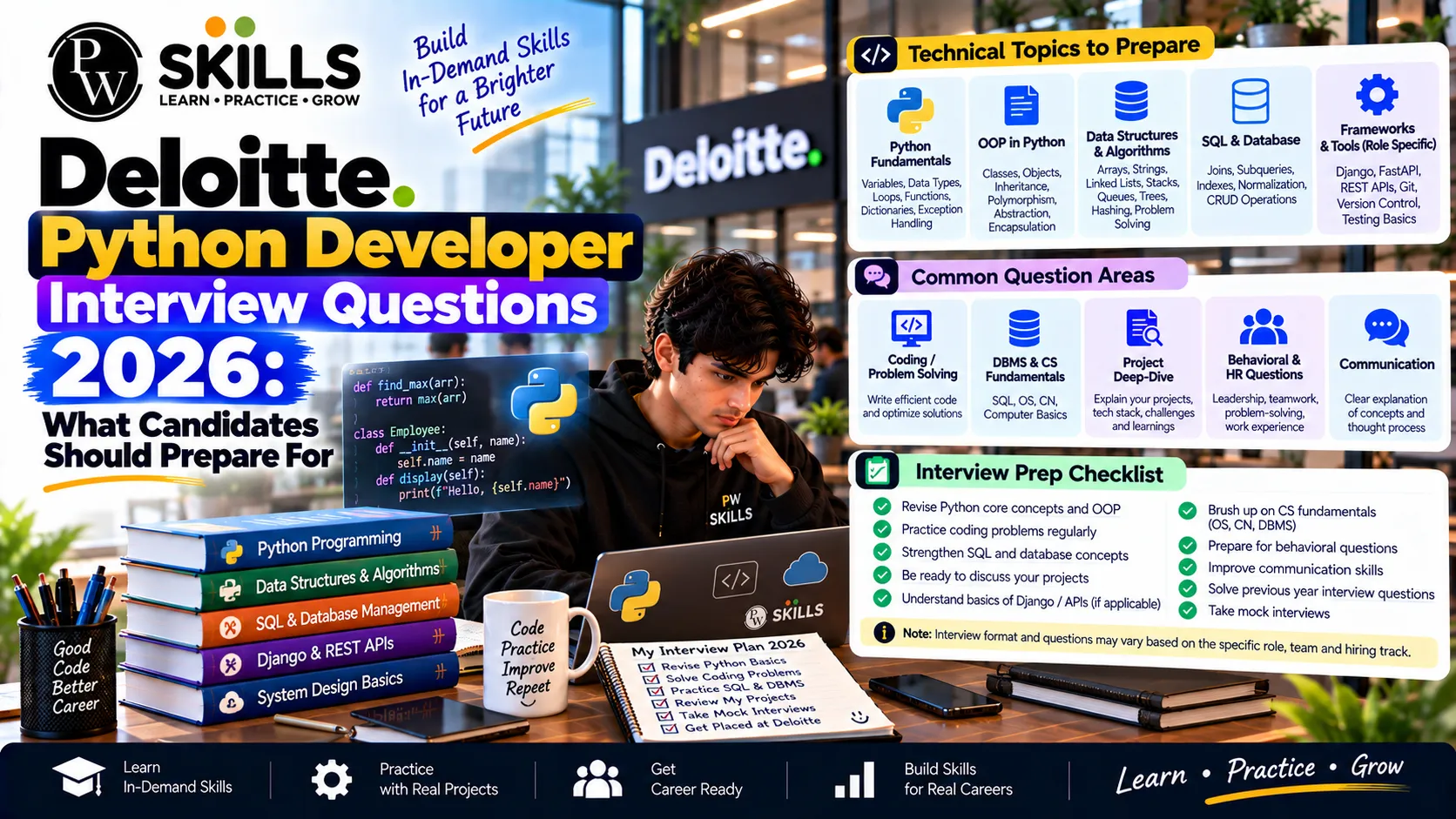
Deloitte Python Developer Interview Questions 2026: What Candidates Should Prepare For
 Hardik Gupta26 Sept, 2026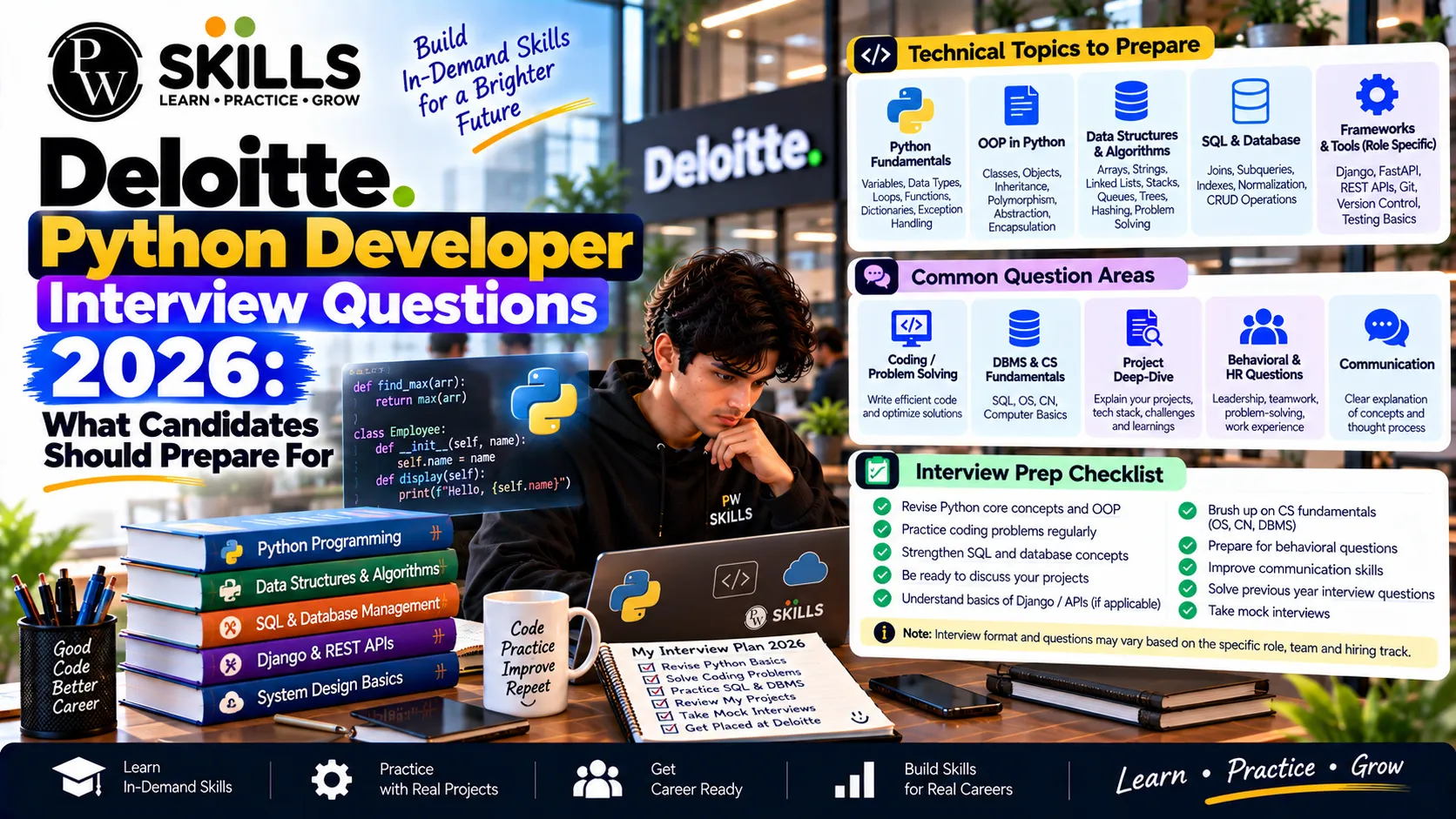
Many candidates fail due to lack of systematic knowledge of key programming ideas and actual execution. Knowing what to expect in a hiring round makes all the difference. Standard Deloitte Python developer interview questions might provide you a sense of the assessment patterns, key syntax standards, and problem-solving requirements.
Basic Deloitte Python Developer Interview Questions for Freshers
Starting your evaluation journey means brushing up on foundational syntax, data types, and fundamental language rules. Deloitte Python interview questions 2026 often cover these basic concepts to test your understanding of Python and programming fundamentals.
-
What are the built-in data types in Python? Python features several native data types, including numeric types (int, float, complex), sequence types (str, list, tuple), mapping types (dict), set types (set, frozenset), and boolean types (bool).
-
What is the difference between lists and tuples? Lists are a mutable collection type, constructed using square brackets. Elements can be changed, added or removed after a list is created. Tuples are immutable collections, created using parenthesis . Using tuples provides efficiency benefits, and protection from accidentally changing data.
-
What is PEP 8? PEP 8 is the official style guide for Python code. It provides coding conventions concerning indentation, line length, imports, and naming styles to enhance readability across development teams.
-
How does memory management work? Python automatically manages memory from a private heap space where all of your objects and data structures are stored. - An internal garbage collector counts references to the objects and frees the memory when an item is no longer referenced .
Structured learning paths, such as the Decode Python with DSA Course, help learners build a rock-solid foundation in these basic principles before tackling complex corporate evaluations.
Also Explore our Course : Decode Python with DSA Course 1
Deloitte Python Developer Interview Questions on Data Structures
Evaluators will look for how well you can work with data utilizing built-in structures and object-oriented ideas, in addition to the basics of syntax. These are the basic areas that usually determine your ability to write clean reusable code in a Deloitte technical interview.
-
What is the purpose of the self keyword? The argument self is a reference to the specific instance of a class and gives access to its properties and methods. You can use any acceptable identification name, but there is a community-wide convention that self be used.
-
How do dictionary methods get() and indexing differ? Using standard square bracket indexing like dict[key] raises a KeyError if the key is missing. Conversely, the get() method safely returns None or a specified default value instead of crashing execution.
-
What are decorators and how do they function? Decorators are design patterns that allow you to modify or extend the behaviour of a function or method without permanently altering its source code. They rely heavily on first-class functions and closures.
-
Explain shallow copy vs deep copy. A shallow copy creates a new compound object and then, to the extent possible, adds references into it to the objects contained in the original. A deep copy creates a new compound object and then, recursively, populates it with copies of the objects contained in the original.
Sharpening your knowledge through targeted Python interview preparation ensures you can explain these object-oriented concepts without hesitation.
Deloitte Python Developer Interview Questions on Coding and Programs
Technical rounds usually test your algorithmic skills with real coding tasks. Practicing typical Python coding questions helps you minimize execution speed and manage edge cases successfully.
-
How do you reverse a string efficiently? You can reverse strings cleanly using slice notation s[::-1], which runs in linear time and leverages C-level optimizations inside the interpreter.
-
Write a logic to check for palindromes. A string is a palindrome if it reads the same forward and backward. Comparing s == s[::-1] provides an elegant, pythonic validation check.
-
How do you merge two sorted lists? You can iterate through both lists using two pointer variables, comparing elements sequentially and appending the smaller value to a new result list until completion.
-
What are args and kwargs? The *args syntax allows a function to accept a variable number of positional arguments as a tuple. Meanwhile, **kwargs accepts variable keyword arguments as a dictionary.
Below is a quick reference table comparing key operational methods frequently evaluated in coding assessments:
|
Concept / Method |
Primary Purpose |
Key Behaviour |
Performance Implication |
|
List Comprehension |
Creating new lists based on existing iterables |
Concise syntax replacing traditional loops |
Faster execution speed in most standard use cases |
|
Lambda Functions |
Creating small anonymous inline functions |
Restricted to a single expression body |
Useful for short-term sorting keys or callbacks |
|
Set Operations |
Storing unique elements and filtering duplicates |
Automatically drops duplicate values on insertion |
Fast membership testing with O(1) average time |
|
Generator Yield |
Producing sequences of values lazily on demand |
Suspends function state between successive iterations |
Highly memory-efficient for large dataset streaming |
Advanced Deloitte Python Developer Interview Questions for Experienced Candidates
For senior roles, evaluation panels dig deeper into concurrency models, memory leaks, and performance optimization techniques. Knowing these nuances separates average candidates from top-tier contenders.
-
What is the Global Interpreter Lock (GIL)? The GIL is a mutex that protects access to Python objects, preventing multiple native threads from executing Python bytecodes at once. This design simplifies CPython memory management but limits multithreaded CPU-bound parallelism.
-
When should you choose multiprocessing over multithreading? For CPU-bound tasks like mathematical computation, multiprocessing bypasses the GIL by utilizing separate process memory spaces. For I/O-bound tasks involving network requests or file input-output, multithreading remains appropriate.
-
What are generators and iterators? An iterator is an object representing a stream of data that implements __iter__() and __next__() methods. A generator is a specialized routine using the yield keyword to generate values lazily, conserving system memory.
-
What is duck typing? Duck typing is a programming concept where an object's suitability is determined by the presence of certain methods and properties, rather than its explicit inheritance lineage. If it walks like a duck and quacks like a duck, Python treats it as a duck.
Learning these advanced themes will help you stand out during high-stakes evaluations and technical screening sessions.







FAQ
What is the primary difference between is and == operators?
How can you remove duplicate items from a list quickly?
Why are mutable default arguments dangerous in function definitions?
What does name mangling do in classes?
How do you handle exceptions effectively?

Get Free Counselling Today
and Clear up all your Doubts
 Live & recorded classes available at easeDashboard for progress trackingLakhs of practice questions

