

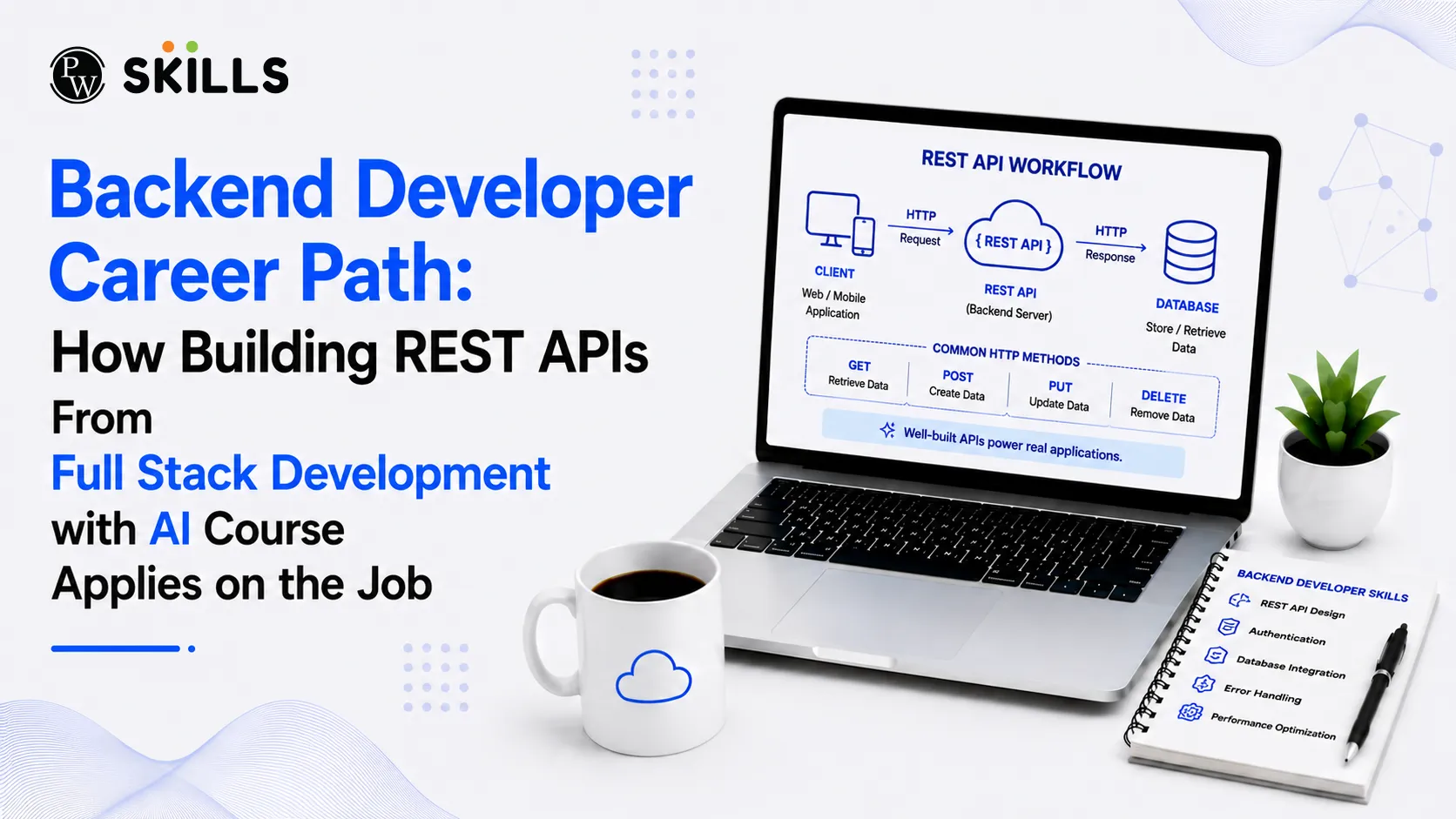
How Building REST APIs From Full Stack Development with AI Course Applies on the Job
 Hardik Gupta18 Jul, 2026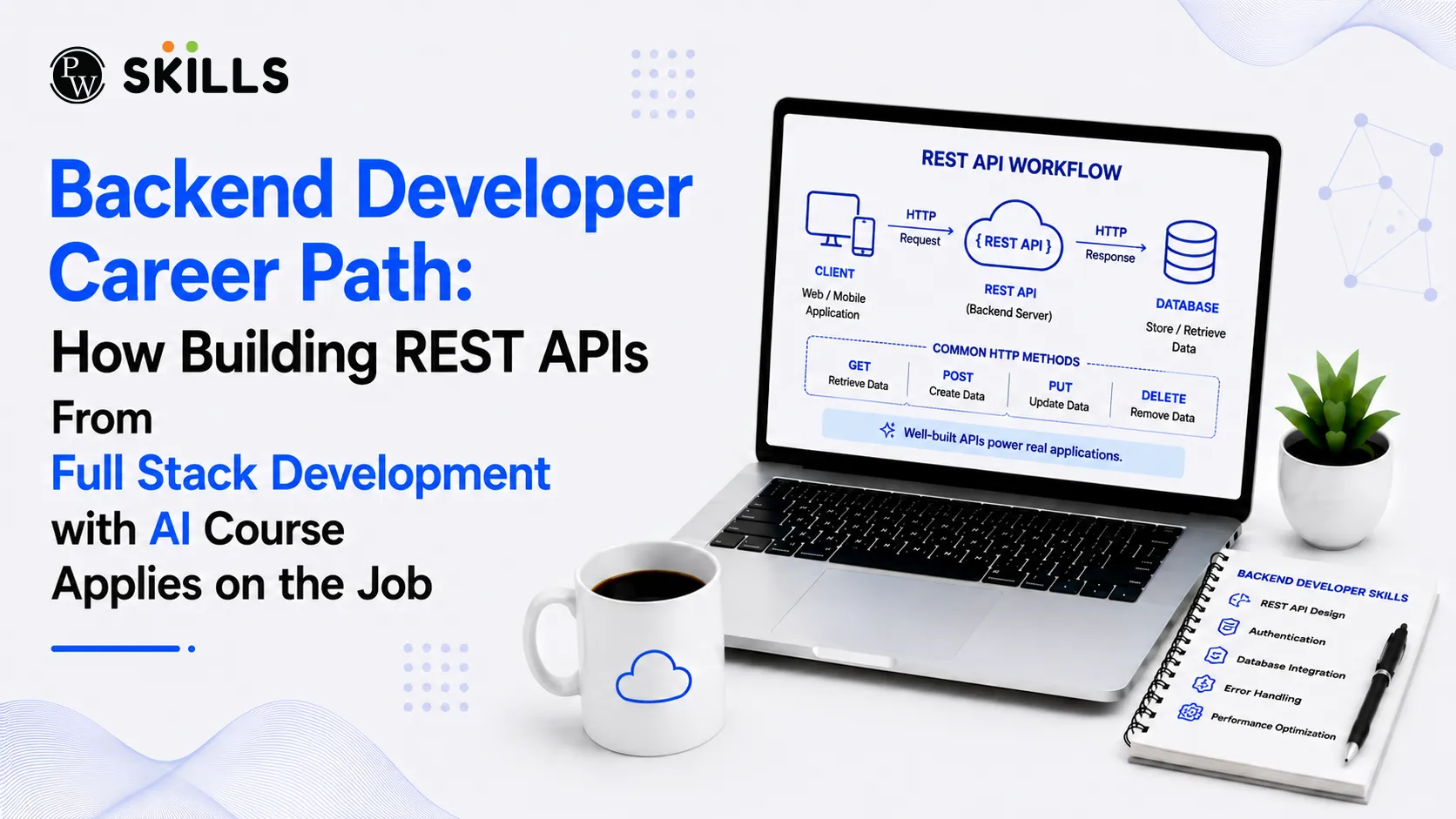
Securing backend developer jobs requires more than just knowing syntax. Many aspiring engineers struggle to understand how databases, server logic, and user interfaces actually communicate in production environments. Reading theory does not prepare you for real-world development challenges. Taking a Full Stack Development with AI Course solves this problem by teaching you how to build robust architectures from scratch. You will learn how to connect server-side code with frontend applications seamlessly while using automation tools to speed up your coding workflow.
Overview of Full Stack Development with AI Course
The AI full-stack development course is a modern software engineering program designed to teach learners how to build, deploy, and manage complete web applications while using artificial intelligence tools to improve development efficiency. Unlike traditional coding courses that focus only on frontend or backend technologies, this program covers the entire application lifecycle, including user interface development, server-side programming, database management, API creation, cloud deployment, and application maintenance. Students learn how different components of a software system communicate and work together in real production environments.
Why Does a Full Stack Development with AI Course Teach REST API Skills Early?
Modern applications rely heavily on Representational State Transfer (REST) APIs to handle data exchange. When you browse a website or use a mobile app, every action triggers a request to a server. Backend engineers spend a significant amount of time writing the logic that processes these requests securely and efficiently.
Employers tracking market trends look for developers who can build clean, predictable endpoints. For instance, recent industry reports like the GitHub Octoverse highlight how automation and AI integrations are rapidly changing repository workflows. Understanding the core patterns of data delivery ensures you remain highly employable.
A structured training program bridges the knowledge gap between simple coding and engineering. By enrolling in an AI full-stack development course, you learn how to handle real-world server traffic, manage user sessions, and deploy scalable APIs that companies need.
How Does a Full Stack Development with AI Course Teach API Architecture?
Learning backend development involves understanding how different architectural layers interact. A comprehensive curriculum walks you through the entire lifecycle of an application, showing you how to manage data flows from the user's screen down to the server.
Clean Endpoints
A solid course teaches you to create uniform resource identifiers (URIs) that make sense. You learn to map standard HTTP methods to specific server actions:
-
GET: Retrieves data from the database without modifying it.
-
POST: Submits new data to the server to create a resource.
-
PUT/PATCH: Updates existing information stored in the system.
-
DELETE: Removes specific data from the database permanently.
AI Coding Assistants
Modern backend development leverages artificial intelligence to write boilerplates faster. AI full-stack development course teaches you how to prompt AI tools to generate routes, validate incoming data, and write unit tests, which drastically cuts down development time on the job.
How Does a Full Stack Development with AI Course Teach Database Design Fundamentals?
An API is only as good as the database behind it. Backend developers must know how to structure data so that the server can retrieve it quickly without crashing under heavy user traffic.
Relational vs Non-Relational Databases
You need to know when to use structured tables and when to use flexible documents. Structured training ensures you master both approaches:
|
Database Type |
Best Used For |
Key Characteristic |
|
Relational (SQL) |
Financial apps, user accounts |
Uses strict tables, rows, and foreign keys |
|
Non-Relational (NoSQL) |
Real-time chats, content feeds |
Uses flexible JSON-like document structures |
Optimized Queries
Poorly structured data leads to slow application performance. Through a Full Stack Development with AI Course + Database design focus, you learn how to normalize tables, create efficient indexes, and prevent common performance bottlenecks like the N+1 query problem. This ensures your API responds to requests in milliseconds.
How Does a Full Stack Development with AI Course Apply API Development Skills on the Job?
Transitioning from a student to a working professional means handling messy, real-world codebases. The practical projects you build during your training replicate the exact tasks you will face during a typical workday.
Authentication and Security
In a corporate setting, you cannot leave endpoints open to the public. You will apply your knowledge by implementing JSON Web Tokens (JWT) or OAuth to secure routes. This ensures that only verified users can access sensitive database information.
Version Control and Documentation
Code bases evolve constantly as features are added. You will write clear API documentation using tools like Swagger, allowing frontend teams to understand your backend logic without reading lines of raw code. You will also use Git workflows to collaborate cleanly with other engineers.
The following checklist highlights the standard backend workflow used during production deployments:
-
Input Validation: Sanitize all incoming user data to prevent malicious SQL injection attacks.
-
Error Handling: Return explicit HTTP status codes so the frontend knows exactly what went wrong.
-
Rate Limiting: Restrict the number of requests a single user can make to prevent server overload.
-
Environment Variables: Keep secret database credentials out of the public source code.
How Does a Full Stack Development with AI Course Help You Get Backend Developer Jobs?
Landing your first professional role requires demonstrating that you can solve business problems, not just pass theoretical coding tests. Recruiters look for portfolios that show complete production cycles.
Production-Ready Portfolio
Instead of building simple to-do apps, focus on creating complex applications that solve real issues. Show that you can deploy an API to cloud platforms, manage live databases, and connect AI APIs to add smart features like automated text generation or predictive filtering.
Backend Technical Interviews
Interviewers will test your system architecture knowledge. By completing a Full Stack Development with AI Course + Backend Developer Jobs preparation pathway, you gain the confidence to explain architectural choices, defend your database schema decisions, and debug complex server errors under pressure.
How Does a Full Stack Development with AI Course Teach Scalable System Design?
As applications grow from dozens of users to thousands, the backend architecture must adapt. Building a scalable system requires deep knowledge of optimization strategies that prevent server crashes.
Caching Layers
You will learn to store frequently accessed data in temporary memory blocks rather than querying the database every single time. Using tools like Redis reduces the strain on your primary database and speeds up response times significantly.
Microservices vs Monolithic Setups
Understanding how to break down a giant application into smaller, independent services is a critical backend skill. A Full Stack Development with AI Course + How to scale module teaches you how to decouple services so that a failure in one feature does not take down the entire web platform.



FAQs
What is the main difference between REST and GraphQL APIs?
How does an AI course help with database optimization?
Why are status codes important in REST API design?
How do you protect a backend API from malicious traffic?
Can I get backend developer jobs without knowing frontend frameworks?





Get Free Counselling Today
and Clear up all your Doubts
 Live & recorded classes available at easeDashboard for progress trackingLakhs of practice questions

