
Top Java Projects for Career Growth
 Hardik Gupta10 Jul, 2026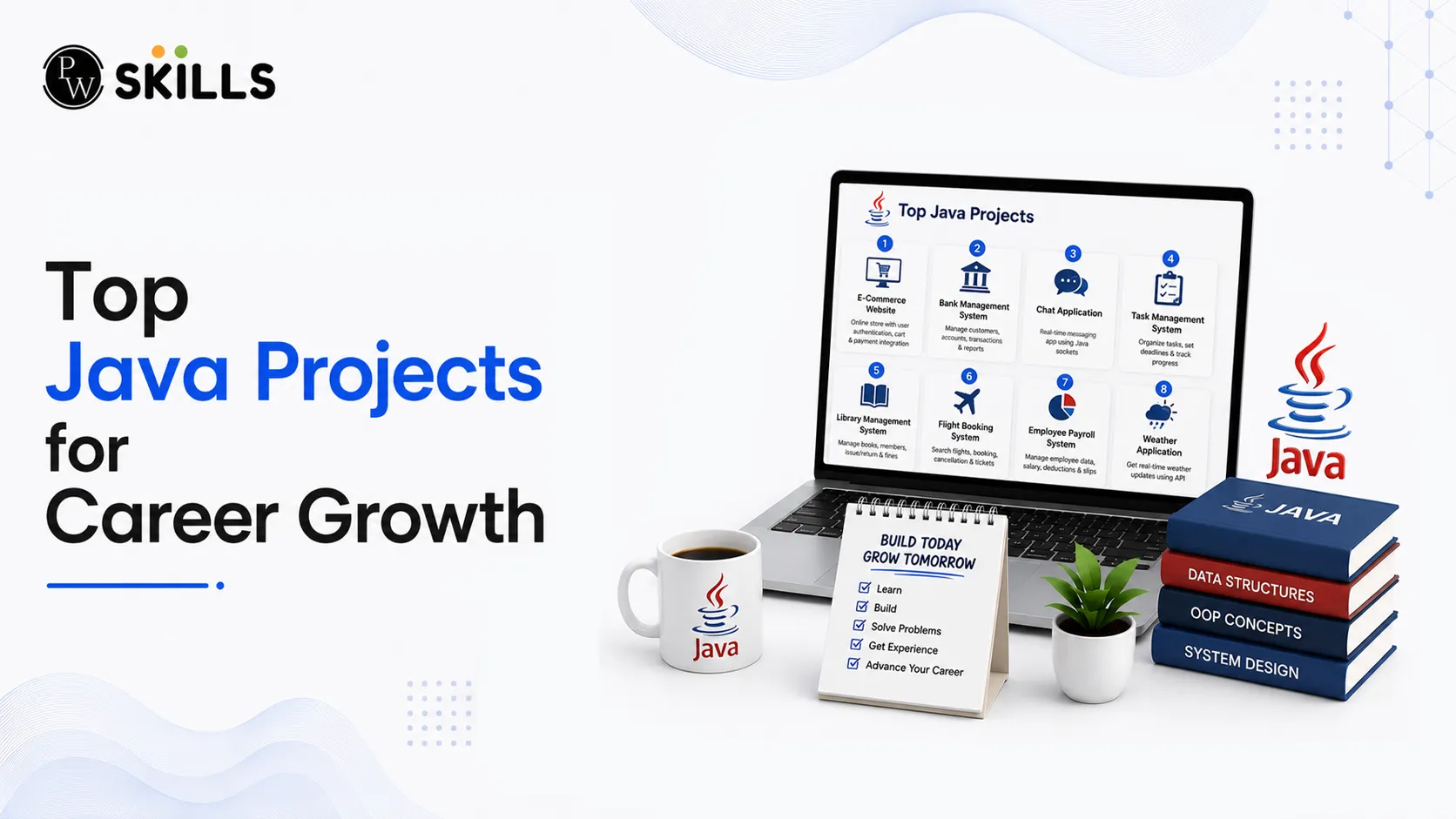
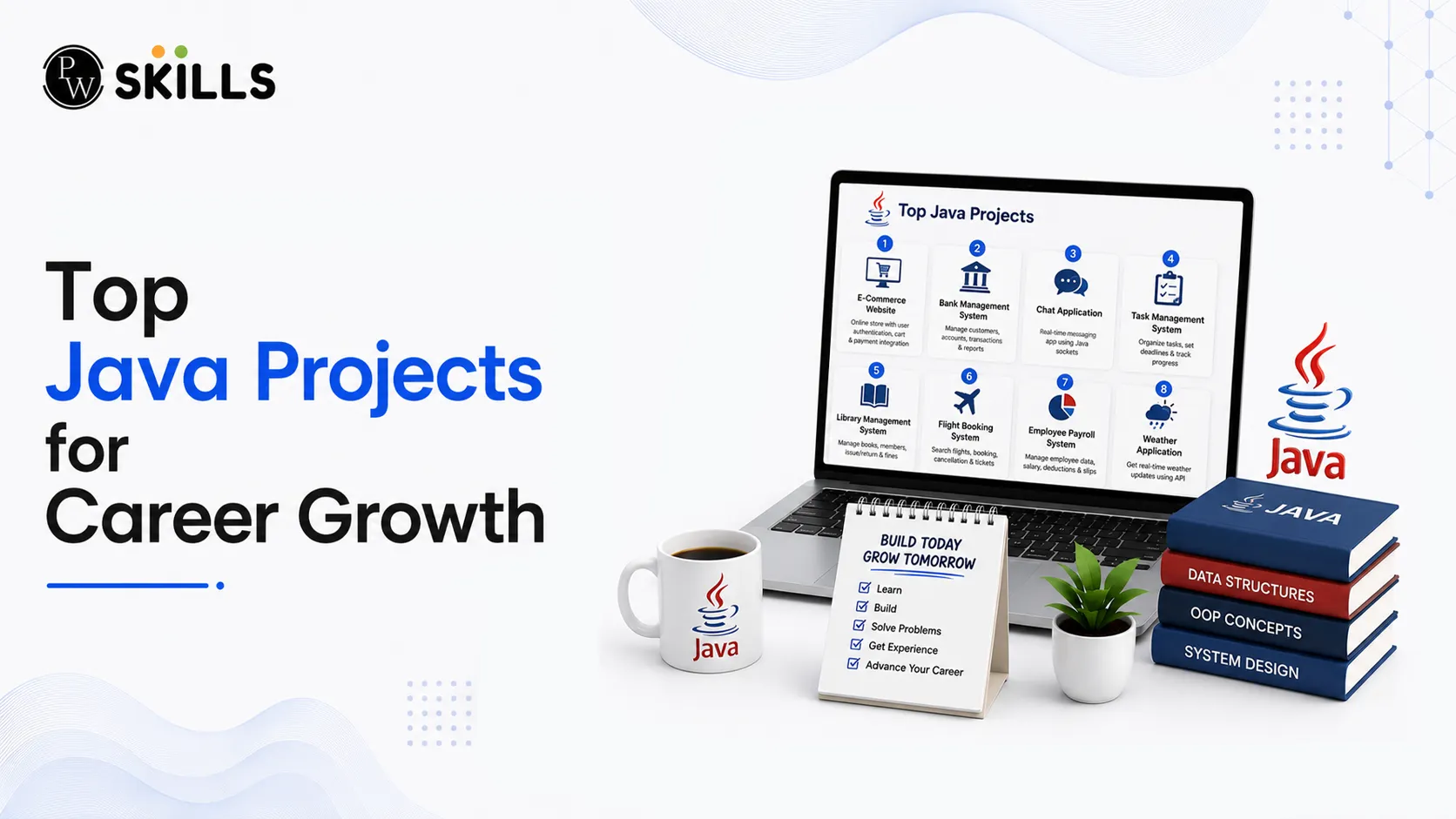
Many aspiring software engineers find it hard to translate theory of syntax into application. In this essay, we will discuss the greatest Java projects that will display your architectural knowledge, programming skills and problem solving skills. You will end up with a complete portfolio of projects that showcase your enterprise preparedness, progressing in a systematic way from simple command-line tools to highly scalable cloud structures.
Importance of Java Projects
Creating production-grade applications is an absolute necessity for modern software professionals. Employers want proof that you can structure enterprise applications, manage dependencies, and apply proper design patterns.
Building structural applications allows you to experience the full lifecycle of software production, including:
-
Dependency Management: Learning automation utilities like Maven and Gradle to handle external libraries efficiently.
-
Database Connectivity: Implementing secure data layers via JDBC or Object-Relational Mapping (ORM) frameworks like Hibernate.
-
Architectural Conventions: Separating operational concerns using industry-standard patterns like Model-View-Controller (MVC).
-
Error Management: Designing reliable exception handlers that keep systems stable during unexpected inputs.
Also Check: Java Data Types Real-Life Example
Beginner Java Projects for Foundation Building
All experienced software engineers begin with the fundamentals of input and output streams. These simple command-line interface (CLI) programs are limited to core language syntax, object-oriented architecture, and the basic collection frameworks without the added complication of graphical interfaces.
1. CLI Task Tracker
A task tracker teaches you how to handle real-time user input, manipulate collection objects, and store files locally.
-
Key Skills Learned: Core syntax, File I/O operations, JSON parsing, and standard Java Collections (Lists, Maps).
-
Implementation Strategy: Create an application that takes arguments from the terminal to add, update, delete, or list tasks. Save the output in a local file to preserve states between application restarts.
2. GitHub User Activity Tool
This tool introduces the fundamentals of web connectivity by fetching live data from public web servers.
-
Key Skills Learned: Native HTTP client handling, working with JSON responses, and API interaction.
-
Implementation Strategy: Utilize Java's integrated HTTP client to execute GET requests to the public GitHub API. Parse the returned payload to display recent user events directly inside your terminal console.
3. Expense Tracker Application
An expense tracker is excellent for practicing basic conditional logic, loops, and custom mathematical calculations.
-
Key Skills Learned: Console scanning, custom data structures, and date-time manipulation.
-
Implementation Strategy: Develop a text-driven utility where users input daily expenses categorized by type. Store data structures in memory and generate clean summary reports directly on the screen.
4. Number Guessing Game
This classic logic game reinforces your knowledge of conditional statements and random value generation.
-
Key Skills Learned: Random number generation, loops, and user input validation frameworks.
-
Implementation Strategy: Program an interactive loop that picks a random number within a specific range. Prompt the user for input and supply higher or lower hints until they successfully identify the target value.
5. Multi-Unit Converter
A multi-unit converter focuses on building clean mathematical functions and structured user navigation paths.
-
Key Skills Learned: Method creation, numeric type conversions, and terminal menu structures.
-
Implementation Strategy: Design a command menu that converts measurements like temperature, weight, or distance. Implement proper input validation to ensure the application does not crash on text inputs.
6. Personal Blog Platform
A simple blogging engine introduces the concept of structural entity tracking and text-based publishing.
-
Key Skills Learned: Object model architecture, string parsing, and structured data handling.
-
Implementation Strategy: Build an in-memory storage layout that holds individual blog posts. Allow terminal users to create articles, view lists of published entries, or read whole posts using distinct commands.
Intermediate Java Projects for Portfolio Growth
Once you have the hang of basic cli manipulation you then have to move into database integration, network routing and framework utilisation. These intermediate software development projects show your skills to handle data persistence and design usable web layers.
|
Project Name |
Primary Technology Stack |
Key Educational Value |
|
Blogging Platform API |
Spring Boot, Spring Data JPA, H2 Database |
RESTful API design, HTTP status code management, CRUD operations |
|
Todo List API |
Java Spring, PostgreSQL, Maven |
Relational database configuration, validation layers, exception handling |
|
Expense Tracker API |
Spring Boot, Hibernate, MySQL |
Financial logic processing, query optimization, structural entity relations |
|
Weather API Service |
Java HTTP Client, Third-Party API, Jackson |
External integration, payload transformations, asynchronous requests |
|
Caching Proxy Server |
Java Sockets, Memory Maps, Concurrency |
Network socket programming, basic caching logic, multi-thread mechanics |
|
Markdown Note-Taking App |
Spring MVC, Thymeleaf, Flexmark |
UI-to-backend integration, text formatting libraries, local state control |
|
URL Shortening Service |
Spring Boot, Redis, Base62 Encoding |
Hashing algorithms, high-performance key-value lookups, redirect routing |
|
Broadcast Messaging Server |
Java ServerSockets, Thread Pools, IO Streams |
Concurrent network architecture, client state management, system broadcasting |
-
Blogging Platform API: Move your beginner blog concept into a proper web service. By building a RESTful API with Spring Boot, you learn how to expose endpoints that web apps can communicate with. You will gain experience handling GET, POST, PUT, and DELETE requests while mapping database tables using Spring Data JPA.
-
URL Shortening Service: This is a fantastic addition to your Java portfolio projects. It teaches you how to map a long web address into a shortened hash string. You will configure Redis to manage fast lookups and handle standard HTTP 302 redirect responses, which are vital architectural skills for modern web development.
-
Caching Proxy Server: This project fills the gap between web frameworks and system level processes. Write a terminal app that will intercept client traffic and cache web responses, and you will get a deep dive into typical HTTP headers, proxy logic, and raw network input/output streams.
Also Check: Core Java Language – Is Core Java Easy To Learn
Advanced Java Projects for Career Growth
Enterprise level recruiting demands knowledge of distributed infrastructures, high concurrency patterns and async messaging setups. These new innovative solutions are the latest additions to your portfolio.
1. Movie Ticket Reservation System
Managing concurrent seat choices prevents two people from buying the same ticket at the exact same moment.
-
Key Tech Stack: Spring Boot, Spring Security, Hibernate, MySQL, optimistic locking.
-
Why It Matters: This project proves you can manage database transactions safely under heavy traffic, handle concurrent database writes, and implement clean security validation checks.
2. Real-Time Leaderboard Engine
A leaderboard requires immediate scoring calculations and instant data distribution for live gaming setups.
-
Key Tech Stack: Spring Boot WebFlux, Redis Sorted Sets, WebSocket protocol.
-
Why It Matters: It shows you can build event-driven setups, handle real-time bidirectional web traffic, and process fast data entries using reactive programming styles.
3. Automated Database Backup Utility
This tool automates system administration tasks by taking snapshots of running databases and placing them into safe locations.
-
Key Tech Stack: Core Java, ProcessBuilder API, Cron scheduling, AWS SDK.
-
Why It Matters: This project proves your system-level understanding. You learn to handle runtime OS processes, automate file execution tasks, and upload structured data safely into cloud platforms like Amazon S3.
4. Distributed Microservices E-Commerce Platform
A large retail system uses independent microservices to process orders, manage inventories, and handle checkout payments separately.
-
Key Tech Stack: Spring Cloud, Netflix Eureka, Spring Cloud Gateway, Apache Kafka, Docker.
-
Why It Matters: This is the ideal showpiece for your portfolio work. It shows that you can find services, decouple microservices with Kafka message queues and bundle your code into Docker containers.



FAQs
1. Why is the study of DSA for Java Developers crucial for enterprise software?
2. Can I clear modern tech interviews by just knowing basic Java syntax?
3. How do these concepts enhance my day-to-day problem-solving skills?
4. Which built-in tools should a developer use when applying DSA for Java Developers?
5. What is the most effective study strategy for mastering these concepts?





Get Free Counselling Today
and Clear up all your Doubts
 Live & recorded classes available at easeDashboard for progress trackingLakhs of practice questions

