
Common Java Interview Questions Explained
 Hardik Gupta10 Jul, 2026
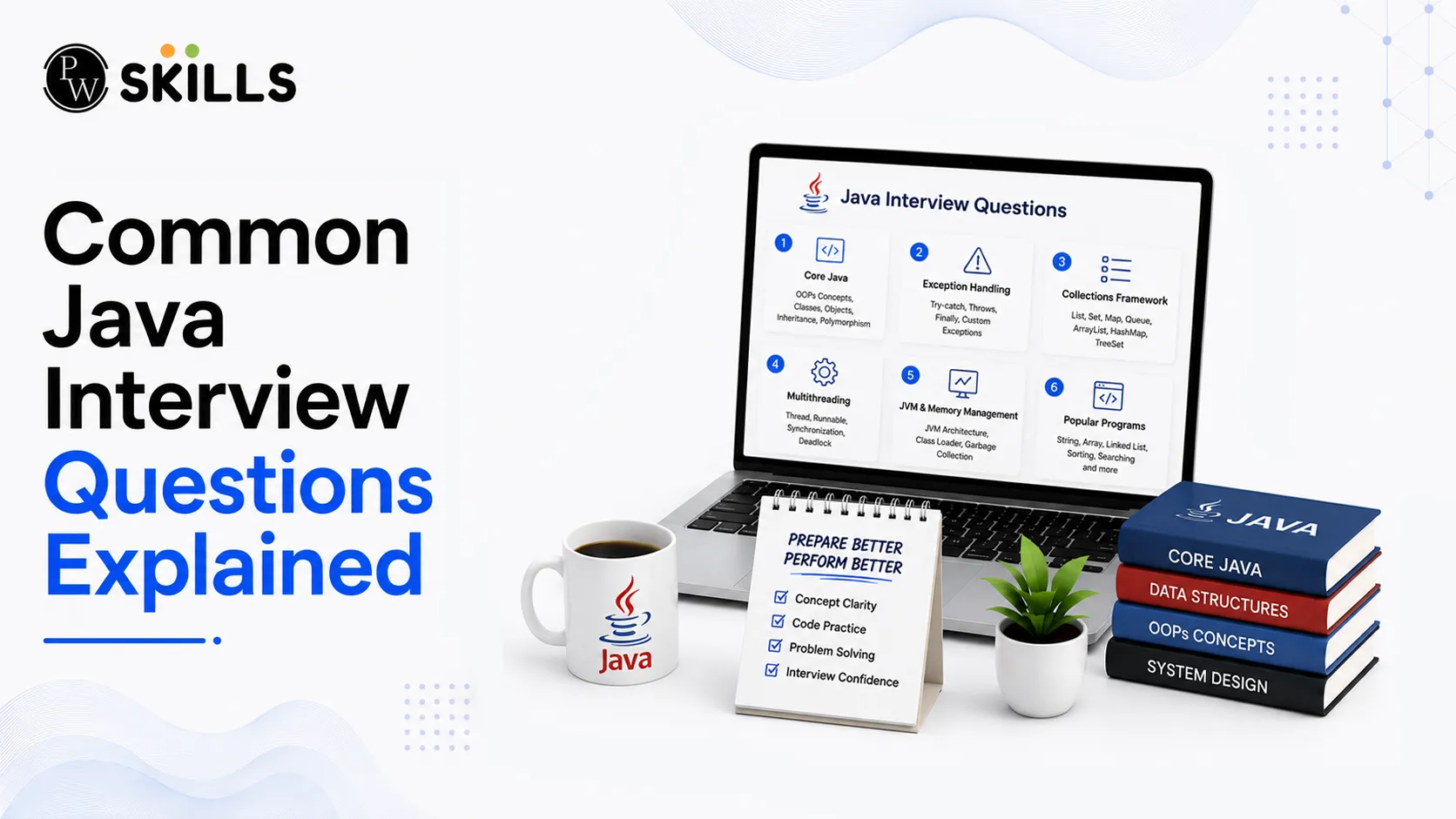
Preparing for a Java Interview Questions can feel overwhelming when balancing language fundamentals, memory layouts, and data structure implementations. Many candidates struggle to explain complex architectural concepts under pressure, costing them their dream roles. This article simplifies essential concepts to strengthen your technical interview preparation and give you the confidence to excel.
Important Java Interview Questions
Understanding how the platform executes code is a fundamental requirement during any interview. Interviewers frequently include Java coding questions to test your knowledge of runtime environments, platform independence, and code execution.
Why is Java considered platform-independent?
The language was designed to remain independent of any specific hardware or software configuration.
-
The compiler (javac) compiles source code into intermediate bytecode (a .class file).
-
This bytecode is not directly executable by physical processors.
-
Instead, the Java Virtual Machine (JVM) interprets or compiles this bytecode at runtime into native machine code.
-
While the JVM software itself is platform-dependent, the bytecode remains identical across all systems.
What is the exact purpose of the JIT compiler?
The Just-In-Time (JIT) compiler is a core component of the JVM designed to optimize runtime efficiency.
-
It monitors code execution paths and identifies "hot spots" that run frequently.
-
It translates these bytecode segments directly into native machine instructions.
-
This avoids repeated interpretation of the same instructions, drastically boosting application speed.
How do JDK, JRE, and JVM differ?
Understanding the boundaries of the runtime ecosystem is essential for structural clarity:
|
Component |
Description |
Included Features |
|
JVM |
Java Virtual Machine |
Interprets bytecode, handles memory, and executes software. |
|
Java Runtime Environment |
Contains the JVM and the standard runtime libraries needed to run code. |
|
|
JDK |
Java Development Kit |
Full toolkit including the JRE and development tools like compilers and debuggers. |
What is a ClassLoader and what are its duties?
A ClassLoader is a structural sub-component of the JVM responsible for dynamically loading class files into memory during application runtime. Its execution flow includes three distinct stages:
-
Loading: It reads the raw bytecode (.class file) from storage locations, network streams, or target paths.
-
Linking: It performs strict verification checks on the bytecode to ensure safety, allocates memory for static fields, and resolves symbolic references.
-
Initialization: It executes static initializer blocks and assigns initial values to static variables.
Why is Java not considered a 100% pure OOP language?
A completely pure object-oriented language handles every single item of data as an object. Java does not meet this requirement because it retains eight built-in primitive data types:
-
byte
-
short
-
int
-
long
-
float
-
double
-
char
-
boolean
These primitive types are stored directly on the stack for efficiency rather than as objects, which keeps the language from being classified as a pure OOP language.
How do overloading and overriding differ?
Polymorphism questions are a staple of any Java developer interview. The key distinctions include:
|
Feature |
Method Overloading |
Method Overriding |
|
Definition |
Multiple methods sharing a name but having different parameter signatures within a class. |
Redefining a parent class method inside a subclass with the exact same signature. |
|
Binding Time |
Resolved at compile-time (Static polymorphism). |
Resolved at runtime based on the actual object type (Dynamic polymorphism). |
|
Class Scope |
Happens within the single class boundaries. |
Requires an inheritance relationship between at least two classes. |
What is the distinction between Aggregation and Composition?
Both design strategies define relationships between objects, but their lifecycles behave differently:
-
Aggregation: Represents a loose, independent relationship where child objects can exist outside the parent. For example, a department contains professors, but professors can exist independently if the department closes.
-
Composition: Establishes a highly dependent relationship where child objects cannot exist without the parent. For instance, a human body contains a heart; the heart cannot survive or function independently outside the body.
How does Java separate Stack and Heap allocations?
The runtime environment segregates memory areas depending on the data type and architectural role:
-
Stack Memory: A fixed allocation assigned to individual execution threads. It stores local variables, primitive variables, and references to objects using a Last-In, First-Out (LIFO) model.
-
Heap Memory: A shared, dynamic memory space used to store actual objects and arrays created during application runtime.
When you instantiate an array or object, the actual data is allocated in the heap, while the reference address pointing to that heap location is stored in the stack.
How do shallow copying and deep copying differ?
Object cloning approaches change how nested references are duplicated:
-
Shallow Copy: Copies only the top-level structure of the target object. Any nested references inside point back to the original objects, meaning changes to a nested object will impact both copies.
-
Deep Copy: Creates a completely independent duplicate of the object along with all its nested child objects, ensuring changes to the new object do not affect the original.
How do Collection and Collections differ?
-
Collection: A root-level interface in the java.util package that sets up a standard structure for groups of objects like List, Set, and Queue.
-
Collections: A utility class that contains static helper methods to operate on, sort, or synchronize collections.
What are the differences between an ArrayList and a Vector?
Both classes implement the List interface, but they have distinct performance traits:
-
Synchronization: Vector is synchronized and thread-safe, meaning multiple threads can access it safely. ArrayList is not synchronized or thread-safe by default.
-
Performance: ArrayList is faster because it does not have the overhead of synchronization locks.
-
Growth Rate: When full, an ArrayList increases its capacity by 50% of its current size, whereas a Vector doubles its capacity by default.
How do List, Set, and Map compare?
Choosing the right data structure is a common topic in a Java developer interview:
|
Attribute |
List |
Set |
Map |
|
Duplicates |
Allowed |
Not Allowed |
Unique Keys required (Values can repeat) |
|
Insertion Order |
Maintained |
Depends on implementation (e.g., HashSet does not maintain order) |
Depends on implementation (e.g., HashMap does not maintain order) |
|
Data Format |
Single elements |
Single elements |
Key-Value pairs |
How does the String Constant Pool manage memory?
The String Constant Pool is a dedicated memory space within the heap designed to optimize memory usage:
-
When you create a string literal, the JVM checks the pool first.
-
If the sequence already exists, the JVM returns the existing reference.
-
If it is not found, a new string object is created and added to the pool.
-
Using the new operator bypasses this optimization, forcing the JVM to create a brand new object in the general heap memory area.
Why is String designed to be immutable?
Making strings immutable offers several clear advantages:
-
Security: Prevents unauthorized modifications to sensitive data like database connection strings or network paths.
-
Thread Safety: Multiple threads can share the same string instance without needing synchronization locks.
-
Caching: Allows the pool to share instances safely, lowering the overall memory footprint of the applicati
Understanding Java Interview Questions requires a solid understanding of core concepts such as the JVM, memory management, object-oriented programming, collections, and string handling. Regular practice with conceptual and coding-based questions helps strengthen problem-solving skills and technical confidence. Reviewing these commonly asked Interview Questions can improve your interview performance and prepare you for both fresher and experienced developer roles.



FAQs
1. Why does the main method need to be declared static?
2. Can we overload the main method?
3. What happens if a local variable is not initialized?
4. How does a HashSet find and block duplicate entries?
5. In what scenarios will a finally block fail to execute?





Get Free Counselling Today
and Clear up all your Doubts
 Live & recorded classes available at easeDashboard for progress trackingLakhs of practice questions

