

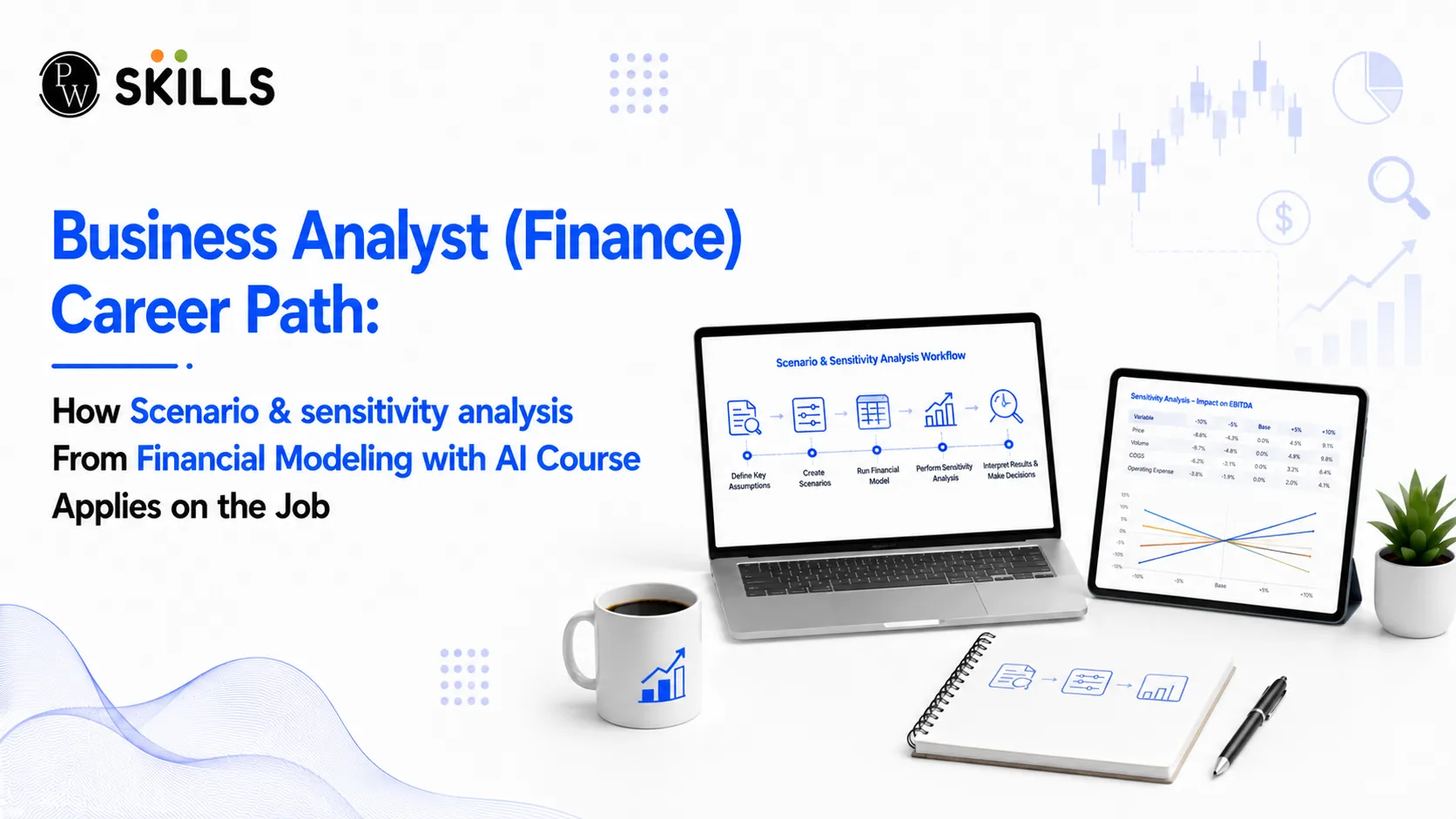
How Scenario & sensitivity analysis From Financial Modeling with AI Course Applies on the Job
 Hardik Gupta30 Jul, 2026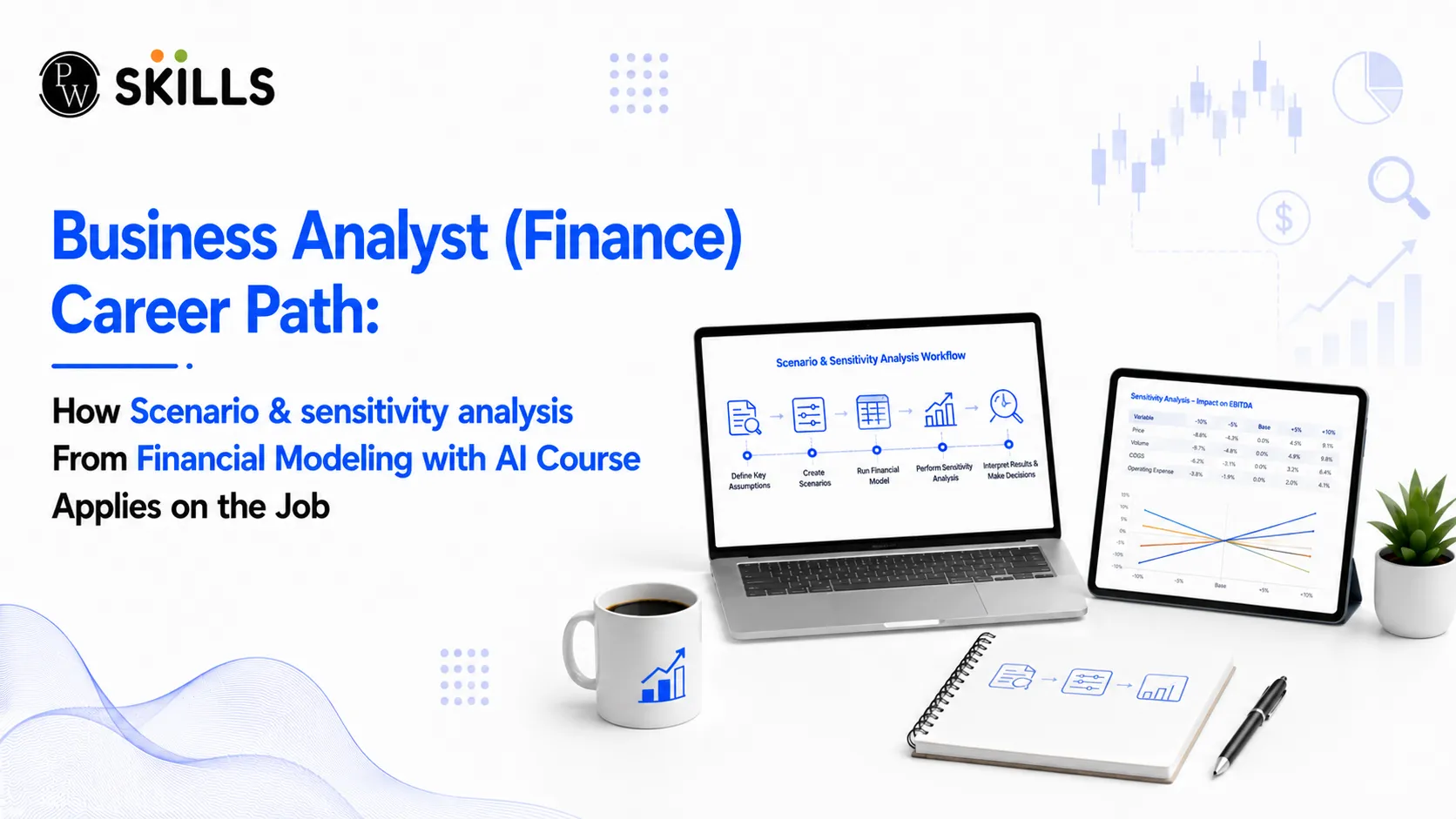
Today's business managers want analysts who can model unpredictable markets, stress-test growth strategies, and deliver clear risk assessments without spending weeks building manual worksheets.
Enrolling in a targeted Financial Modeling with AI Course solves this exact gap by teaching you how to combine traditional valuation principles with predictive automation.
By mastering automated scenario and sensitivity analysis, you build the core technical capability needed to evaluate corporate risk and support critical investment decisions from day one.
Overview of Financial Modeling with AI Course
A structured Financial Modeling with AI Course delivers comprehensive training in constructing dynamic financial frameworks, automating data collection, and deploying machine learning logic to forecast corporate performance.
Static spreadsheet models are no longer sufficient in fast-moving industries. Modern financial analysts use intelligent platforms that instantly adapt to market shifts, operational disruptions, and changing economic inputs.
-
Integrated Three-Statement Forecasting: Automatically linking income statements, balance sheets, and cash flow projections.
-
Predictive Data Analytics: Applying machine learning scripts to forecast sales cycles and operational costs accurately.
-
Multi-Variable Scenario Planning: Creating automated dynamic switches to model best-case, base-case, and worst-case outcomes.
-
Single-Variable Sensitivity Testing: Isolating specific financial drivers to test their direct impact on profit margins and valuations.
-
Automated Executive Summaries: Using standard prompt frameworks to turn complex financial data into concise management reports.
Through practical assignments, learners move beyond simple spreadsheet maintenance and learn to build automated financial systems capable of answering complex corporate questions.
Why Is Financial Modeling with AI Course Important for Business Analysts?
Modern corporate decisions depend on objective data rather than intuitive guesswork. A survey reveals that 62% of Indian workers expect their job skill requirements to change significantly over the next five years, while 51% view AI as a primary tool to boost productivity at work.
This rapid transformation makes practical technical training essential for anyone aiming to secure a financial analyst role.
|
Key Area |
Traditional Financial Modeling |
AI-Enhanced Financial Modeling |
|
Data Ingestion |
Manual data entry and formula updates |
Automated data feeds with instant error checks |
|
Risk Testing |
Manual calculation tables limited to few variables |
Automated stress-testing across hundreds of parallel outcomes |
|
Turnaround Time |
Days required to update and verify complex models |
Minutes required to run updated assumptions |
|
Strategic Focus |
Historical trend extrapolation |
Predictive analytics combined with real-time risk checks |
Landing competitive positions requires proving your ability to handle real corporate challenges. Combining a Financial Modeling with AI Course + Business Analyst (Finance) Jobs preparation plan equips candidates to deliver rapid, data-backed insights during case study interviews and practical tests.
What is Scenario and Sensitivity Analysis in Financial Modeling with AI Course?
Evaluating financial risk requires understanding how internal operational changes and external economic shifts affect a company's bottom line. The two primary analytical techniques used to model uncertainty are scenario analysis and sensitivity analysis.
-
Scenario Analysis changes multiple operational variables together to simulate a specific future state (such as rising inflation alongside supply chain delays).
-
Sensitivity Analysis changes one variable at a time while keeping all other inputs constant to measure its exact mathematical impact on key performance metrics like Net Present Value (NPV).
Operational Focus Matrix
-
Scenario Planning: Evaluates broad strategic outcomes. For example, testing how a simultaneous 15% fall in sales and a 5% increase in production costs affects overall corporate liquidity.
-
Sensitivity Testing: Pinpoints high-risk variables. For example, calculating the exact drop in profit margin caused by a 1% increase in raw material costs.
On-the-Job Applications
-
Determining Profit Baselines: Finding the exact sales volume needed to maintain profitability during market downturns.
-
Capital Budget Evaluation: Stress-testing proposed equipment purchases against interest rate changes before presenting to the board.
-
Acquisition Modeling: Simulating combined revenue savings under various market growth conditions during corporate mergers.
Completing a Financial Modeling with AI Course + How-to analytical module ensures you know how to execute these stress tests using automated tools, saving hours of manual calculation work.
How Financial Modeling with AI Course Improves Business Decision-Making?
Executive teams rely on clear financial models to allocate capital efficiently. An automated model converts complex market data into practical business strategies, reducing financial risk while highlighting profitable opportunities.
Automated financial models improve strategic decision-making through several clear channels:
-
Proactive Risk Management: Identifies potential losses early, enabling management to adjust pricing or secure credit lines before cash flow shortages occur.
-
Optimised Capital Allocation: Identifies which business divisions offer the highest risk-adjusted returns on investment.
-
Real-Time Meeting Adjustments: Allows analysts to update key model assumptions live during executive meetings and show updated financial results instantly.
-
Clear Stakeholder Communication: Mastering a Financial Modeling with AI Course + Report writing framework helps analysts present complex quantitative outputs as simple, actionable memos for executive leadership.
Study Strategy Plan for Financial Modeling with AI Course
Mastering advanced financial modeling requires a structured, step-by-step approach. Balancing core accounting concepts with hands-on practical exercises helps build technical accuracy and speed.
Phase 1: Core Accounting and Spreadsheets (Weeks 1-2)
Review fundamental accounting principles. Ensure you can link income statements, balance sheets, and cash flow statements manually before applying automated tools.
Phase 2: Manual Model Construction (Weeks 3-4)
Build 3-statement models from scratch using standard spreadsheet software. Practice setting up dynamic assumption tables, calculating discounted cash flows, and linking basic sensitivity formulas manually.
Phase 3: Automated Workflow Integration (Weeks 5-6)
Incorporate automated data tools and predictive scripts. Learn to run automated trend forecasts, perform multi-variable stress tests, and set up automated formula auditing routines.
Phase 4: Applied Case Studies and Reporting (Weeks 7-8)
Work through real-world business scenarios. Take raw financial data, construct an automated dynamic model, execute multi-variable scenario tests, and write a clear one-page executive memo summarizing your findings.
Tips for Building a Career in Financial Modeling with AI Course
Earning a course certificate is just the start of building a successful financial career. To attract top employers, candidates must actively apply their technical skill set to real-world financial problems.
-
Build a Portfolio: Publish three to four completed financial models (such as an M&A valuation model or a SaaS revenue forecast) in a public portfolio.
-
Refine Executive Communication: Practice summarizing complex technical findings into concise, two-minute verbal updates suitable for senior leaders.
-
Follow Tool Developments: Stay current with updates in financial software, spreadsheet add-ins, and data analysis platforms.
-
Analyze Live Company Filings: Select publicly traded companies, study their quarterly reports, and build independent forecast models to test your assumptions against actual performance.
Common Mistakes to Avoid in Financial Modeling with AI Course
When learning modern financial modeling, students often run into technical mistakes that lower model accuracy and credibility.
Watch out for these common errors during model development:
-
Skipping Logic Audits: Accepting automated predictions without verifying the underlying accounting links and assumptions.
-
Ignoring Downside Risks: Failing to stress-test financial models against severe market downturns or unexpected cost spikes.
-
Circular Logic Errors: Creating broken formula chains that cause calculation errors during automated updates.
-
Unstructured Worksheets: Presenting messy workbooks without clear visual structure, standardized formatting, or clear color-coding.
-
Incomplete Assumption Notes: Leaving models without explanatory notes detailing data sources, formula logic, and underlying assumptions.





FAQs
What will I learn in a Financial Modeling with AI Course?
How does scenario analysis differ from sensitivity analysis?
Do I need a coding background to start financial modeling with AI?
Why do employers look for financial modeling skills with AI experience?
What career roles can I apply for after finishing this course?







Get Free Counselling Today
and Clear up all your Doubts
 Live & recorded classes available at easeDashboard for progress trackingLakhs of practice questions

