

Why Does DevOps Recommend Shift-Left Testing Principles? Benefits, Process and Examples
 Hardik Gupta1 Oct, 2026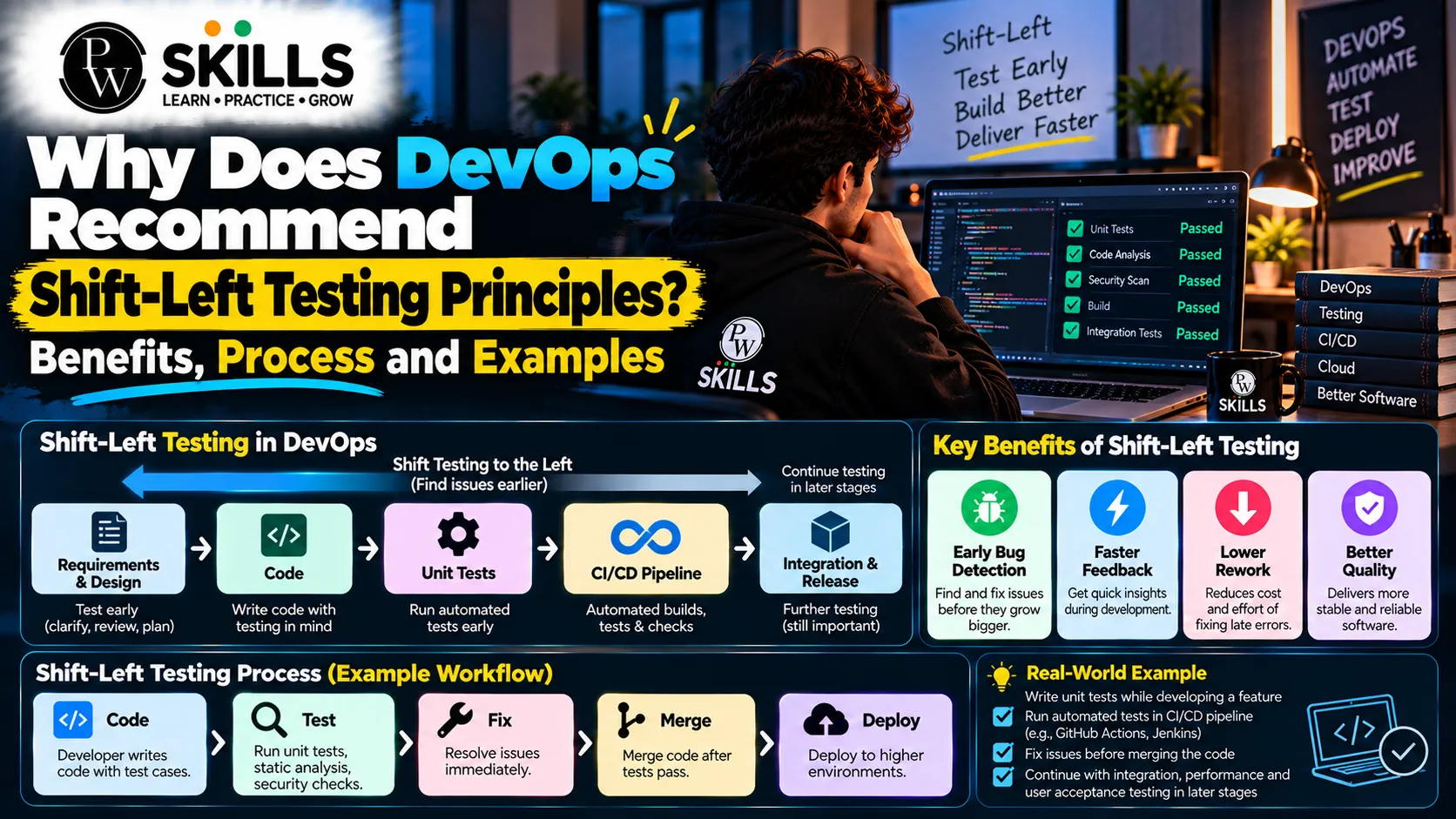
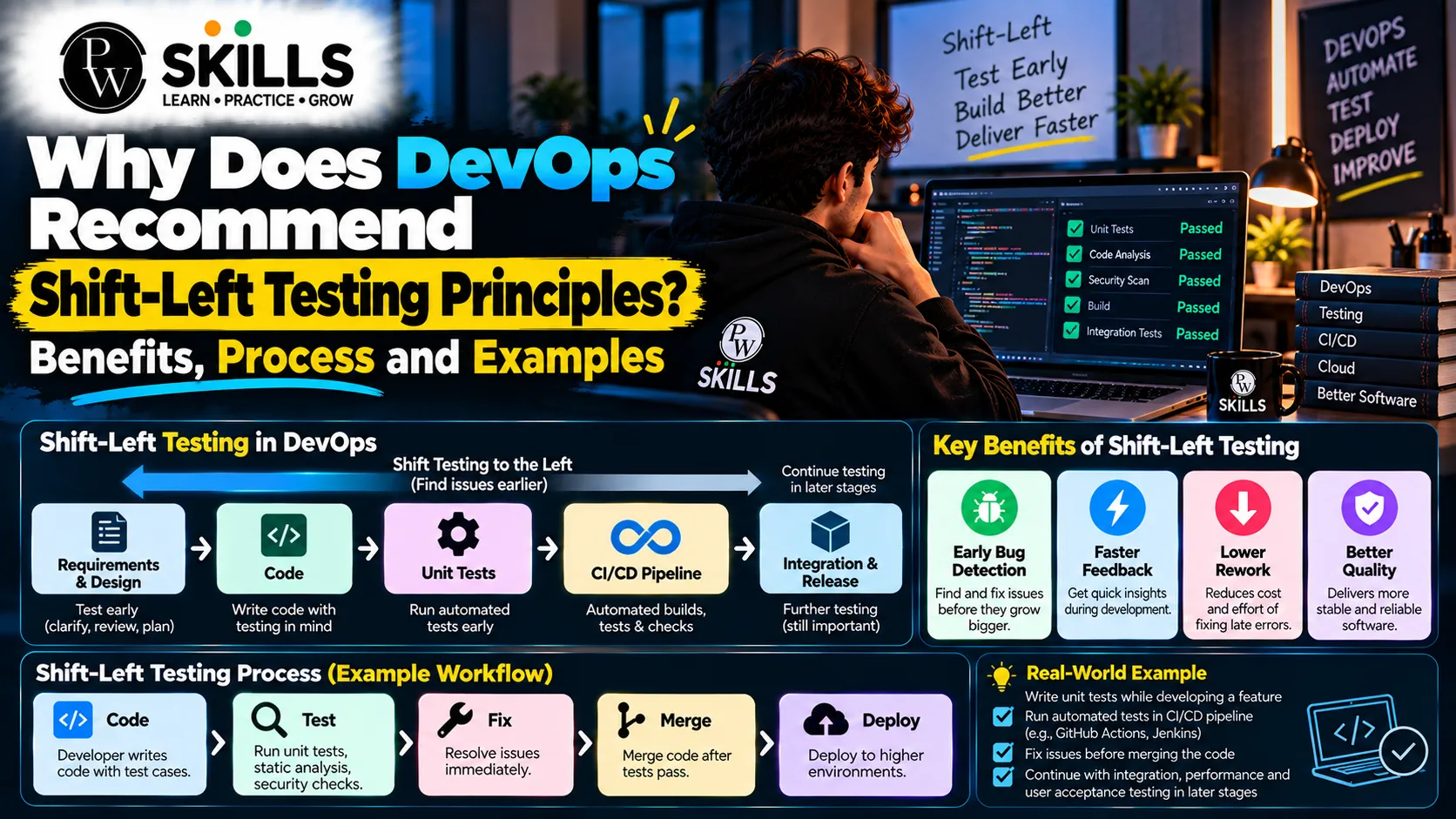
Modern software teams need to release updates quickly while maintaining application quality and security. Software testing in DevOps helps make testing a regular part of development rather than a final step.
Understanding why does devops recommend shift-left testing principles can help learners see how early testing, automation, continuous integration, and security checks can reduce problems before deployment.
Overview of DevOps Recommend Shift-Left Testing
One major reason for using shift-left testing is early bug detection. A defect found during coding is usually easier to understand and fix than a defect discovered after deployment. Early testing also prevents small problems from moving into later stages of development.
Teams can review requirements, check designs, perform unit testing, and run security checks before the application reaches full system testing. Developers can also create automated tests along with new features.
This approach makes quality a shared responsibility. Developers, testers, and operations teams can discuss possible problems earlier and work toward the same quality goals.
-
Early Risk Detection: Problems can be found while requirements, design, or code are still being changed.
-
Lower Rework: Developers can fix many issues without waiting for a later testing stage.
-
Better Teamwork: Developers, testers, and operations teams get more opportunities to work together.
-
Faster Feedback: Automated checks can tell developers about errors soon after code changes are made.
Also Explore our Course : DevOps and Cloud Computing Course
Why Does DevOps Recommend Shift-Left Testing Principles to Accelerate Continuous Testing?
Another important reason why DevOps recommends shift-left testing principles is the need for continuous testing. DevOps teams often make frequent code changes, so testing cannot depend only on a final testing phase.
With continuous testing, automated checks can run at different points in the development pipeline. Unit tests may run when code is committed, while integration, security, and other tests can run during later pipeline stages.
For example, a developer may push a code change to a repository. The CI pipeline can automatically build the application and run unit tests. If a test fails, the team can investigate the problem before the change moves further through the pipeline.
-
Automated Feedback: Developers can quickly see whether a code change has caused a problem.
-
Faster Development: Smaller tests can run regularly instead of waiting for one large testing phase.
-
Consistent Checks: Automated tests provide the same checks each time they run.
-
Safer Releases: Problems can be identified before an application is moved toward production.
Why Does DevOps Recommend Shift-Left Testing Principles for Core Shift-Left Testing Benefits?
The main shift-left testing benefits are connected to quality, teamwork, and development efficiency. When testing starts earlier, teams have more time to understand and correct problems before they become release issues.
Early testing can also help teams reduce the amount of technical debt created by repeated defects. When developers receive feedback while working on a feature, they can correct the problem before building more code on top of it.
However, shift-left testing does not mean that production or end-to-end testing is no longer required. Different types of testing are still useful at different stages of the software lifecycle.
-
Better Code Quality: Regular checks help developers identify coding and logic problems early.
-
Improved Reliability: Finding defects before release can reduce some production issues.
-
Less Rework: Teams may spend less time fixing problems that have already moved into later stages.
-
Better Use of Time: Automation can handle many repetitive checks and give teams faster feedback.
-
Stronger Security: Security testing can begin during development rather than being left until the final review.
Why Does DevOps Recommend Shift-Left Testing Principles Through Structured Implementation?
Implementing shift-left testing requires more than simply adding automated tests. Teams need to decide what should be tested, when testing should happen, and which tools should run automatically.
The process can begin during the requirements stage. Developers and testers can review user stories and acceptance criteria to identify unclear requirements. During coding, developers can create unit tests for individual functions or components.
When the code enters a version control system, CI tools can automatically start builds and tests. Additional checks can be added as the code moves through the pipeline.
A practical implementation can include:
-
Requirement Validation: Review requirements early and identify unclear or incomplete acceptance criteria.
-
Code-Level Testing: Use unit tests to check individual functions, classes, or modules.
-
Static Analysis: Check source code for coding problems and possible security issues.
-
Integration Testing: Verify that different application components work correctly together.
-
CI/CD Integration: Add automated checks to continuous integration and delivery pipelines.
-
Security Testing: Run suitable security checks before applications move toward production.
Test-driven development can also support this approach in teams that choose to use it. In TDD, developers write tests before or alongside the implementation of a feature.
Why Does DevOps Recommend Shift-Left Testing Principles Using Real-World Examples?
Real-world development environments provide many situations where early testing can be useful. Consider a team using infrastructure as code to manage cloud resources. A configuration mistake in an infrastructure file could create deployment problems if it is discovered only after the infrastructure is created.
The team can use automated validation and linting tools before deployment. This allows many syntax and configuration problems to be detected earlier.
Security is another example. Static application security testing can examine source code for certain types of security weaknesses before the application is packaged and deployed. Container images can also be scanned for known vulnerabilities before they are used in a deployment.
Microservices teams can test individual services before connecting the entire application. This can make it easier to identify which component is causing a failure.
-
Infrastructure Linting: Checks infrastructure configuration files before deployment.
-
Static Security Testing: Looks for certain security issues in source code at an early stage.
-
Container Scanning: Checks container images for known vulnerabilities before deployment.
-
Service Testing: Tests individual services before they are combined into a larger application.
-
API Testing: Checks whether APIs return the expected results before dependent services are released.
These examples show that shift-left testing can be used across application development, cloud infrastructure, security, and deployment workflows.




FAQs
What is the reason why DevOps recommends shift-left testing principles in modern software development?
How does shift-left testing improve continuous testing workflows?
Why are shift-left testing benefits crucial for engineering teams?
What role does software testing in DevOps play in cloud deployments?
How can beginners master DevOps testing and automation practices?






Get Free Counselling Today
and Clear up all your Doubts
 Live & recorded classes available at easeDashboard for progress trackingLakhs of practice questions

