

DevOps Future Scope in 2026: Career Opportunities, Skills, Salary Trends and Industry Demand
 Hardik Gupta3 Oct, 2026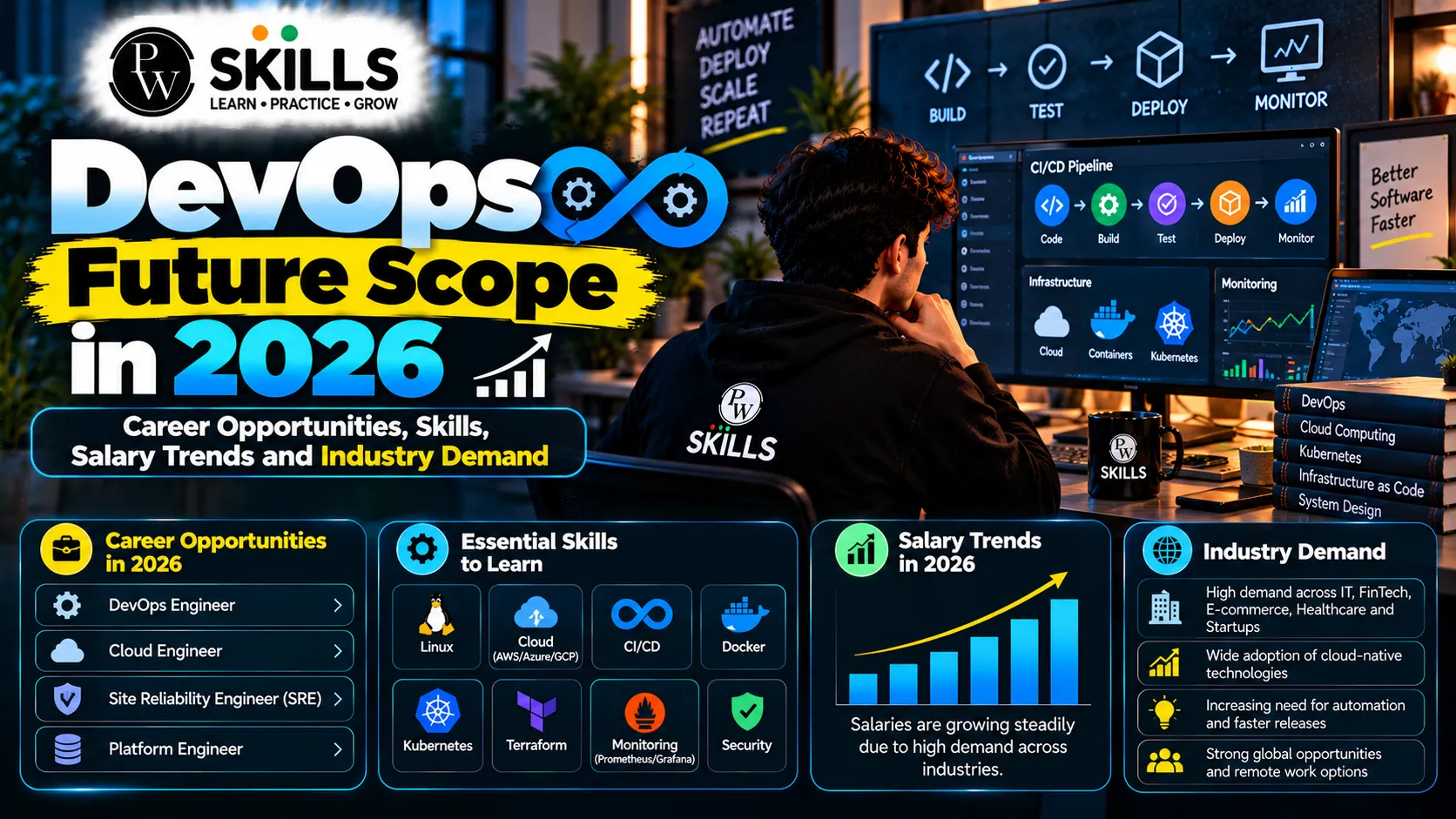
Modern software teams need to release applications quickly while keeping them stable and secure. Traditional IT processes often separated development and operations teams, which could make software releases slower. DevOps brings these areas closer through automation, continuous integration, monitoring, and shared processes.
Understanding the DevOps future scope can help students and working professionals see how the field is changing. It also helps them understand which skills are useful, what career roles are available, and how salary can vary with experience, skills, location, and job responsibilities.
What Is the DevOps Future Scope and Market Demand?
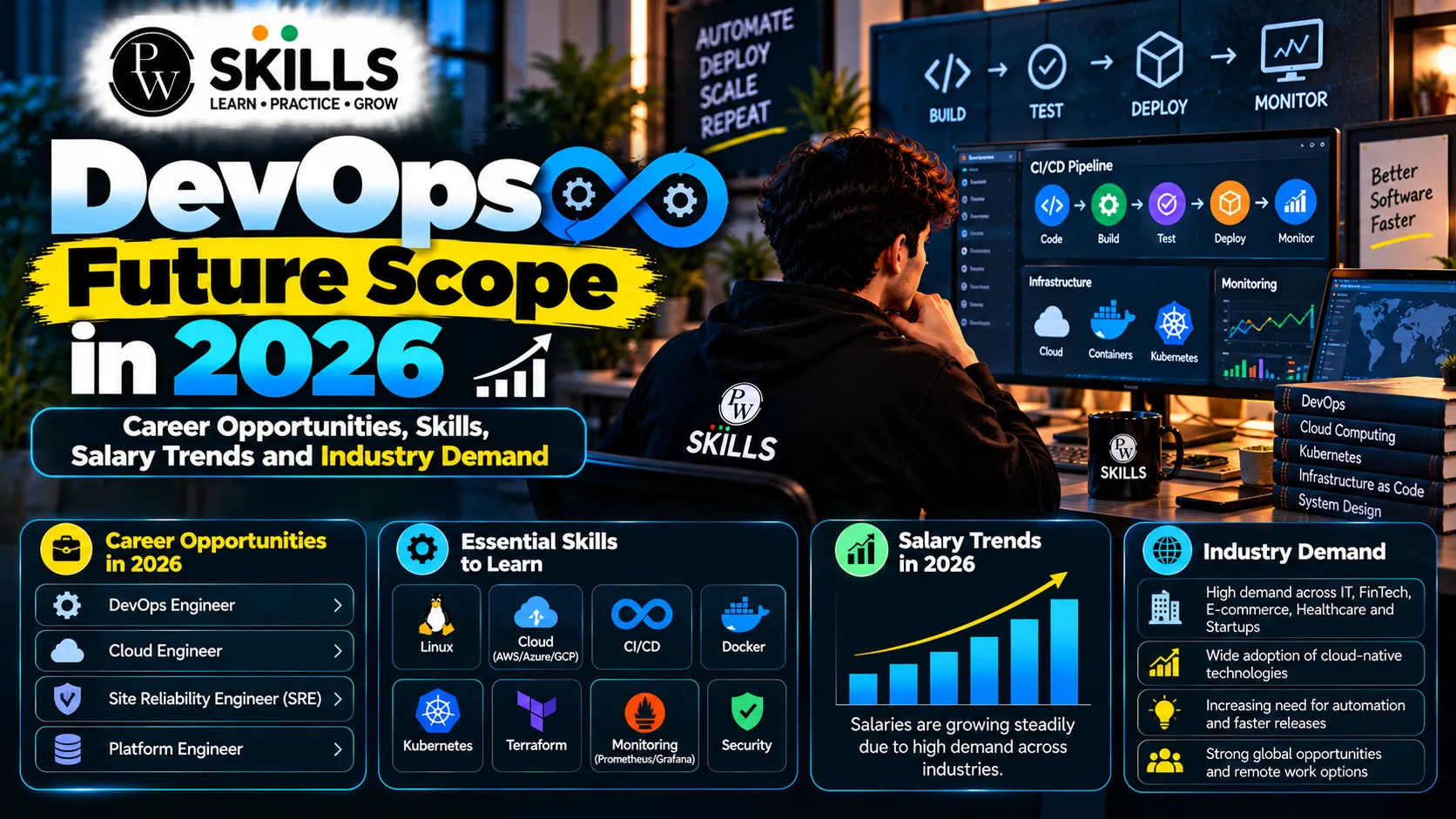
The DevOps future career scope is closely connected with the growing use of cloud services, automation, and modern software development practices. Businesses that release software frequently need reliable ways to build, test, deploy, and monitor applications.
DevOps helps teams automate many repeated tasks. For example, a CI/CD pipeline can automatically build an application, run tests, and prepare it for deployment after code changes. Monitoring tools can also help teams identify system issues and respond to them.
The demand for DevOps skills can differ by industry, company size, location, and technology stack. Professionals who understand both development and infrastructure can work across several areas of technology.
-
Faster Software Delivery: CI/CD practices can help teams release application updates in smaller and more regular steps.
-
Better System Monitoring: Logging and monitoring tools help teams track application and infrastructure performance.
-
Cloud Resource Management: DevOps practices can help teams manage cloud resources and automate infrastructure tasks.
-
Process Automation: Repeated manual tasks can be replaced with scripts and automated workflows.
Understanding these changes can help learners choose relevant skills instead of trying to learn every DevOps tool available.
What Is the DevOps Future Scope in Modern Technology?
The future of DevOps is closely connected with cloud-native applications, containers, microservices, Infrastructure as Code, and security automation. Modern applications may contain many separate services, making manual configuration difficult to manage at scale.
Infrastructure as Code allows teams to define infrastructure through configuration files. Instead of manually creating every environment, engineers can use tools such as Terraform to create repeatable infrastructure setups.
Containers are another important part of modern application development. Docker can package applications and their dependencies, while Kubernetes can help manage containerized workloads across clusters.
Security is also becoming an important part of DevOps workflows. DevSecOps brings security checks into development and delivery processes instead of treating security as a separate final-stage activity.
-
Infrastructure as Code: Tools such as Terraform can help teams create repeatable infrastructure configurations.
-
Containerization: Docker helps package applications and their required components in a consistent environment.
-
Container Orchestration: Kubernetes helps teams manage and scale containerized applications.
-
Security Automation: Security checks can be added to development and deployment pipelines.
-
Cloud-Native Development: DevOps teams increasingly work with cloud services, microservices, and automated infrastructure.
These technologies do not remove the need for basic IT knowledge. Linux, networking, scripting, and troubleshooting remain useful foundations for many DevOps roles.
What Career Opportunities Are Part of the DevOps Future Scope?
The growth of cloud services and software-based businesses has created different DevOps career opportunities. DevOps skills can be useful in industries such as banking, healthcare, e-commerce, telecom, education, and enterprise software.
The exact responsibilities depend on the company. Some roles focus more on cloud infrastructure, while others focus on automation, reliability, security, or deployment pipelines.
Common career paths include:
-
Cloud Engineer: Works with cloud platforms to deploy, manage, and maintain infrastructure and services.
-
Site Reliability Engineer: Focuses on application reliability, monitoring, automation, and system performance.
-
DevOps Engineer: Builds and manages development and deployment workflows, automation, and infrastructure processes.
-
Automation Engineer: Uses scripts and automation tools to reduce repetitive manual work.
-
Platform Engineer: Helps create internal platforms and tools that make it easier for development teams to build and deploy applications.
Practical experience is important for these roles. Learners can build projects around CI/CD pipelines, cloud deployment, Docker, Kubernetes, monitoring, and Infrastructure as Code to understand how the tools work together.
Which Skills Are Needed for the DevOps Future Scope?
Getting started with DevOps jobs requires more than knowing the names of popular tools. Professionals need a mix of system knowledge, programming or scripting skills, cloud concepts, and problem-solving ability.
Linux is an important foundation because many servers and cloud environments use Linux-based systems. Basic networking knowledge is also useful for understanding DNS, HTTP, IP addresses, ports, and connectivity problems.
Version control is another key skill. Git allows developers and DevOps teams to track changes and work together on code and configuration files.
-
Linux: Learn commands, files, permissions, processes, services, and basic troubleshooting.
-
Scripting: Python or Bash can be used to automate common tasks.
-
Git: Understand repositories, branches, commits, merges, and pull requests.
-
CI/CD: Learn how automated build, test, and deployment pipelines work.
-
Docker: Understand images, containers, Dockerfiles, and container networking.
-
Kubernetes: Learn basic concepts such as pods, deployments, services, and clusters.
-
Cloud Platforms: Build working knowledge of services offered by platforms such as AWS.
-
Infrastructure as Code: Learn how tools such as Terraform can define and manage infrastructure.
-
Monitoring: Understand logs, metrics, alerts, and tools used to observe systems.
Learners do not need to master every tool at the beginning. A strong foundation followed by hands-on practice can make the learning process easier.
Also Explore our Course : DevOps and Cloud Computing Course
How Does Salary Growth Affect the DevOps Future Scope?
A DevOps salary can vary widely based on experience, location, company, technical skills, and job responsibilities. There is no single salary figure that applies to every DevOps professional.
Entry-level roles may focus on basic Linux administration, cloud concepts, scripting, monitoring, and CI/CD support. As professionals gain experience, they may take responsibility for larger infrastructure environments, automation systems, deployment pipelines, or cloud architecture.
Senior professionals may work on complex systems, reliability planning, security, cost management, platform engineering, or technical leadership.
-
Entry-Level Roles: Usually involve learning infrastructure basics, Linux, cloud services, scripting, and CI/CD workflows.
-
Mid-Level Roles: Often involve managing production systems, improving automation, working with containers, and maintaining deployment pipelines.
-
Senior Roles: Can include cloud architecture, reliability planning, security, platform design, and technical leadership.
Certifications can help demonstrate knowledge of particular technologies, but they are only one part of a candidate's profile. Hands-on projects, real work experience, troubleshooting ability, and knowledge of current tools can also matter when employers assess candidates.
Professionals should therefore view salary growth as a result of several factors rather than assuming that a certification alone will lead to a specific pay increase.




FAQs
What drives the DevOps future scope in enterprise environments?
How does the future of DevOps impact traditional IT roles?
What are the primary factors influencing DevOps career opportunities?
Which technical competencies are vital for securing DevOps jobs?
How do experience and certifications affect a DevOps salary?






Get Free Counselling Today
and Clear up all your Doubts
 Live & recorded classes available at easeDashboard for progress trackingLakhs of practice questions

