

DevOps and Cloud Computing Course Eligibility Criteria: Who Can (and Cannot) Enroll
 Hardik Gupta22 Aug, 2026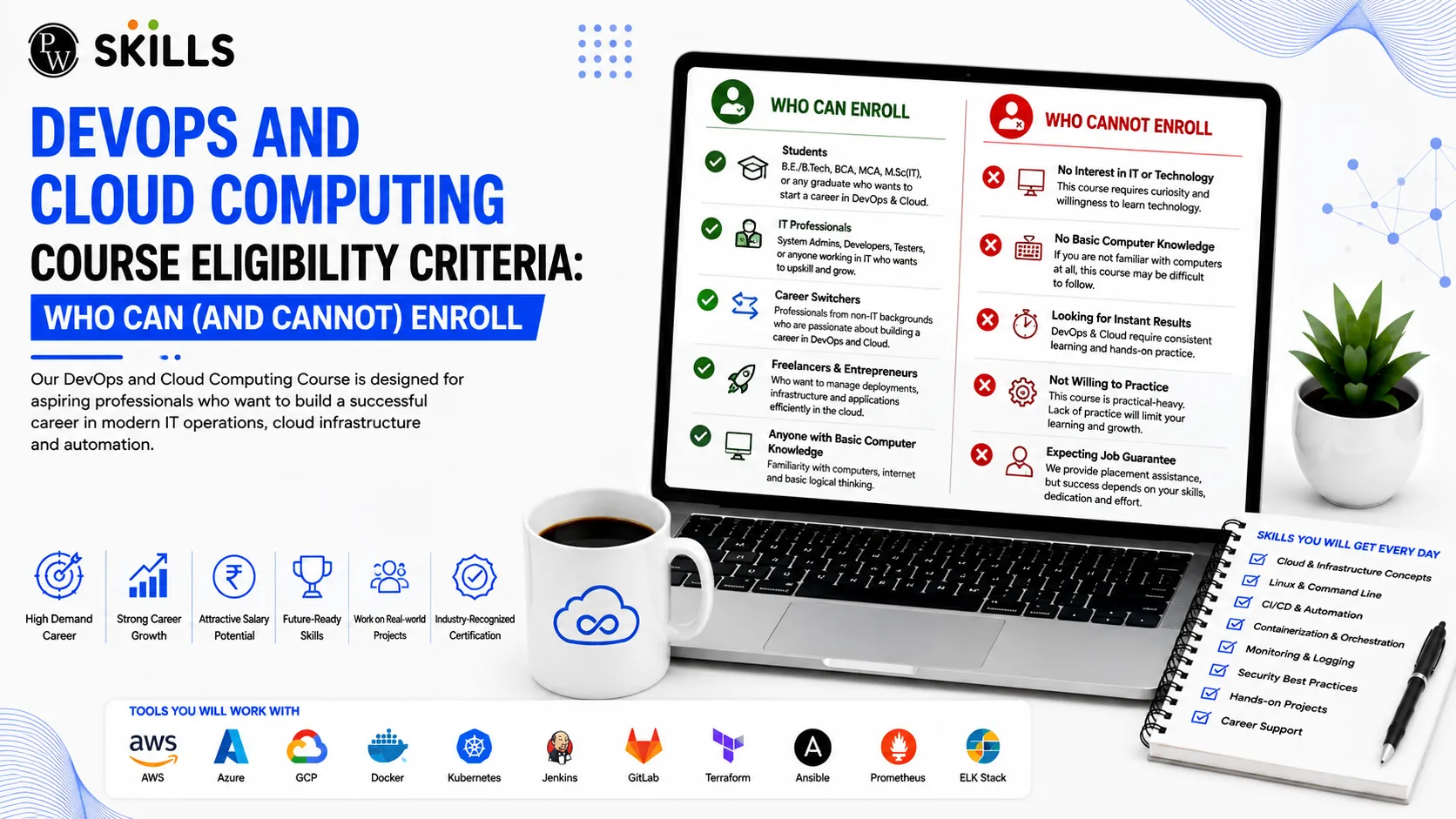
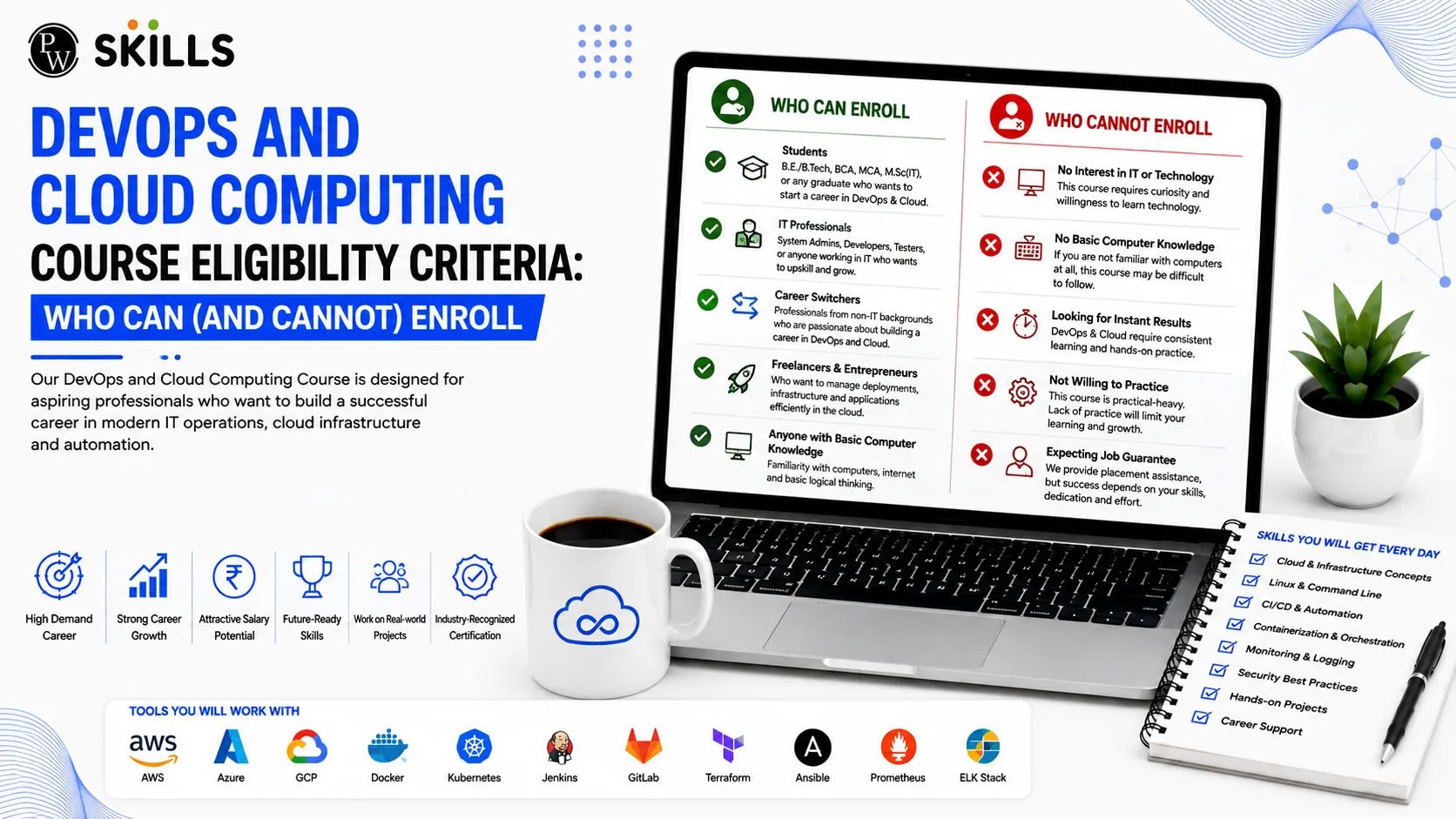
Navigating the transition into modern technology fields often creates confusion regarding prerequisites. Many aspiring tech professionals hesitate to apply because they fear their academic background or current technical stack might fall short. The demand for infrastructure automation and scalable deployment continues to climb across global industries. Understanding whether you qualify for a structured training programme is the first step toward building a sustainable career. This article outlines the academic, technical, and practical eligibility criteria for a DevOps and Cloud Computing Course, helping you determine whether this learning path matches your background and career ambitions.
What is DevOps and Cloud Computing Course?
A Cloud Computing and DevOps Course helps learners build practical skills in cloud infrastructure, automation, deployment, and system management. It is suitable for students, fresh graduates, IT professionals, and career changers who are ready to learn Linux, networking, scripting, and cloud technologies. The course covers tools such as Git, GitHub, Jenkins, Docker, Kubernetes, Terraform, Ansible, and AWS. With hands-on practice, learners can understand CI/CD pipelines, infrastructure automation, monitoring, and cloud deployment. This training can prepare learners for roles such as DevOps Engineer, Cloud Infrastructure Engineer, Site Reliability Engineer, and Cloud Support Associate.
DevOps and Cloud Computing Course Educational Eligibility
Educational qualifications for modern skill-based training have shifted significantly over recent years. While traditional corporate hiring once mandated formal computer science degrees, structured certification programmes focus heavily on practical capabilities and conceptual clarity.
Minimum Academic Requirements and Degree Backgrounds
Most industry-standard learning programmes maintain accessible entry thresholds to encourage diverse talent pools. You do not need an advanced engineering degree to get started.
-
High School Graduates (10+2): Candidates who have completed secondary education with a basic understanding of mathematics and logic are eligible to apply.
-
Diploma Holders: Individuals holding polytechnic or technical diplomas in engineering, information technology, or related trades meet all basic eligibility requirements.
-
Undergraduate Students: Pursuing degrees such as Bachelor of Technology (B.Tech), Bachelor of Science in IT (B.Sc IT), or Bachelor of Computer Applications (BCA) provides a solid foundation.
-
Non-Tech Graduates: Candidates holding degrees in commerce, arts, or business administration (such as B.Com, BA, or BBA) can enrol, provided they build foundational computer knowledge.
|
Academic Background |
Eligibility Status |
Recommended Preparation Level |
|
B.Tech / BE / BCA / B.Sc IT |
Directly Eligible |
Moderate (Focus on cloud architectures) |
|
Diploma in Engineering / IT |
Directly Eligible |
Moderate (Focus on Linux terminal) |
|
B.Com / BA / BBA / Other Streams |
Eligible with Prerequisites |
High (Learn operating system basics first) |
|
Working Professionals (Any Field) |
Directly Eligible |
Varies based on previous IT exposure |
Can Non-Computer Science Graduates Enrol?
Yes, non-computer science graduates can enrol successfully. Tech recruiters increasingly prioritize hands-on expertise over formal degree titles. However, non-CS background students must dedicate extra time during the initial weeks to grasp basic computing fundamentals.
Understanding how operating systems manage memory, how networks transfer packets, and how text-based interfaces function allows non-tech learners to bridge the gap quickly. A well-designed Cloud Computing and DevOps Course builds these skills from the ground up, starting with Linux basics before advancing to complex cloud infrastructure.
DevOps and Cloud Computing Course Technical Requirements
While formal academic barriers are low, technical readiness determines how comfortably you navigate the training. You do not need to be an expert coder before starting, but familiarity with core computing concepts creates a distinct advantage.
Computer Literacy and Operating System Knowledge
Before diving into automated deployment tools, learners must feel comfortable interacting with computer systems beyond basic graphic interfaces.
-
Command Line Interface (CLI): Navigating directories, editing files, and managing permissions via terminal commands is essential. Linux forms the backbone of cloud servers, making terminal familiarity a core requirement.
-
Basic Networking Concepts: Understanding IP addresses, ports, DNS configurations, subnets, and HTTP/HTTPS protocols helps when setting up virtual networks in cloud environments.
-
System Resource Monitoring: Basic awareness of how CPUs, memory, disk storage, and processes interact enables better troubleshooting during system deployments.
Importance of Understanding Basic Scripting and CI/CD Pipelines
Automation serves as the primary engine of modern software deployment. Understanding the role of continuous integration and continuous delivery ensures smooth progress through advanced modules.
When evaluating a DevOps and Cloud Computing Course + CI/CD pipelines, beginners quickly realize that automation relies on simple scripting rather than complex software development. Learning basic Python, Shell, or Bash scripting allows you to write instructions that execute repetitive server management tasks automatically.
Understanding how code moves from a repository to a live server through automated pipelines helps learners connect version control systems like Git with deployment tools like Jenkins or GitHub Actions.
Who Can Join DevOps and Cloud Computing Course?
Different career profiles benefit from cloud and automation training. Whether you are entering the workforce for the first time or seeking a domain switch, identifying your learner profile helps set clear expectations.
Fresh Graduates and College Students
Students entering the job market face intense competition for entry-level developer roles. Gaining specialized skills in cloud infrastructure and deployment automation makes candidate profiles stand out to prospective employers.
-
Immediate Career Readiness: Learning production-grade tools during college builds practical portfolio projects.
-
Broader Role Availability: Graduates qualify for junior system administration, cloud support, and junior DevOps roles.
-
Faster Onboarding: Familiarity with version control and cloud environments reduces company training timelines.
IT Professionals and System Administrators
Traditional IT roles are shifting away from manual server maintenance toward automated cloud infrastructure. Experienced professionals must upgrade their skill sets to remain competitive.
-
System Administrators: Transition from manual physical server setups to automated Infrastructure as Code (IaC) using Terraform or Ansible.
-
Quality Assurance (QA) Engineers: Move from manual software testing to managing automated testing within deployment workflows.
-
Software Developers: Learn to manage deployment environments, containerize applications using Docker, and oversee cloud hosting independently.
Non-IT Career Changers and Domain Switching Professionals
Professionals from sales, banking, technical support, or operations often seek stable transitions into tech. A structured Cloud Computing and DevOps Course offers a clear path because it emphasizes process management, logic, and infrastructure setup rather than heavy software architecture.
-
Commitment to Foundation Building: Willingness to spend initial weeks mastering Linux and networking.
-
Consistent Hands-on Practice: Completing lab exercises daily to build muscle memory for command-line syntax.
-
Problem-Solving Orientation: Applying logical approaches to system troubleshooting and error log analysis.
Who Should Not Join DevOps and Cloud Computing Course?
Not every tech programme suits every learner. Being aware of personal preferences and career expectations prevents wasted time and financial investment.
Individuals Unwilling to Learn Command-Line Interfaces
If you prefer using exclusively graphical drag-and-drop interfaces and dislike working in text terminals, cloud infrastructure management will feel frustrating.
-
Terminal-Centric Workflows: Over 80% of enterprise cloud management happens through terminal sessions, remote SSH connections, and configuration files.
-
Text-Based Configurations: Tools like Kubernetes, Docker, and Terraform rely heavily on YAML and JSON text files rather than visual buttons.
-
Debugging Reality: Identifying server failures requires reading system logs and diagnostic outputs line by line in terminal displays.
Aspirants Expecting Zero-Effort or Automation-Free Roles
Entering a Cloud Computing and DevOps Course under the assumption that automation eliminates the need for active maintenance leads to disappointment.
|
Unrealistic Expectation |
Industry Reality |
|
"No coding or logic required." |
Requires scripting in Bash or Python for workflow automation. |
|
"Cloud systems manage themselves completely." |
Requires active monitoring, security patch management, and cost optimization. |
|
"Guaranteed jobs without practical portfolio work." |
Hiring requires demonstrating real project deployments and hands-on lab proof. |
|
"One-time learning with fixed tools." |
Demands continuous learning as cloud tools and security standards evolve. |



FAQs
1. Can a DevOps and Cloud Computing Course help me get DevOps Engineer Jobs?
2. What/Why should I choose a Cloud Computing and DevOps Course?
3. Does the Cloud Computing and DevOps Course cover CI/CD pipelines?
4. Can beginners join a Cloud Computing and DevOps Course?
5. Do I need coding experience for DevOps training?





Get Free Counselling Today
and Clear up all your Doubts
 Live & recorded classes available at easeDashboard for progress trackingLakhs of practice questions

