

Cloud deployment Explained: Why DevOps and Cloud Computing Course Teaches It Early
 Hardik Gupta22 Aug, 2026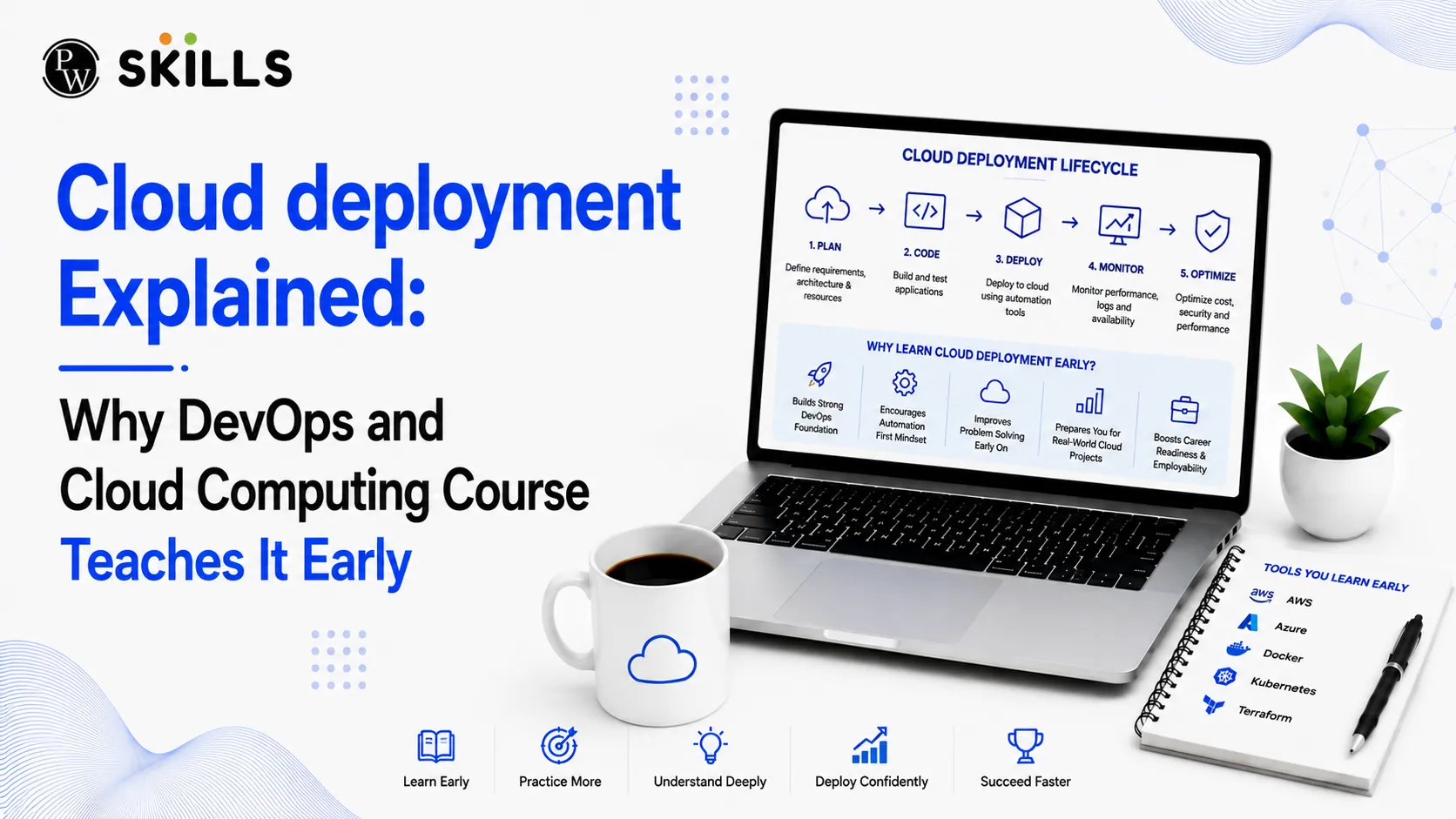
Many tech aspirants face a common frustrating barrier: writing clean code on a local computer, only to see it fail in live environments. Traditional computer science curricula often keep infrastructure, deployment pipelines, and server management until the very end, leaving students struggling to understand how software functions in the real world.
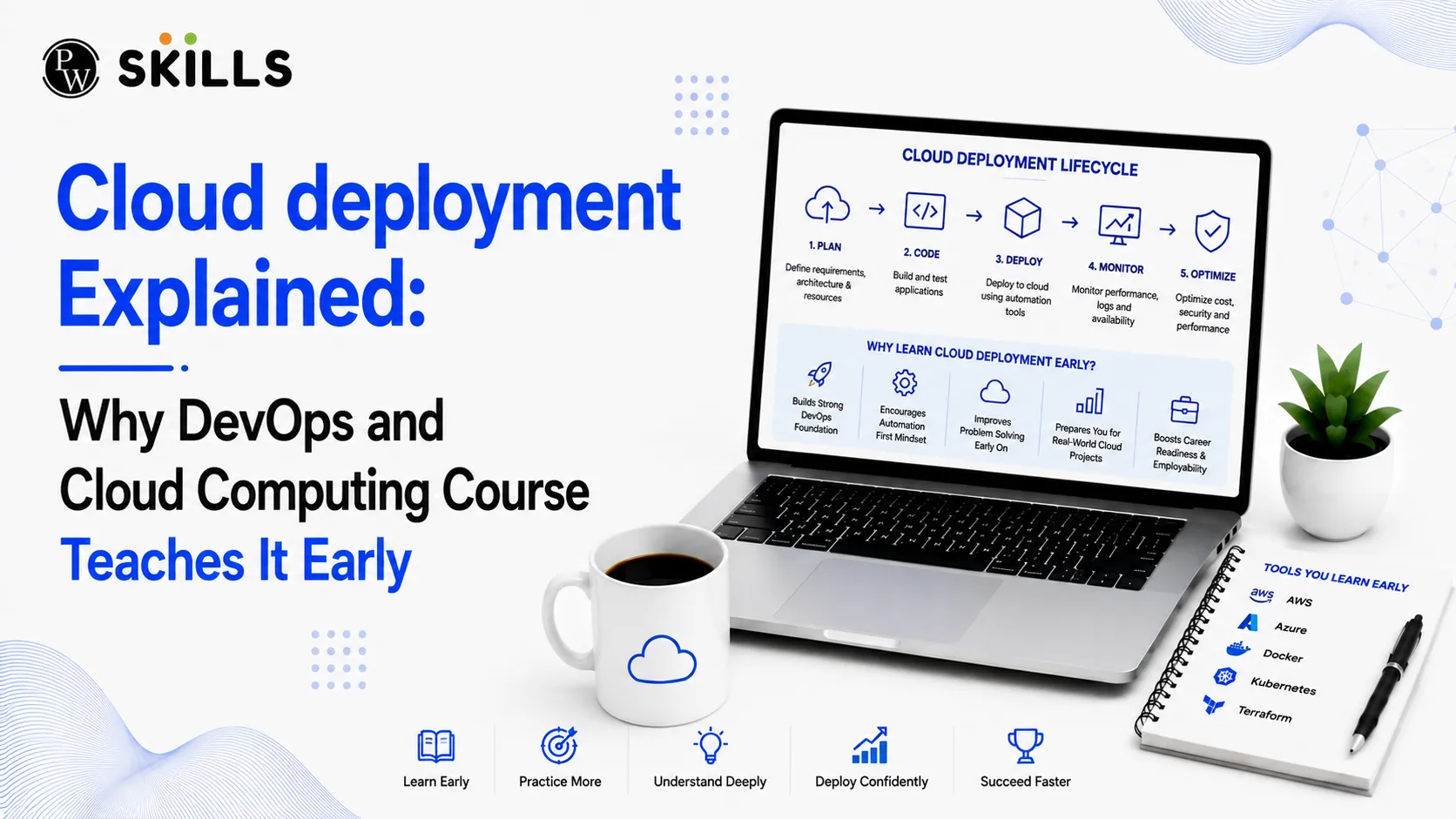
Modern IT training addresses this gap directly through a DevOps and Cloud Computing Course that introduces cloud deployment early. Mastering cloud infrastructure early allows students to understand the full software lifecycle, configure live server environments, and build hands-on expertise with AWS, Linux, and continuous integration workflows.
Importance of DevOps and Cloud Computing Course
A DevOps and Cloud Computing Course is important for learners who want to build practical skills for modern IT and cloud jobs. It helps students understand how software is developed, tested, deployed, monitored, and managed in real cloud environments.
Instead of learning only theory, students get practical exposure to tools such as AWS, Linux, Docker, Kubernetes, Terraform, Git, and CI/CD pipelines. These skills can help learners prepare for roles such as Cloud Support Associate, DevOps Engineer, Cloud Engineer, and Site Reliability Engineer.
Why Should You Learn Cloud Deployment Early With a DevOps and Cloud Computing Course?
Early infrastructure mastery shifts a student's mindset from basic application development to comprehensive systems management. In traditional learning setups, students write applications locally for months before attempting to host them on public web servers. This delayed exposure creates severe knowledge gaps regarding server provisioning, system resource monitoring, memory allocation, and network security.
Here is a breakdown comparing traditional late-stage deployment teaching with early cloud deployment integration:
|
Learning Aspect |
Traditional Late-Stage Learning |
Early Cloud Deployment Approach |
|
Development Environment |
Local host (localhost/127.0.0.1) |
Managed cloud instances (AWS EC2, S3) |
|
System Debugging |
Local terminal & IDE debuggers |
System logs, CPU monitoring, network traffic tracking |
|
Security Understanding |
Basic local file permissions |
IAM roles, security groups, SSH keys, firewalls |
|
Deployment Skill |
Manual file copying via FTP |
Automated pipeline deployment to cloud nodes |
|
Infrastructure Awareness |
Neglected until final capstone projects |
Integrated into daily exercises and weekly tasks |
Early exposure to cloud infrastructure helps students grasp system resource optimization, processes and threads, file systems, and network firewalls. Understanding these fundamentals early makes advanced topics like container orchestration with Kubernetes and automated configuration management with Ansible much easier to master.
How Does a DevOps and Cloud Computing Course Teach Infrastructure Automation?
Infrastructure automation is the backbone of modern cloud engineering. Rather than manually configuring cloud servers through a graphical user interface, production environments use code to create, modify, and destroy cloud resources. This approach, known as Infrastructure as Code (IaC), relies heavily on tools like Terraform and Ansible.
Learning cloud deployment early establishes the necessary foundation for mastering infrastructure automation:
-
Manual Server Provisioning (The Baseline): Students manually launch cloud virtual machines, configure security groups, assign elastic IP addresses, and update system dependencies. This manual step helps them understand the underlying architecture.
-
Configuration Automation with Ansible: Once manual provisioning is understood, students write automated playbooks to configure multiple servers simultaneously, install software dependencies, and manage system states cleanly.
-
Declarative Provisioning with Terraform: Learners write declarative code templates to automate the entire creation of cloud networks, load balancers, database instances, and compute nodes.
-
Integration with Version Control: Automation scripts are stored in Git repositories, allowing infrastructure changes to undergo code reviews, pull requests, and automated testing just like application code.
A structured Course and Infrastructure automation module ensures that learners move beyond manual server setups. By combining hands-on AWS training with IaC tools, students build repeatable, error-free deployment pipelines that scale seamlessly across enterprise environments.
How Does a DevOps and Cloud Computing Course Help With Site Reliability Engineer Jobs?
The demand for skilled Site Reliability Engineers (SREs) and Cloud Engineers continues to grow rapidly. Companies seek professionals who can ensure application stability, optimize cloud costs, maintain high system availability, and automate recovery workflows.
Understanding early cloud deployment directly prepares candidates for site reliability engineering roles through practical experience in:
-
System Resource & Performance Monitoring: Tracking CPU usage, memory allocation, network throughput, and disk IOPS on running AWS instances to prevent application downtime.
-
Network Traffic Management & Firewalls: Setting up load balancers, configuring network access control lists (NACLs), and managing firewall rules to secure cloud traffic.
-
High Availability & Fault Tolerance: Deploying multi-tier website architectures across multiple availability zones to ensure applications remain operational during hardware failures.
-
Incident Response & Automated Recovery: Utilizing cloud monitoring tools, alarm triggers, and automated restart scripts to address application failures instantly.
Enrolling in a Course and site reliability engineer jobs-focused curriculum helps learners align their skill sets with real-world industry requirements. Industry-oriented capstone projects—such as deploying a multi-tier web application on AWS EC2 with automated scaling and load balancing—provide concrete portfolio evidence for prospective employers.
Modules Covered in Early DevOps and Cloud Computing Course
A comprehensive training program structures cloud deployment learning into logical, hands-on modules designed to build deep technical competency step-by-step.
Module 1: Linux Fundamentals and Resource Monitoring
-
Linux OS Core: File systems, process management, thread handling, and command-line utilities.
-
Resource Optimization: Monitoring CPU usage, tracking memory consumption, and diagnosing system bottlenecks.
-
Network Security: Managing Linux firewall rules, inspecting network traffic, and using diagnostic tools like netstat and htop.
Module 2: Cloud Computing Core and AWS Infrastructure
-
AWS Compute Services: Provisioning and configuring Amazon EC2 virtual machines for application deployment.
-
Storage Solutions: Managing block storage (EBS) and object storage (S3) for media files and system backups.
-
Networking & Identity: Building Virtual Private Clouds (VPC), managing subnets, and configuring IAM security policies.
Module 3: Source Code Control and CI/CD Automation
-
Version Control: Git workflows, branching strategies, and repository management on GitHub.
-
CI/CD Pipelines: Building continuous integration and delivery pipelines using Jenkins to automate code testing and cloud deployment.
-
Artifact Management: Packaging software applications cleanly for automated distribution across server environments.
Module 4: Containerization, Infrastructure as Code, and Orchestration
-
Docker Containers: Packaging applications and their dependencies into lightweight, portable container images.
-
Kubernetes Orchestration: Managing container clusters, handling auto-scaling, load balancing, and automated rollouts.
-
Terraform & Ansible: Automating cloud infrastructure provisioning and configuration management through declarative code scripts.
What Cloud Deployment Projects Can You Build in a DevOps and Cloud Computing Course?
Hands-on projects bridge theoretical concepts and real-world deployment challenges. Building real applications on public cloud infrastructure validates a learner's ability to manage production environments effectively.
Key industry-oriented projects typically include:
-
Deploying a Multi-Tier Website Using AWS EC2:
-
Objective: Host a full-stack web application featuring a front-end web server, back-end application logic, and a secure database instance on AWS.
-
Skills Applied: AWS EC2 provisioning, security group configuration, database connectivity, and environment variable setup.
-
Automating Multi-Tier Deployments with CI/CD Pipelines:
-
Objective: Create an automated continuous integration pipeline in Jenkins that triggers every time code is committed to GitHub.
-
Skills Applied: Webhooks setup, automated unit testing, deployment artifact building, and server deployment scripts.
-
Streamlining Deployment and Scaling with Kubernetes and Terraform:
-
Objective: Use Terraform scripts to provision an AWS EKS (Elastic Kubernetes Service) cluster and deploy microservices with automated scaling policies.
-
Skills Applied: Infrastructure as Code, declarative cluster setup, Kubernetes pods, service routing, and auto-scaling configuration.




FAQs
How does a DevOps and Cloud Computing Course prepare students for Site Reliability Engineer Jobs?
Why does a DevOps and Cloud Computing Course introduce cloud deployment early?
How does a DevOps and Cloud Computing Course teach Infrastructure automation?
Is cloud deployment useful for beginners learning DevOps?
What tools are useful for infrastructure automation?





Get Free Counselling Today
and Clear up all your Doubts
 Live & recorded classes available at easeDashboard for progress trackingLakhs of practice questions

