
Recursion in One Shot | C Programming | Lecture 6 | Complete C Course
 Varun Saharawat24 Jun, 2026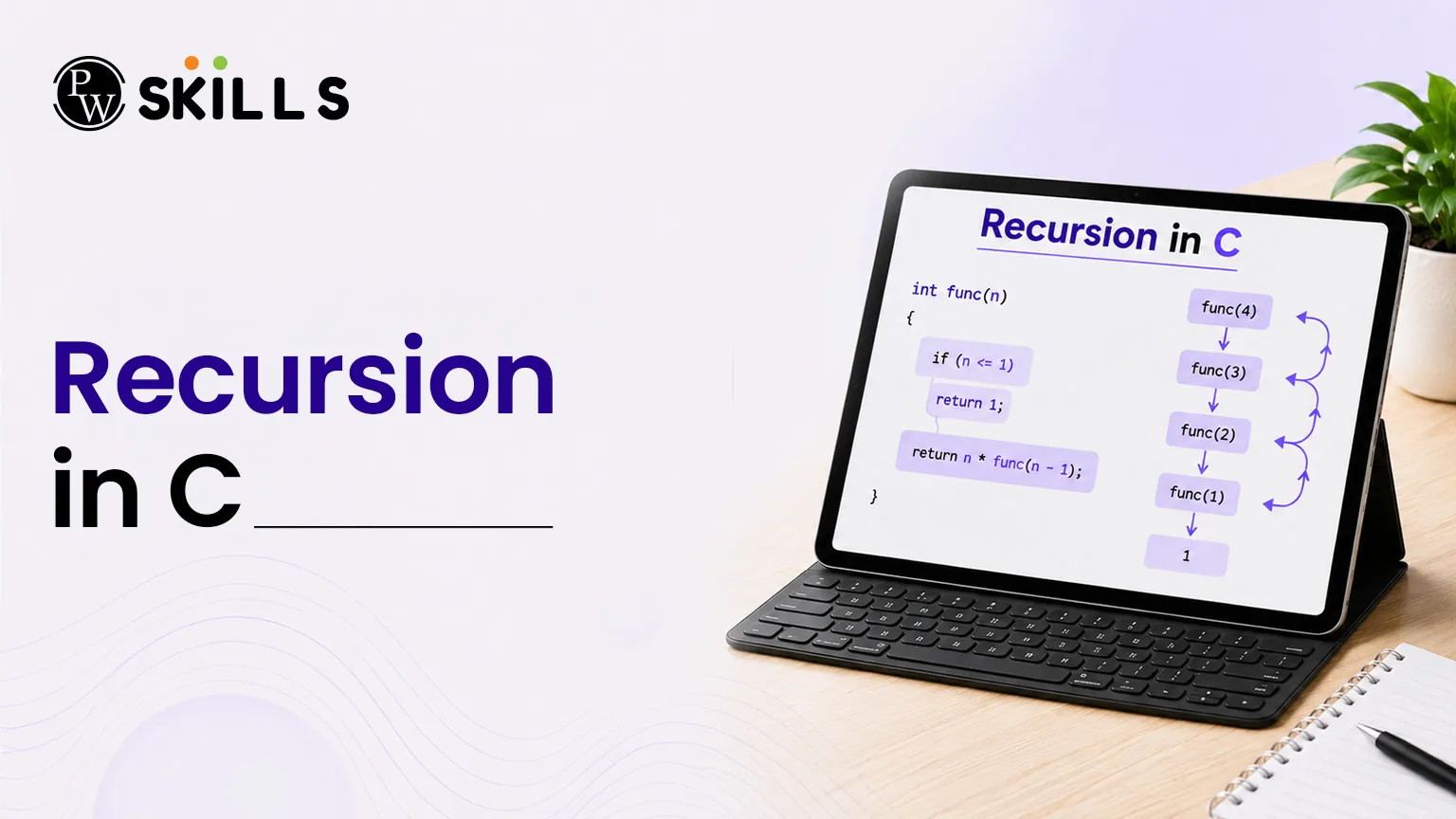
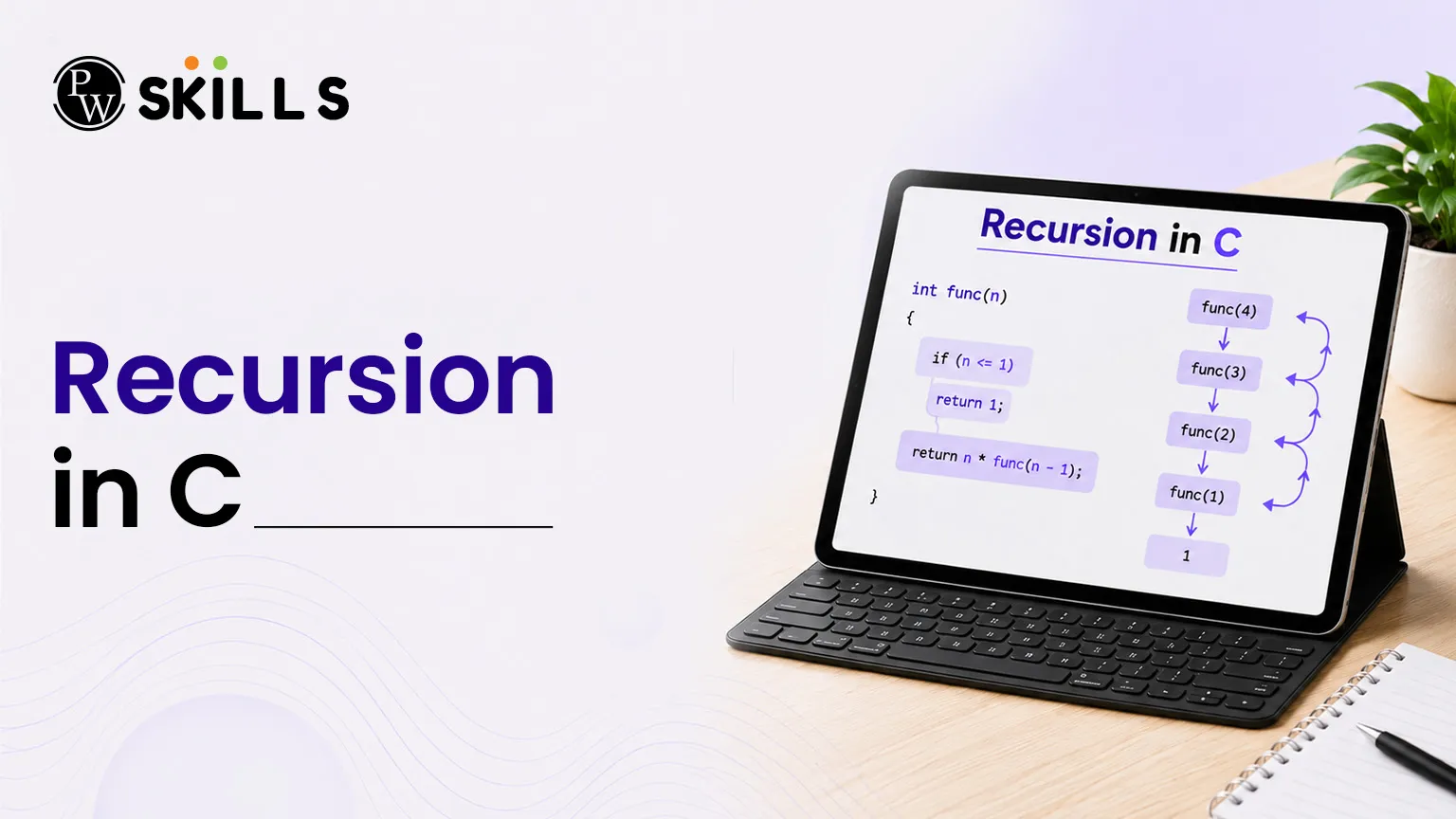
Many programming students struggle to visualize how a function can call itself without creating an infinite loop. When you first encounter complex algorithms like the Tower of Hanoi or tree-graph traversals, traditional iteration loops often make the code messy and difficult to debug.
This comprehensive article simplifies Recursion in C, showing you how to break complex data structures down into manageable self-calling routines.
What is Recursion in C?
Recursion in C is a powerful programming technique where a function calls itself repeatedly until a specific base condition is met. A function that exhibits this self-calling behaviour is explicitly known as a recursive function, and each individual instance of the function calling itself is called a recursive call.
Instead of relying on standard loops like for or while, this technique breaks down a large problem into smaller sub-problems of the same nature. The process continues until the logic reaches a predefined state that stops the cycle.
C
// Conceptual structure of a recursive function
void countdown(int n) {
if (n <= 0) { // Base Condition
return;
}
printf("%d ", n);
countdown(n - 1); // Recursive Call
}
How Does Memory Management Work in Recursion in C?
To fully grasp how C Recursion works internally, it is vital to understand how the system call stack behaves during execution. Like other standard functions, all local data, variables, and parameters of a recursive function are stored in stack memory inside an isolated block called a stack frame.
-
Stack Frame Push: Every single time a function makes a new recursive call, a brand-new stack frame is created and pushed onto the top of the existing stack memory. The system pauses the current state of execution and jumps to the new call.
-
The Chain of Control: Because the function call occurs before returning an ultimate value, multiple stack frames sit on top of each other simultaneously.
-
Stack Frame Removal: Once the base condition is met, the topmost function returns its value. Its stack frame is immediately removed from memory, and the control passes back to the previous function execution context using an internal instruction pointer.
The table below illustrates a comparative analysis between traditional loops and self-calling methods regarding memory usage and structural style:
|
Parameter |
Iteration (Loops) |
C Recursion |
|
Memory Control |
Uses minimal memory as no extra frames are generated. |
High memory consumption due to continuous stack frame allocation. |
|
Execution Path |
Travels sequentially inside a single active frame. |
Travels deeper into the stack before returning back one by one. |
|
Termination |
Controlled by loop conditions and counter updates. |
Strictly controlled by an explicitly defined base condition. |
Types of Recursion in C
The structuring of these functions heavily dictates how memory allocations behave and how clean your program looks. Depending on where the self-call occurs and how many times it triggers, the implementation falls into distinct categories.
1. Tail Recursion
A function is considered tail-recursive if the recursive call is the absolute final statement executed by the function. There are no pending operations left to execute after the call returns. The compiler can easily optimize tail-recursive functions to save stack space.
2. Head Recursion
In head recursion, the recursive call occurs at the very beginning of the function, right after checking the mandatory base condition. All processing or computational operations happen after the recursive call returns from the stack.
3. Linear Recursion
Linear recursion occurs when a function makes only a single recursive call during its execution cycle. The growth of the stack frames increases linearly with the size of the input data.
4. Tree Recursion
When a function makes multiple calls to these functions inside its body, it establishes a branching structure resembling a tree. A classic example is a function that calls itself twice with reduced parameters, meaning each parent call branches out into two separate child frames.
Practical Recursion Examples in C
Let us check some practical examples to clarify these foundational C programming concepts. We will review two essential programs that are frequently asked in academic examinations and technical interviews.
Sum of First N Natural Numbers
This program calculates the cumulative sum of numbers from 1 up to a user-defined integer n. The recursive breakdown states that the sum of n numbers is equal to n added to the sum of n-1 numbers.
C
#include <stdio.h>
// Function definition using C Recursion
int calculateSum(int n) {
// Base condition to stop execution
if (n <= 1) {
return n;
}
// Recursive call combining current value and sub-problem
return n + calculateSum(n - 1);
}
int main() {
int number = 5;
int result = calculateSum(number);
printf("The sum of first %d natural numbers is: %d\n", number, result);
return 0;
}
Classic Factorial Calculation
Finding the factorial of a number follows a highly predictable recursive pattern. The factorial of n (written as n!) is evaluated by multiplying n by the factorial of n-1.
C
#include <stdio.h>
// Finding factorial using recursive functions
int findFactorial(int n) {
// Base condition for 0 or 1
if (n <= 1) {
return 1;
}
return n * findFactorial(n - 1);
}
int main() {
int target = 4;
printf("Factorial of %d is: %d\n", target, findFactorial(target));
return 0;
}
Stack Overflow Mistakes in Recursion in C
A program's call stack has a strictly fixed, predefined memory allocation that is perfectly sufficient for normal application workflows. However, if a program encounters an excessively deep or infinite sequence of self-calls, a critical error known as a stack overflow occurs.
-
The Cause: If you forget to add a base condition or design an invalid termination logic, the function will keep pushing new frames onto the stack endlessly.
-
The Result: The system quickly runs completely out of allocated stack memory. Because it cannot store any additional execution data, the operating system terminates the program abnormally with a crash.
-
The Fix: Always verify that your base condition is reached logically for every possible input parameter. Additionally, ensure your variable inputs decrement or increment smoothly toward that specific base target.
When to Choose Recursion in C
While self-calling mechanisms are visually elegant, they are not universally superior to loops. You must evaluate the specific problem structure before selecting your implementation style.
Best Used For:
-
Tree-Graph Algorithms: Navigating hierarchical structures like binary trees, where sub-nodes replicate the layout of the parent tree perfectly.
-
Divide and Conquer: Breaking massive array datasets into halves, such as in Merge Sort or Quick Sort methodologies.
-
Mathematical Problems: Working through deeply nested logic, like the Tower of Hanoi or generating Fibonacci combinations.
-
Dynamic Programming: Storing smaller sub-problems to resolve larger computations smoothly.
Avoid When:
-
Memory constraints are highly restrictive, and your input size is massive.
-
The solution requires a simple linear traversal that can be written easily with a simple while loop.
-
High-speed execution is your absolute top priority, as function call overhead slows down execution times slightly.




FAQs
1. What is the fundamental requirement for C Recursion to stop?
2. How do recursive functions differ from normal iteration loops?
3. What triggers a stack overflow when using C Recursion?
4. Can you provide common recursion examples used in real-world software?
5. Is it possible to convert any recursive program into an iterative loop?





Get Free Counselling Today
and Clear up all your Doubts
 Live & recorded classes available at easeDashboard for progress trackingLakhs of practice questions

