
What are the Basic Rules of Python?
Start learning Python with Python basics and fundamentals and then move to the advanced concepts of Python programming language. Discover a wide range of future career options with Python programming language this year.
 Varun Saharawat30 Oct, 2025
Let us dive into the world of Python programming with Python basics. You can either start learning Python with a reputed online learning program providing you with career guidance and more. However, we are going to discuss some Python basics to help you get started with the Python programming language this year.
Who Developed Python?
The Python language was developed in the late 1980s by Guido Van Rossum in the Netherlands with its implementation in the live market starting in 1989. Python was made available for the general public in 1991 February month with the first version as 0.9.0. It was named after the BBC TV show Monty Python’s Flying Circus.Python 1.x (1994-2000)
- Python 1.0 (1994) introduced functional programming tools (lambda, map, filter, reduce).
- Python 1.4 introduced keyword arguments and built-in complex numbers.
- Python 1.6 included a new CNRI license, which later became GPL-compatible.
Python 2.x (2000-2020)
- Python 2.0 (2000) introduced list comprehensions and a garbage collector for memory management.
- Python 2.2 (2001) unified Python’s type and class hierarchies, making it purely object-oriented.
- Python 2.5 (2006) introduced the statement for better resource management.
- Python 2.6 and 2.7 included features from Python 3 to ease migration.
- Python 2.7 support ended on January 1, 2020, marking the official end-of-life of Python 2.
Python 3.x (2008-Present)
- Python 3.0 (2008) introduced backward-incompatible changes to improve consistency.
Why Learn Python Programming Language?
There is more than one reason to learn Python Programming this year. Python with its astonishing features and smooth integration with various technologies makes it easy for everyone to step into the world of technology.
Easy to Learn 📃
Python program is the only high-level programming language with a very simple and readable syntax which makes it a beginner friendly programming language. You will need to write fewer lines of code in Python as compared to other languages.Variety of Applications 📽️
Python can easily be integrated with various domains such as data science, machine learning, web development, automation, game development, cybersecurity, and more with its advanced and extensive library support.High Demand 🐾
Many organizations seek skilled Python developers for their organization, and it is a high paying job opportunity. Startups and new companies prefer Python developers for speed and efficiency.Strong Community 🎓
Python has one of the largest communities with experienced developers, designers, innovators, contributors, and more who can provide you with updated information starting from Python basics to advanced topics.Cross Platform Support 📲
Python can easily be integrated with other platforms such as Windows, Mac, Linux, or even mobile devices and work smoothly without any issues. It is used in IoT, cloud computing, and embedded systems nowadays.Open Source and Free 🆓
Python language is available for developers without any additional cost and developers can contribute to open source projects and improve coding skills without any hefty payment.Future Suitable Language 🚀
Python is regularly updated to meet advanced technological demands and is suitable for beginners as well as experienced developers in various domains.Key Characteristics of Python Programming Language
 Some of the key characteristics of Python Programming language are listed below.
Easy to Learn and Readable
Python with its simple and English-like syntax makes it easy to understand. Also, Python uses indentation instead of braces for code blocks, improving readability.Interpreted Language
Python code is executed line by line (no need for compilation like C++ or Java). It especially makes debugging easier.Dynamically Typed
There is a need to declare variable types with more flexibility but can lead to runtime errors if types are misused.Object-Oriented and Multi-Paradigm
It supports OOP (Object-Oriented Programming) principles like classes and inheritance. It also supports procedural and functional programming.Extensive Standard Library
Python comes with built-in modules for tasks like file handling, math operations, and networking. It reduces the need for external libraries.Platform Independent
Python code can run on Windows, macOS, and Linux without modification (cross-platform). It only requires Python installation.High-Level Language
You can easily handle low-level details like memory management automatically on Python. It focuses on ease of development rather than hardware specifics.Support for Third-Party Libraries
Python has a huge ecosystem with libraries like NumPy, Pandas, TensorFlow, Django, Flask, etc. It is ideal for web development, data science, AI, and more.Extensible and Embeddable
Python can be integrated with C, C++, or Java for performance improvements. It can be embedded into applications as a scripting language.Python Variables and Data Types
 Python supports all data types and variables within its framework. Being a dynamically typed language you do not explicitly need to declare Python data type as it can recognize the data type and store it accordingly.
Data types are kinds of data items stored in a variable while variables are containers used to store data. Let us know some of the frequently used data types in Python basics.
Python supports all data types and variables within its framework. Being a dynamically typed language you do not explicitly need to declare Python data type as it can recognize the data type and store it accordingly.
Data types are kinds of data items stored in a variable while variables are containers used to store data. Let us know some of the frequently used data types in Python basics.
| Category | Data Type |
| Primitive Data Types | int |
| float | |
| complex | |
| bool | |
| str | |
| Secondary Data Types | list |
| tuple | |
| set | |
| dict | |
| frozenset | |
| byte, byte array |
Python Basics Rules of Naming Variables
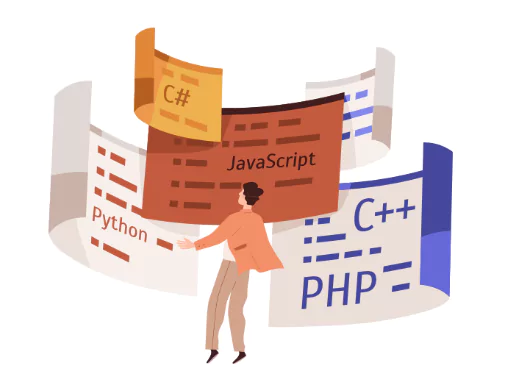 Check a clear explanation of Python basics rules for naming variables without causing syntax errors.
Must Start with a Letter or Underscore (_)
- ✅ Valid: name, _value, my_var
- ❌ Invalid: 1name, @var, -test
Can Contain Letters, Digits, and Underscores (_)
- ✅ Valid: var_1, data_set, age25
- ❌ Invalid: price$, var#3, name space
Case-Sensitive
- ✅ Name, name, NAME are different variables
Cannot Use Python Keywords or Reserved Words
- ❌ Invalid: if, while, return, class
- ✅ Use an underscore: _if, while_
Use Descriptive Names (For readability and maintainability)
- ✅ Good: total_price, user_age
- ❌ Bad: tp, x, data1
Follow Snake Case for Multi-Word Variables
- ✅ Good: first_name, max_speed
- ❌ Bad: firstName (camel case, usually for JavaScript), FirstName (Pascal case)
Avoid Special Characters and Spaces
- ❌ Invalid: user@name, user name, score!
Do Not Start Variable Names with Underscore Unless Necessary
- _variable: Used for internal/private variables
- __variable__: Special (dunder) methods like __init__
Python Basics Indentation Syntax
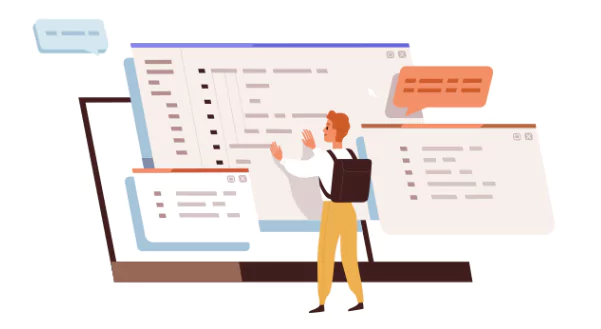 Let us learn what indentation is in Python and its importance for writing Python programs. Indentation in Python is used to create a whitespace using a space keypad or tab which can be used at the beginning of a line to define blocks of code. Python relies on indentation to determine the structure of code rather than using brackets.
- Python indentation improves readability.
- It is important to maintain the structure in Python. An incorrect Python indentation will cause an error.
- It is used to group statements together.
Correct Indentation
| # Correct indentation def greet(): print("Hello, world!") # Indented block inside function greet() |
| def say_hello(): print("Hello!") # Missing indentation (Expected IndentationError) |
Output
| IndentationError: expected an indented block |
Python Basics Interview Questions
Let us learn about some of the Python basics code and questions generally asked during the interview round of technical recruitment.- What is Python, and what are its key features?
- How is Python interpreted?
- What are Python’s key data types?
- What are mutable and immutable types in Python?
- What is the difference between Python 2 and Python 3?
- How do you declare variables in Python?
- What are the different types of data types in Python?
- What is type conversion (casting) in Python?
- How do you define a function in Python?
- What is the difference between *args and **kwargs?
- What is the lambda function in Python?
- What is recursion in Python?
- What are local and global variables?
- What is the difference between a list and a tuple?
- How do you remove duplicates from a list?
- How do you create and use a dictionary?
- What are Python sets, and how are they different from lists?
Python Hello World Example
Most of us start learning Python basics with a Hello World Statement executed on the screen. Let us check a simple demonstration of the Python Hello World example.| print("Hello, World!") |
Different Types of Python Statements
Check some of the frequently used Python statements in Python below.Expression Statement
Python is used to evaluate and return a value with expression statements like assignment operators to evaluate expressions such as equations.| x = 5 + 3 # Expression: 5 + 3 is evaluated and assigned to x print(x) # Output: 8 |
Conditional Statement
These conditional statements comprise If, else, else if, and while are used to evaluate a statement based on the conditions of true or false output.| age = 18 if age < 18: print("Minor") else: print("Adult") # Output: Adult |
Looping Statements in Python Basics
Python is used to repeat a block of code using a for or while loop. We can use loops to repeat statements until the following conditions are met.| for i in range(3): print(i) # Output: 0, 1, 2 |
Break and Continuous Statements
The break and continuous statements are two important functions that can be used to stop the loop or skip an iteration based on the needs of the program.| for i in range(5): if i == 3: break # Stops loop when i = 3 print(i) # Output: 0, 1, 2 |
Learn Python Basics and Tools with PW Skills
Become proficient in Python libraries and learn to prepare, process, clean, and visualize data for analysis purposes. Learn about Python programming and data structures and algorithms with PW Skills Decode DSA With Python Course . Get in-depth tutorials and practice exercises to strengthen your concepts in Python programming.



🔥 Trending Blogs
Python Basics FAQs
Q1. What is Python and why is it popular?
Ans: Python is a high-level, interpreted programming language known for its readability and simplicity. It is popular due to its extensive libraries, community support, and versatility in web development, data science, AI, and automation.
Q2. How do you declare a variable in Python?
Ans: In Python, variables are created when you assign a value to them. You don’t need to declare the type explicitly.
Q3. How do you define and call a function in Python?
Ans: Python function can be defined using the def keyword and can be called using the name keyword.
Q4. When was Python launched?
Ans: Python was made available for the general public in 1991 February month with the first version as 0.9.0. It was named after the BBC TV show Monty Python’s Flying Circus.


Talk to a counsellorHave doubts? Our support team will be happy to assist you!



Get Free Counselling Today
and Clear up all your Doubts
Talk to Our Counsellor just by filling out the form.
Join 15 Million students on the app today!
 Live & recorded classes available at easeDashboard for progress trackingLakhs of practice questions

