
The Roadmap to Becoming a Python Developer
 Hardik Gupta13 Jul, 2026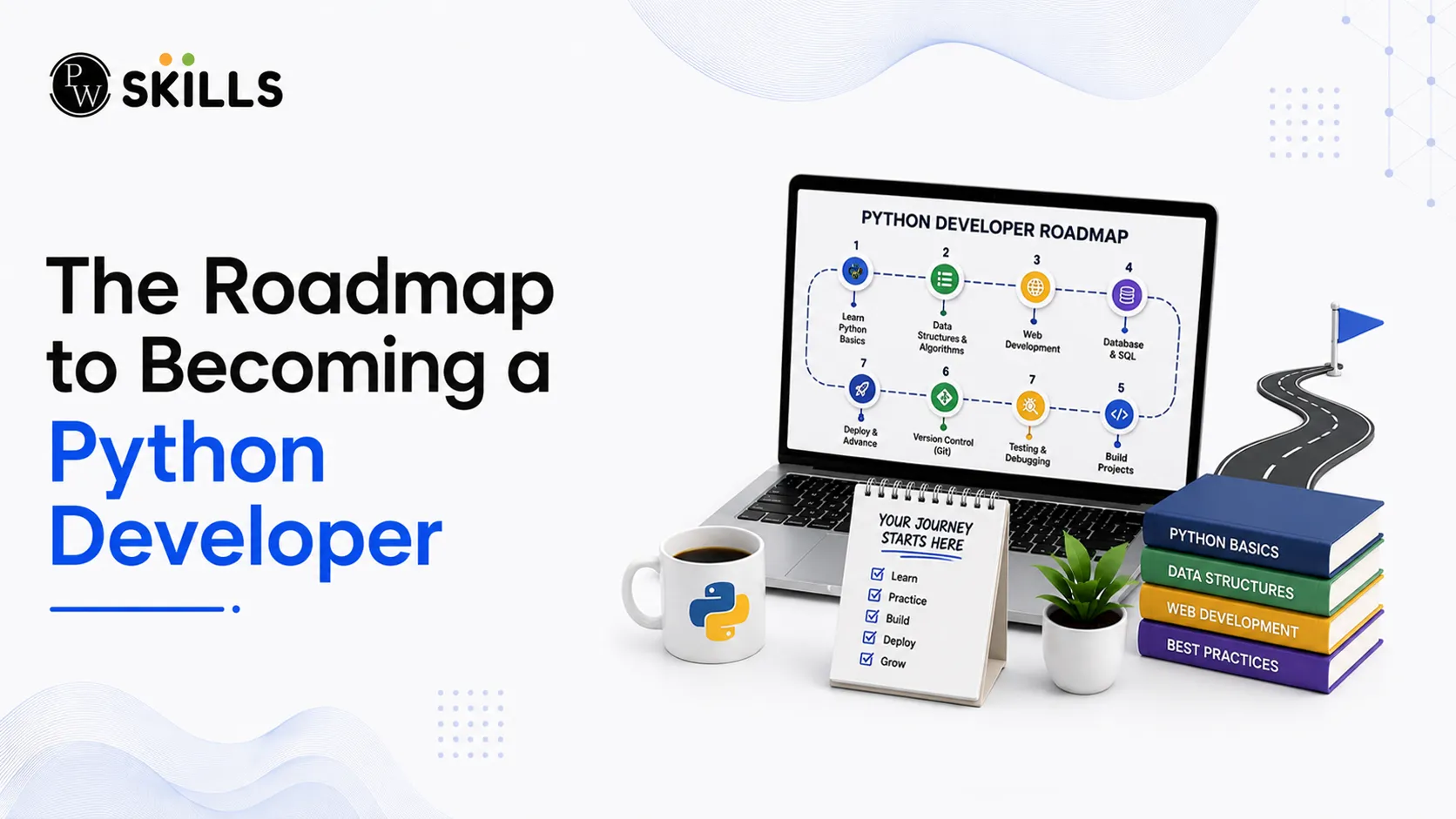
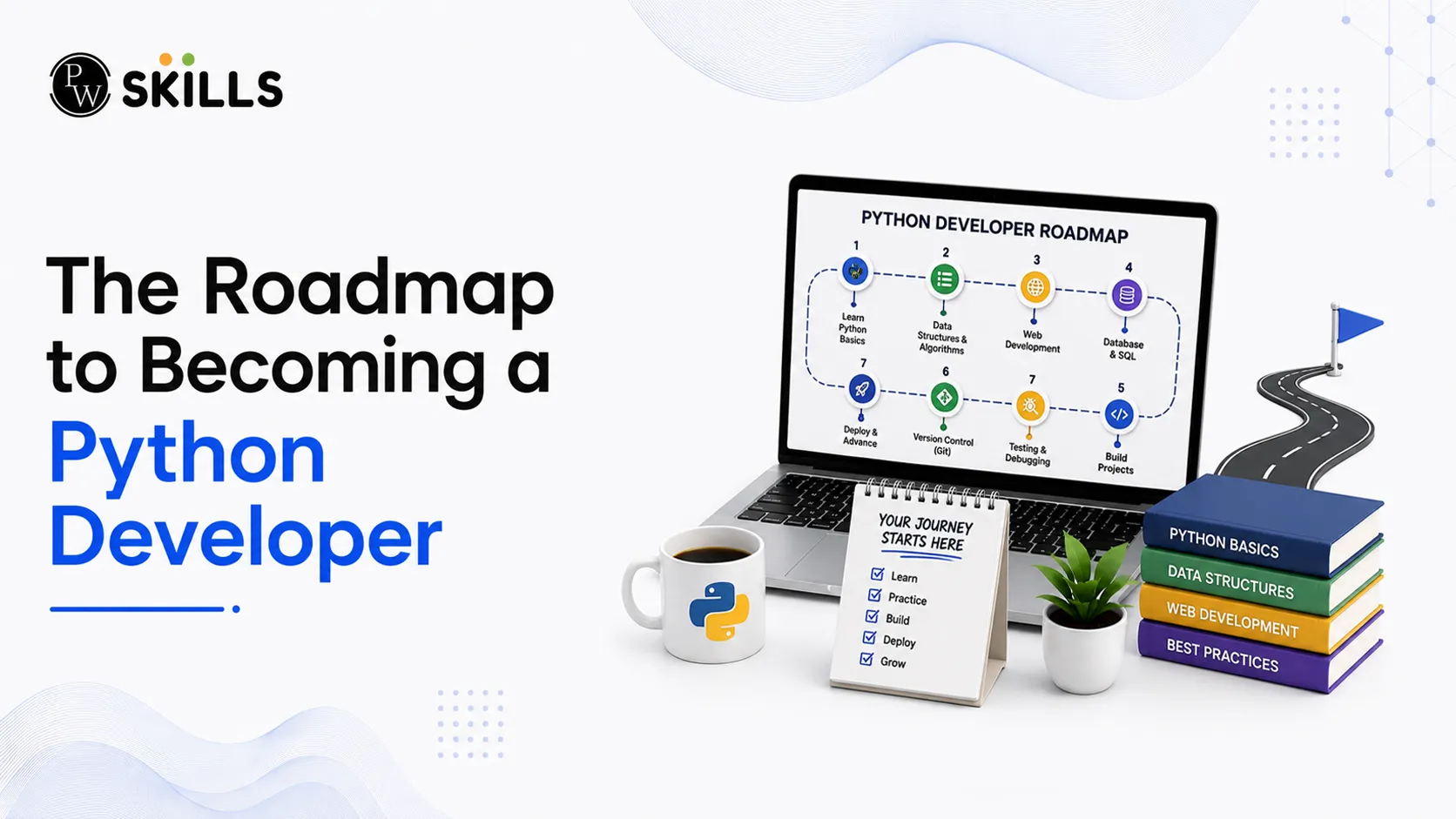
Learning programming can feel confusing when there are thousands of videos, blogs, and courses online. Many beginners jump between different tutorials without following a proper plan. This often leads to confusion and wasted time. A clear Python Developer Roadmap gives you the right direction from the beginning. It shows what to learn first, what to learn next, and which tools are important for getting a Python job. This Python learning roadmap explains every step in simple language so you can build the right skills with confidence.
Python Developer Roadmap Overview
Every successful Python developer starts with the basics. If your foundation is strong, learning advanced topics becomes much easier.
Start by learning these core topics:
-
Basic Syntax and Variables: Learn how to write Python code, print output, create variables, and add comments.
-
Data Types and Type Casting: Understand integers, floats, strings, booleans, and how to change one data type into another.
-
Conditionals and Loops: Learn to use if, elif, else, for, while, and match-case statements to control program flow.
-
Functions: Learn how to create reusable code, pass values to functions, and return results.
-
Exception Handling: Use try and except blocks to handle errors without stopping your program.
Python Basics
Syntax & Variables
↓
Data Types & Type Casting
↓
Conditionals & Loops
↓
Functions
↓
Exception Handling
Python Developer Roadmap for Data Structures and Algorithms
After learning Python basics, the next step in your Python career path is understanding data structures and algorithms. They help your programs run faster and manage data more efficiently.
Learn Python Data Structures
Python includes several built-in data structures.
-
Lists: Ordered collections that can be changed.
-
Tuples: Ordered collections that cannot be changed after creation.
-
Sets: Store unique values and remove duplicates automatically.
-
Dictionaries: Store information as key-value pairs for fast searching.
Each data structure has a different purpose, so learning when to use them is very important.
Learn Basic Algorithms
You should also study common computer science topics like:
-
Queues
-
Trees
-
Sorting algorithms
-
Searching algorithms
-
Big O notation
Big O notation helps you measure how fast your program runs and how much memory it uses. Understanding these topics helps you write better and more efficient code.
Python Developer Roadmap for Object-Oriented Programming
Object-Oriented Programming (OOP) is an important part of every Python career path. It helps you organize your code into small, reusable parts that are easier to manage.
Learn these OOP concepts:
-
Classes and Objects: Create objects from reusable class templates.
-
Inheritance: Reuse code from existing classes instead of writing everything again.
-
Polymorphism: Allow different classes to use the same method in different ways.
-
Encapsulation: Protect important data from being changed directly.
-
Abstraction: Hide unnecessary details and show only what is needed.
-
SOLID Principles: Follow good design practices to make your applications easier to maintain and improve.
Learning OOP makes it easier to build large projects and work with professional software teams.
Python Developer Roadmap for Development Tools
Writing code is only one part of becoming a developer. You also need to learn the tools that software companies use every day.
|
Tool |
Purpose |
|
Git & GitHub |
Save code, track changes, and work with teams |
|
HTTP / HTTPS |
Understand how websites and APIs communicate |
|
Click, Python Fire |
Build command-line applications |
|
venv, pip, conda |
Manage Python packages and project environments |
|
VS Code, PyCharm, Jupyter |
Write, test, and debug Python code |
Learning these tools improves your software developer skills and prepares you for real-world development work.
Also Check: Python Course - Free, Beginners, Certificate, Fees, Online
Python Developer Roadmap for Web Frameworks
Building websites and APIs is one of the most popular parts of the roadmap. Python offers several powerful web frameworks.
Learn Django
Django is a complete web framework used for large applications. It includes many built-in features such as:
-
User authentication
-
Database support through ORM
-
Admin dashboard
-
Security features
Because many tools are already included, Django helps developers build applications faster.
Learn Flask and FastAPI
Flask is a lightweight framework that gives developers more control over their projects. It is a good choice for smaller applications and simple APIs.
FastAPI is one of the fastest-growing Python frameworks. It supports asynchronous programming, automatic API documentation, and high performance. Many companies use FastAPI to build modern backend services and REST APIs.
Popular Python Web Frameworks
Django
• Large web applications
• Built-in ORM
• Admin Panel
• Authentication
FastAPI
• High performance
• Async support
• REST APIs
• Automatic documentation
Flask
• Lightweight
• Flexible
• Easy to learn
Python Developer Roadmap for Databases
Every web application needs a database to store and manage data. That is why learning databases is an important part of the Python learning roadmap.
Start with relational databases such as PostgreSQL, MySQL, or MariaDB. Learn how to write SQL queries to add, update, delete, and retrieve data.
You should also learn NoSQL databases. MongoDB stores data in flexible documents, making it useful for applications with changing data. For large-scale systems, databases like Apache Cassandra can handle huge amounts of information.
Cloud databases such as CosmosDB and DynamoDB are also worth learning because many businesses use cloud services today.
To improve application speed, learn caching tools like Redis and Memcached. These tools store frequently used data in memory so applications can load much faster.
Python Developer Roadmap for Testing and Debugging
Professional developers always test their code before releasing it. Testing helps find bugs early and keeps applications working correctly after new updates.
Learn these testing methods:
-
Unit Testing: Test small parts of your program using tools like Pytest or unittest.
-
Integration Testing: Check whether different parts of your application work together correctly.
-
End-to-End Testing: Use tools like Selenium to test complete user workflows.
Debugging is equally important. Instead of using simple print statements, learn logging tools like Loguru or Sentry. These tools help you find and fix errors quickly in real applications.
Learning testing and debugging strengthens your skills and helps you build reliable software.
Python Developer Roadmap to Choose Your Specialization
Once you understand the basics, choose a field that matches your career goals. Python is used in many industries, so you can build different career paths.
Popular Python Career Options
Core Python
│
├── Web Development
├── Data Analytics
├── AI & Machine Learning
└── Automation & DevOps
Data Analytics
Data Analytics focuses on collecting, cleaning, and studying data.
Useful tools include:
-
NumPy
-
Pandas
-
Matplotlib
You should also learn Exploratory Data Analysis (EDA), charts, graphs, and data visualization to understand business data more easily.
AI and Machine Learning
Python is one of the most popular languages for Artificial Intelligence.
Learn these libraries:
-
Scikit-Learn
-
TensorFlow
-
PyTorch
-
Keras
-
Hugging Face
These tools help you build chatbots, recommendation systems, image recognition software, and machine learning models.
Automation and DevOps
Python is also widely used for automation.
You can learn:
-
Task scheduling
-
Docker
-
RabbitMQ
-
Apache Kafka
These tools help automate daily work, manage servers, and build scalable applications.



FAQs
How long does it take to learn Python?
Which Python framework should I learn first?
Can I become a Python developer without a computer science degree?
Is Python still worth learning?
What projects should I build to improve my skills?





Get Free Counselling Today
and Clear up all your Doubts
 Live & recorded classes available at easeDashboard for progress trackingLakhs of practice questions

