
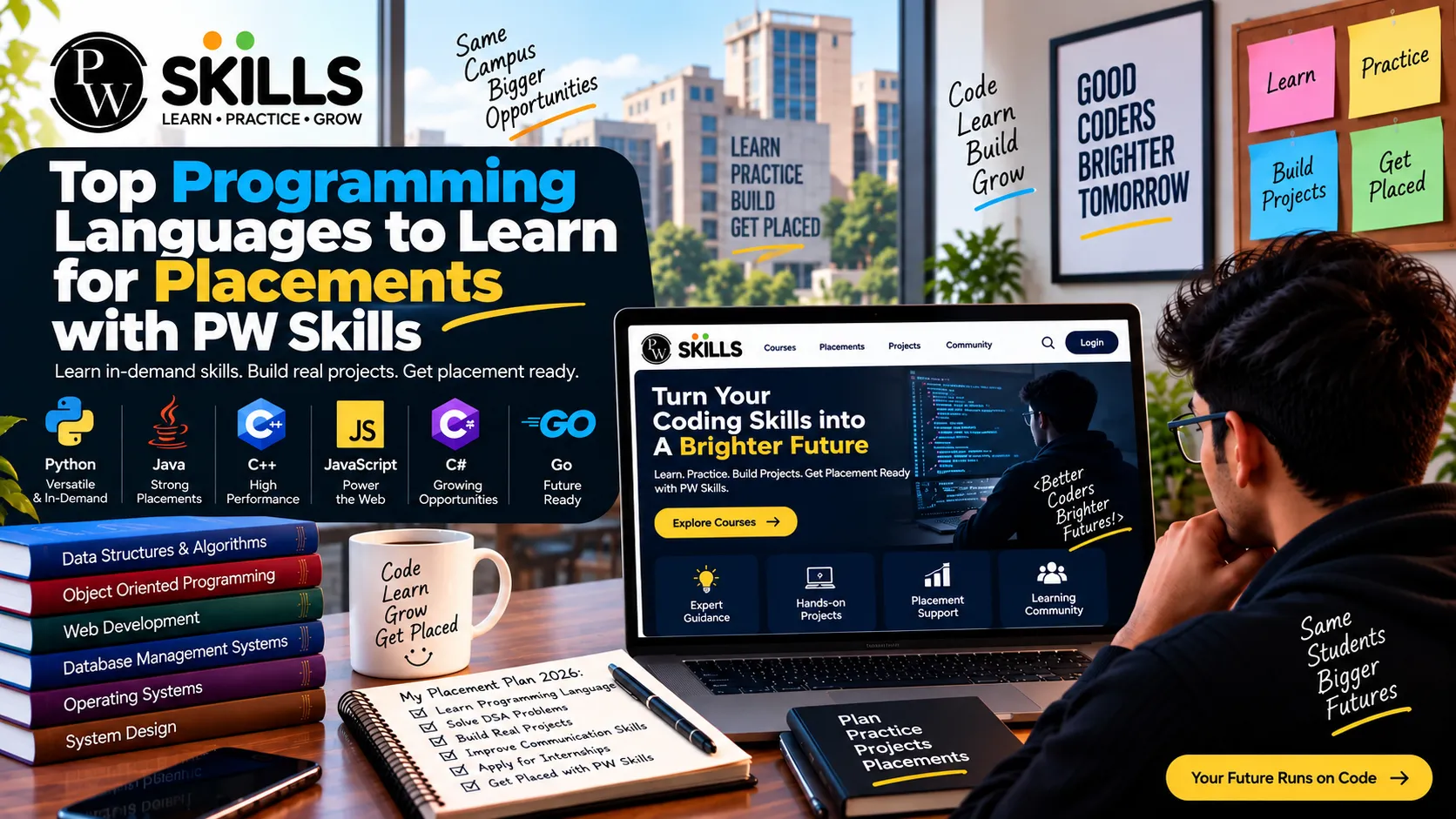
Top Programming Languages to Learn for Placements with College Wallah
 Hardik Gupta24 Sept, 2026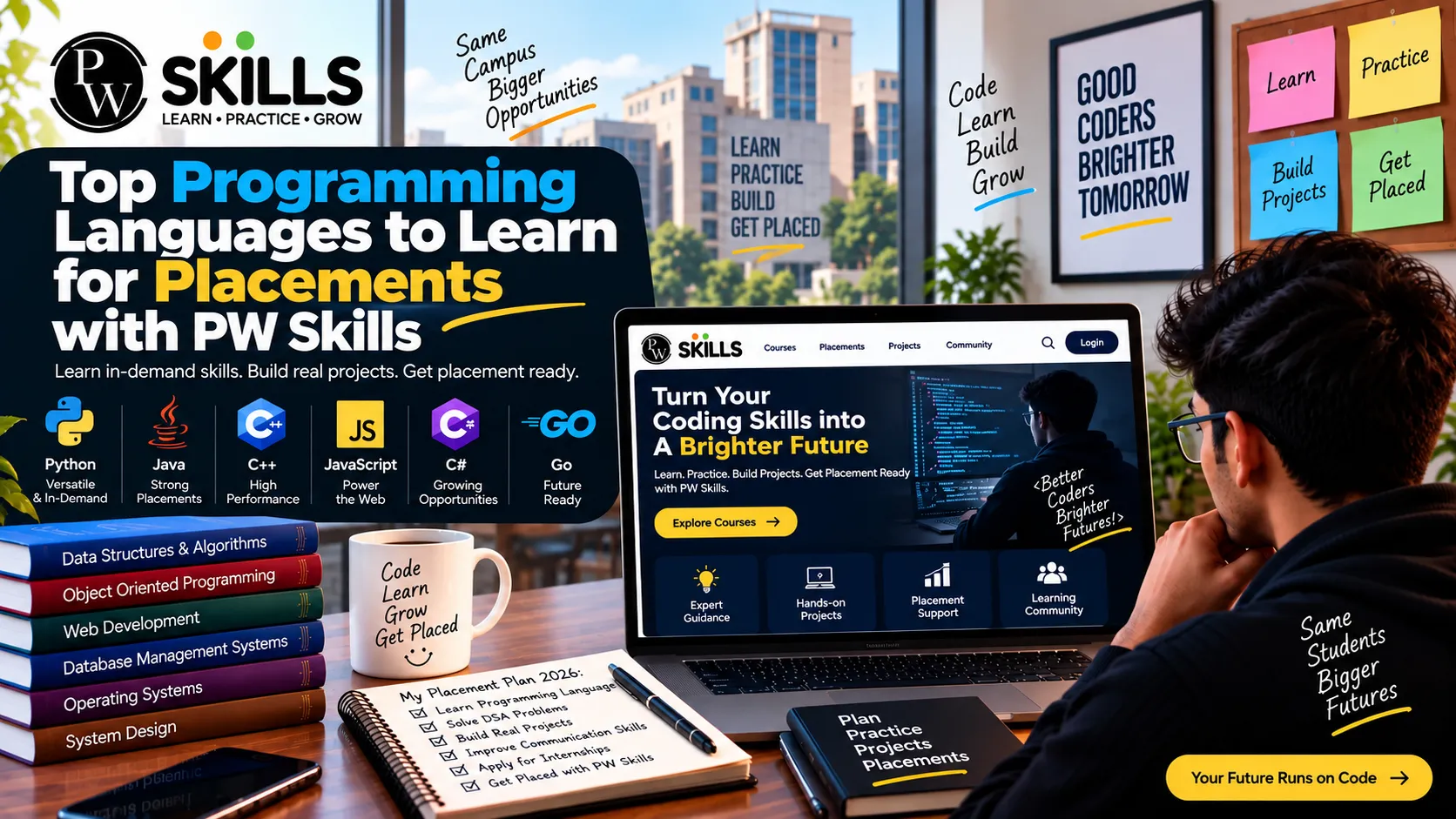
Many students make the mistake of jumping between multiple tools without building a solid base, leading to wasted effort and low confidence during technical rounds.
Selecting the right language to solve Data Structures and Algorithms (DSA) or build core projects determines how smoothly you navigate technical assessments.
Enrolling in structured College Wallah coding courses solves this exact problem by streamlining your preparation. This article breaks down the best technical stacks, offering practical guidance to help you clear coding interviews effortlessly.
Importance of College Wallah Coding Courses
Navigating self-study through unstructured internet tutorials often leads to knowledge gaps and inconsistent practice. Technical recruitment requires a clear, step-by-step approach rather than random learning. Structured educational tracks provide the exact discipline needed to turn basic concepts into interview-level problem-solving ability.
-
Structured Learning Paths: Random topics create confusion. A guided curriculum ensures you learn fundamentals, object-oriented concepts, and complex algorithms in a logical, step-by-step sequence.
-
Focus on Interview Patterns: Technical rounds test specific problem-solving patterns. Guided learning focuses heavily on actual company interview questions rather than just theoretical syntax.
-
Consistent Hands-on Practice: Practical implementation builds confidence. Regular assignments and targeted exercises force you to write clean, error-free code within time limits.
-
Peer Learning Environment: Studying alongside thousands of driven freshers keeps your momentum high and gives you clear insights into current batch standards.
Which Programming Languages Should You Learn in College Wallah Coding Courses for Placements
Choosing the right technical language is the foundation of your interview preparation strategy. Companies evaluate your logic, code efficiency, and deep understanding of computer science fundamentals. Here is a clear breakdown of the top options every student should consider.
1. C++ (The Standard Choice for DSA)
C++ remains the most popular language for competitive programming and technical screening tests. Its Speed, minimal overhead, and vast Standard Template Library (STL) make it an absolute favorite for algorithmic evaluation.
-
Standard Template Library (STL): Built-in containers like vectors, sets, maps, and stacks save significant time during live coding assessments.
-
Memory Control: Direct pointer manipulation and memory management teach you how software interacts directly with system hardware.
-
Execution Speed: Fast execution rates ensure your solutions clear strict time limits in online assessment platforms.
2. Java (Enterprise Favorite & OOP Stronghold)
Java is widely used in large corporate environments and service-based software firms. It is an ideal pick if you want to demonstrate robust Object-Oriented Programming (OOP) concepts.
-
Platform Independence: The Write Once, Run Anywhere (WORA) principle makes Java a staple across enterprise application engineering.
-
Rich Collection Framework: Java provides powerful built-in data structures that streamline complex algorithm implementations.
-
Strict Object-Oriented Design: Writing Java code forces you to adhere strictly to class hierarchies, encapsulation, and clean software architecture.
3. Python (Versatility & Data Science)
Python offers simple syntax and high readability, allowing developers to turn complex logic into fewer lines of code. It is the language of choice for roles in Machine Learning, Data Analytics, and Artificial Intelligence.
-
Readable Syntax: Beginner-friendly syntax lets you focus entirely on logic building without struggling over heavy boilerplates.
-
Extensive Libraries: Powerful frameworks like Pandas, NumPy, and TensorFlow open doors to specialized tech roles.
-
Rapid Prototyping: Ideal for quickly building backend systems and scripting solutions during hackathons and technical project rounds.
4. JavaScript & Web Development Technologies
For students aiming for Full-Stack or Frontend Engineering roles, JavaScript is non-negotiable. Modern tech interviews for web roles evaluate your ability to create scalable, interactive web applications.
-
Universal Web Language: JavaScript runs natively in the browser and powers modern server environments via Node.js.
-
High Industry Demand: Startups and product firms heavily recruit freshers fluent in React, Node, and database integration.
-
Project Value: Building full-stack web applications provides strong, tangible portfolio projects that impress interviewers immediately.
How Can College Wallah Coding Courses Help You Learn Programming Languages
Transitioning from beginner syntax to building optimized logic takes systematic practice. The educational modules inside College Wallah coding courses bridge the gap between simple textbook theories and high-stakes coding interviews.
|
Feature Area |
Self-Study via Random Tutorials |
Structured Learning with College Wallah |
|
Curriculum Structure |
Fragmented, missing key concepts |
Sequential, covering basics to advanced topics |
|
DSA Integration |
Disconnected language tutorials |
Direct mapping of language syntax to DSA patterns |
|
Practice Sets |
Standard textbook problems |
Curated interview questions from top tech firms |
|
Project Orientation |
Theoretical exercises |
Real-world application development |
|
Guidance & Mentorship |
Solitary troubleshooting |
Clear, step-by-step problem-solving frameworks |
Which Programming Language Should You Start in a College Wallah Coding Courses
Your language choice should match your ultimate career aspirations. Trying to master everything at once leads to burnout. Use the breakdown below to align your learning with target job profiles.
Path A: Target Software Development Engineer (SDE) Roles
-
Primary Recommendation: C++ or Java
-
Why Choose This: Core SDE interviews focus heavily on Data Structures, Algorithms, time complexity optimization, and system design basics. C++ and Java offer the best environment for mastering pure DSA.
Path B: Web Development & Startup Roles
-
Primary Recommendation: JavaScript (HTML, CSS, React, Node.js)
-
Why Choose This: If you want to stand out through live, working web applications, full-stack web development provides fast feedback and measurable project results.
Path C: Data Science, Machine Learning & Automation
-
Primary Recommendation: Python
-
Why Choose This: If your interests lie in working with massive data sets, building predictive models, or automating tasks, Python's ecosystem is the industry gold standard.
When to Choose the Right Programming Language in a College Wallah Coding Courses
Timing plays a critical role in how comfortably you prepare for campus recruitment drives. Deciding when to commit to a specific stack prevents last-minute panic.
-
First & Second Year of College (Exploration Phase):
-
Use this time to explore multiple technologies. Pick up Python for simple scripting, write basic C++ logic, or tinker with HTML/CSS. Building general programming skills early gives you an advantage.
-
Pre-Final Year / Semester 5 (Specialisation & DSA Phase):
-
Choose one primary language (preferably C++ or Java) and stick with it strictly for DSA.
-
Dedicate 4 to 6 months solely to algorithmic problem-solving while picking up a secondary technology like Web Development for projects.
-
Final Year / Placement Season (Revision & Mock Phase):
-
Stop switching stacks. Focus entirely on solving company-specific interview archives, refining project explanations, and practicing whiteboard coding.
Mistakes to Avoid While Learning College Wallah Coding Courses
Many ambitious candidates drop marks due to common prep traps. Avoid these frequent errors to keep your study plan effective.
-
Language Hopping: Switching from C++ to Java and then Python every two weeks prevents deep understanding. Pick one primary language for DSA and stay consistent.
-
Rote Memorising Code: Memorising solutions fails completely during live interviews when questions get tweaked. Focus on underlying patterns like two-pointer techniques, sliding windows, and recursion trees.
-
Neglecting Core CS Fundamentals: Writing code is only half the battle. Interviewers expect solid knowledge in Operating Systems, Database Management Systems (DBMS), Computer Networks, and SQL.
-
Ignoring Code Readability: Writing messy variable names or unindented code creates a bad impression. Practice writing clean, self-explanatory code with clear variable declarations.
-
Delaying Project Development: Relying only on DSA without practical projects leaves your resume light. Build at least two functional applications that showcase real-world implementation.
Enrolling in comprehensive College Wallah coding courses ensures you receive targeted guidance, preventing these mistakes and keeping your placement prep on track.



FAQs
1. Which language is best for campus placements?
2. Can I clear coding rounds using Python?
3. How long does it take to prepare for placements using College Wallah coding courses?





Get Free Counselling Today
and Clear up all your Doubts
 Live & recorded classes available at easeDashboard for progress trackingLakhs of practice questions

