
C++ Tutorials | Learn C++ Programming
The C++ tutorials consist of basic syntax, comments, data types, Object Oriented Programming, and more to help beginners learn C++ fundamentals and frameworks easily.
 Varun Saharawat15 May, 2026
The C++ tutorials are the first step in learning C++ programming. If you are familiar with the C language, then the C++ tutorials can help you learn the C language with a detailed overview of the basic and advanced concepts of C plus plus.
If you are a college or working professional save these detailed C++ tutorials to learn about CPP programming. This tutorial will make you familiar with in-depth topics about the C plus plus language.
What is C Plus Plus Programming?
C++ is a popular middle level programming language used in software development. It was developed as an extension of C language with many extra added features. Bell Labs added enhancement of the C language with added support of Object Oriented Programming and more. C++ tutorial includes the basic statements, syntax, objects and classes, inheritance, polymorphism, encapsulation, etc. C++ have features of both high level and low level programming languages. Both language C++ language and C programming have similar syntax. Let us know some important fundamentals of C plus plus.
Why Learn C++ Programming Language?
 There are many reasons to master programming or coding. However, it is important to know some facts about C++ programming language before choosing it as your coding language.
- C++ language is used for software development, system programming, and low level memory manipulation tasks.
- It can handle the principles of OOPs including its features like polymorphism, objects, classes, inheritance, and encapsulation.
- C++ consists of STL libraries, which provide a collection of functions, algorithms and data structures that can help make software development processes more effective.
- C++ Programming is the most widely used programming language for software development and system programming.
- Being a compiled language, C++ is close to hardware which enables developers to write efficient and fast programs.
- C++ offers low level memory management capabilities, enabling developers to fine-tune their applications.
- It is widely used in game development, graphics programming, and financial modeling.
- C++ is a popular choice for competitive programming due to its speed and efficiency.
C++ Basics Syntax for Print Hello World Program
Let us write a C++ program to print Hello World! On the computer screen below.| #include <iostream> int main() { cout<< “Hello World!” <<endl; return 0; } |
Output
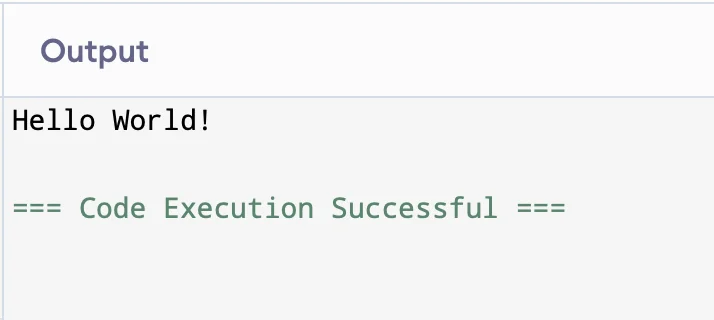
Also, Check How to Write Hello World Programming using C++ language?
Comments in C++ Tutorials
Comments are non-executable parts of the code that are not executed by the compiler. There are single line comments and multi-line comments in C++ language.Single Line Comment
The single line comment is used to add a single sentence comment in between the C plus plus program.| // This is a single-line comment |
Multi-Line Comment
The Multi Line comment is used to enclose multi-line comment sentences in between C++ programming code.| /* This is a multi-line comment */ |
Data Types in C++ Programming
The C++ language consists of more than one type of data which is used to declare variables in the code. There are two major types of data used in C++ programming.- Fundamental Data Type
- Derived Data Type in C++
- User-defined Data Type
Fundamental Data Type
Given below are some of the examples of the fundamental data type used in C++ programming language. These are basic data types in C++ language.| Type | Description |
| int | Integer numbers (e.g., -1, 0, 1). |
| float | Floating-point numbers (e.g., 3.14, -0.5). |
| double | Double-precision floating-point numbers. |
| char | Single character (e.g., 'a', '1'). |
| bool | Boolean values (true or false). |
| void | Represents "no type" for functions that do not return a value. |
| wchar_t | Wide character type for Unicode characters. |
Derived Data Types
The derived data types are made with the use of fundamental data types in C++ programming language. Let us find some of the best Derived data types below.| Type | Description |
| Arrays | Collection of elements of the same type (e.g., int arr[10]). |
| Pointers | Holds memory addresses of variables (e.g., int *ptr). |
| References | Alias for another variable (e.g., int &ref). |
| Functions | Blocks of reusable code that perform specific tasks. |
User Defined Data Type
| Type | Description |
| Arrays | Collection of elements of the same type (e.g., int arr[10]). |
| Pointers | Holds memory addresses of variables (e.g., int *ptr). |
| References | Alias for another variable (e.g., int &ref). |
| Functions | Blocks of reusable code that perform specific tasks. |
Features of C++ Programming Language
In this part of the C++ tutorials, we will discuss the major features of C++ programming language.- C++ language provides higher compatibility with multiple platforms and C language.
- Being an Object Oriented Programming Language it supports objects, classes, encapsulation, polymorphism, inheritance and more.
- C++ is widely accepted for competitive programming due to its speed and efficiency.
- It provides a Standard Template Library for programmers with data structures and algorithms frameworks consisting of containers, iterators, algorithms, etc.
- This programming language offers dynamic memory management which helps to allocate and deallocate memory blocks dynamically.
- It can handle automatic exception handling using try, catch and throw blocks.
Applications of C++ Programming Language
 There are many applications of using C++ programming language for development and programming.
- Software Development: The majority of software is developed using C++ language with all major types of web applications and system applications.
- Application Software Development: C++ language also develops operating systems like Mac Os, Windows, Linux, and other operating systems with many browsers powered up by C++ programming languages like Chrome, Firefox, Mozilla, etc.
- Game Development: C++ is widely used in game engines like Unreal Engine and CryEngine because of its high performance and real-time rendering capabilities. Software games use C++ for physics simulations, artificial intelligence, and complex game mechanics to improve their overall performance.
- Financial and Banking Applications: C++ is ideal for financial systems requiring real-time data processing and low latency. It powers applications that perform complex calculations and simulations.
- Database Management System: Many DBMS software like MySQL and MongoDB are developed in C++ due to its reliability and performance.
C++ Tutorials: Header References in C++ Programming
 The C++ consists of many header references with many uses to get enhanced output and performances.
| Header | Uses |
| <fstream> | File input and output operations. |
| <iomanip> | Manipulation of I/O formatting (e.g., precision, width). |
| <ios> | Basic I/O stream classes and constants. |
| <iosfwd> | Forward declarations for I/O stream classes. |
| <iostream> | Standard input/output stream operations (e.g., cin, cout). |
| <istream> | Input stream operations. |
| <ostream> | Output stream operations. |
| <sstream> | String stream operations (e.g., reading/writing from/to strings). |
| <streambuf> | Provides stream buffer support for I/O streams. |
| <atomic> | Atomic operations for concurrency control. |
| <complex> | Complex number arithmetic. |
| <exception> | Exception handling classes and utilities. |
| <functional> | Defines function objects and templates for functional programming. |
| <limits> | Provides numeric limits for data types. |
| <locale> | Localization utilities and settings. |
| <memory> | Memory management utilities, smart pointers. |
| <new> | Dynamic memory allocation and management. |
| <numeric> | Numeric algorithms like accumulate, inner product. |
| <regex> | Regular expression processing. |
| <stdexcept> | Standard exceptions for error handling (e.g., runtime_error). |
| <string> | String manipulation and operations. |
| <thread> | Multithreading and thread management. |
| <tuple> | Tuple utilities for grouping multiple values. |
| <typeinfo> | Runtime type identification. |
| <utility> | General-purpose utilities like pair, move. |
| <valarray> | Mathematical operations on arrays. |
| <array> | Fixed-size array data structure. |
| <bitset> | Manipulation of bits using a set-like interface. |
| <deque> | Double-ended queue data structure. |
| <forward_list> | Singly linked list data structure. |
| <list> | Doubly linked list data structure. |
| <map> | Associative container with key-value pairs. |
| <multimap> | Associative container for key-value pairs allowing duplicate keys. |
| <queue> | Queue data structure. |
| <priority_queue> | Priority queue implementation. |
| <set> | Unique sorted set of elements. |
| <stack> | Stack data structure. |
| <unordered_map> | Hash table implementation for key-value pairs. |
| <unordered_set> | Hash table implementation for unique elements. |
| <vector> | Dynamic array implementation. |
| <algorithm> | Algorithms like sort, search, and transform. |
| <iterator> | Iterator utilities for traversing data structures. |
Who Should Learn C++ Programming?
Anyone who is interested in becoming a software developer, game developer, system programmer, embedded system developer, and more can attempt to learn the basics to advanced concepts of C++ programming Language. This tutorial will help students and trainers learn C++ programming language. You will have a great level of expertise in C++ programming after reading this tutorial.Prerequisites to Learn C++ Programming
To become an expert in the C++ programming language, you must be aware of the basics of computer programming and must be familiar with using a C++ compiler, IDE, or text editor, whichever suits you the best.Learn to Decode DSA with C++ Programming
Become a certified C++ developer with PW Skills Self Paced Online program Decode DSA with C++. Get in-depth tutorials, practice exercises, module-level assignments, real world projects, and more within this course. Learn from an experienced mentor and get certified after completing the course tutorials, exercises, and projects. Build your job portfolio and experience a wide range of opportunities as a C++ developer with pwskills.com



C++ Tutorials FAQs
Q1. What is included in C++ tutorials?
Ans: C++ tutorials include its basic syntaxes, comments, data types, OOPs, STL, and other features, benefits, and applications used in software and application development.
Q2. Is C++ Language still in demand?
Ans: C++ programming language is still in demand due to its ease of use and various features like OOPs, STLs, and others which help in application development and system programming. The developers with the knowledge of C++ language are highly in demand in the market.
Q3. Is C++ good for competitive programming?
Ans: C++ is a preferred choice for competitive programming language due to its features like OOPs and STLs which offer speed and accurate programming experience.
Q4. How to learn C++ programming?
Ans: C++ programming can be learned by taking a short-term certification course and a lot of practice. The course must include a lot of examples and fundamentals of C++ programming language.


Talk to a counsellorHave doubts? Our support team will be happy to assist you!



Get Free Counselling Today
and Clear up all your Doubts
Talk to Our Counsellor just by filling out the form.
Join 15 Million students on the app today!
 Live & recorded classes available at easeDashboard for progress trackingLakhs of practice questions

