
Best Courses for College Students in 2026 to Build Job-Ready Skills with College Wallah
 Hardik Gupta24 Sept, 2026
College campuses produce millions of graduates each year, yet recruiters constantly mention a severe shortage of practical ability among freshers. Academic syllabi often teach historical concepts while corporate teams demand hands-on experience with modern tools, frameworks, and workflows.
This leaves undergraduates feeling confused, underprepared, and anxious about campus placements. To land competitive offers, you must take charge of your own practical learning path during your university years.
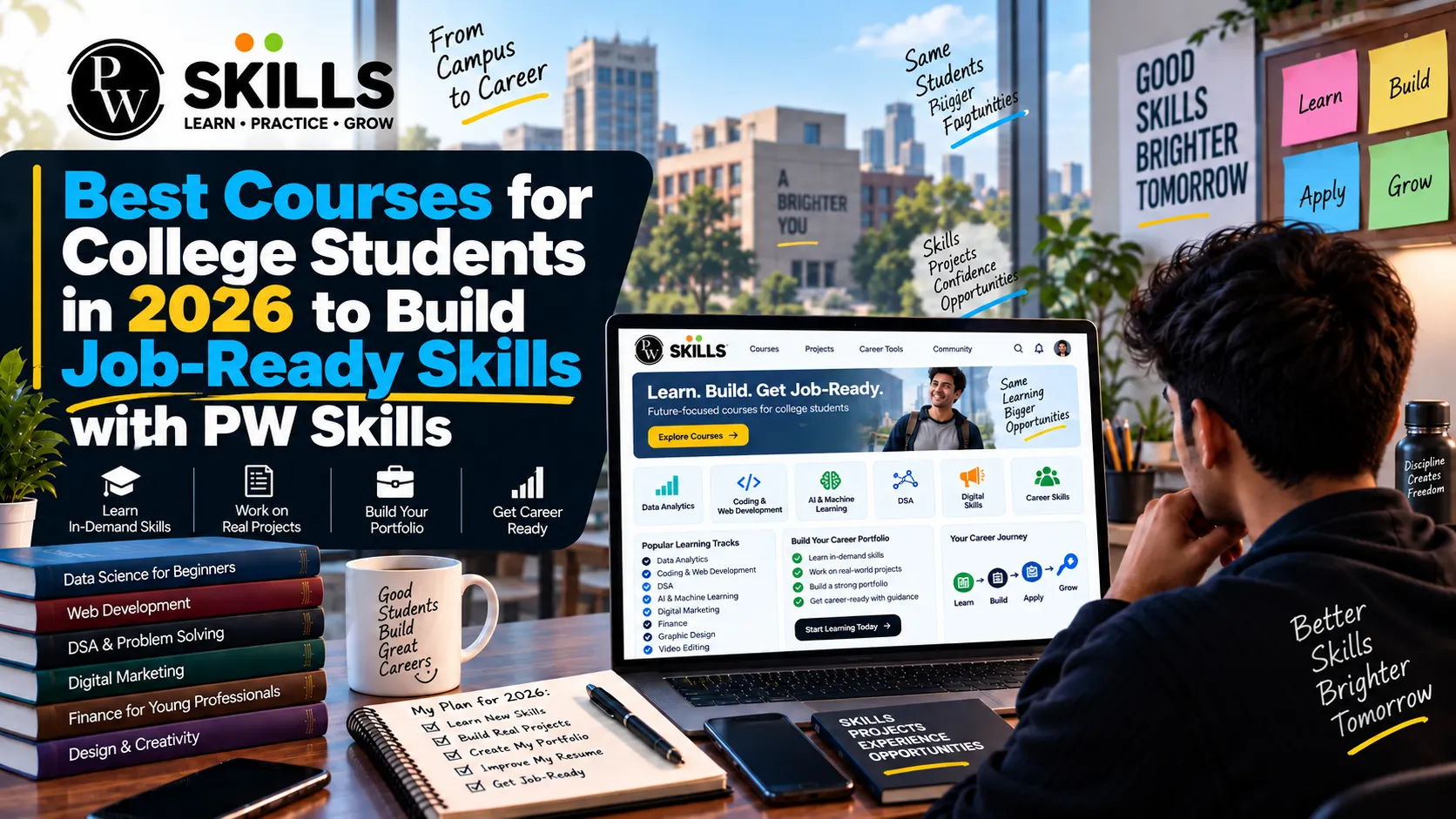
Enrolling in structured College Wallah courses for students gives you direct access to relevant tech tracks, project-based modules, and expert placement guidance designed specifically to bridge the graduate employability gap.
Overview of College Wallah Courses for Students
Undergraduate life is the perfect time to build technical competency without the pressure of an immediate employment gap. College Wallah courses for students are created to help learners transform raw curiosity into clear technical proficiency through step-by-step guidance.
These programs provide a structured environment where learning happens through active execution rather than passive reading.
By focusing on core computer science fundamentals alongside trending industry technologies, students build a comprehensive toolkit that directly aligns with modern tech interviews.
Features of College Wallah Courses for Students
Every learning module is built around clear practical application to ensure students retain key concepts effectively.
-
Structured Learning Track: Curricula begin with zero-level basics and advance logically toward complex system designs, keeping learners on track without feeling overwhelmed.
-
Industry-Relevant Curriculums: Course content focuses on modern tech stacks including React, GenAI, and Python data frameworks used by top companies today.
-
Guided Project Work: Learners do not just read theory; they write real code, debug applications, and publish portfolio-ready software repositories.
-
Aptitude and Placement Support: Modules cover quantitative reasoning, algorithmic problem-solving, and company-specific assessment strategies like TCS NQT preparation.
-
Peer Learning Environment: Collaborative spaces and doubt resolution mechanisms help maintain study momentum across multi-week tracks.
Which College Wallah Courses for Students Can Build Job-Ready Skills
Choosing the right discipline depends on your personal interests and long-term career aspirations. The following specialised tracks form the cornerstone of College Wallah courses for students seeking strong employment opportunities.
1. Data Structures and Algorithms (DSA) in C++ / Java
DSA forms the foundation of tech recruitment assessments across product companies. This module trains students to break down complex logic, optimize time and space complexity, and write clean code under timed conditions.
2. Full Stack Web Development
Web development bridges design and functional backend architecture. Learning HTML, CSS, JavaScript, React, Node.js, and database integration prepares students to build end-to-end web applications from scratch.
3. Data Analytics and Business Intelligence
Businesses rely heavily on data to drive commercial decisions. Training in Python, SQL, data visualisation, and statistical analysis enables students to transform unstructured datasets into actionable business insights.
4. Generative AI and Machine Learning Engineering
AI implementation is transforming traditional software development workflows. Courses covering artificial intelligence basics, machine learning algorithms, Large Language Models (LLMs), and prompt engineering open doors to high-demand technical roles.
5. Cyber Security and Ethical Hacking
Digital infrastructure requires constant protection against security threats. Studying fundamental network security, system penetration concepts, and defensive protocols prepares students for specialized cybersecurity domains.
How Can College Wallah Courses for Students Help You Prepare for Jobs
A college degree proves academic attendance, but real-world capability requires concrete proof of your problem-solving ability.
|
Skill Area |
Traditional College Syllabus |
Job-Oriented Skill Training |
|
Problem Solving |
Theoretical algorithm memorisation |
Hands-on DSA sheet practice and optimization |
|
Development |
Static academic projects |
Real-world full-stack web applications |
|
Aptitude Preparation |
Unstructured exam study |
Targeted quantitative and reasoning test prep |
|
Tech Readiness |
Legacy programming languages |
Modern toolstacks, version control, and AI tools |
Applying structured training directly targets hiring requirements. By solving curated skill based courses problem sets, building functional portfolio applications, and completing real-world assignments, you develop the exact operational competence recruiters seek during campus placements.
Which Skills Should College Students Learn Along with Their Degree
Relying solely on university instruction often leaves significant operational skill gaps. To stay competitive, you should pair your formal qualification with market-tested practical capabilities.
-
Algorithmic Logic: Master array operations, dynamic programming, trees, and graphs to clear initial technical screening rounds.
-
Modern Version Control: Learn Git and GitHub to manage source code, collaborate with development teams, and showcase your project portfolio.
-
Database Management: Practice drafting efficient SQL queries, relational database designs, and handling non-relational storage systems.
-
Aptitude and Logical Reasoning: Sharpen quantitative reasoning and pattern recognition needed for corporate placement assessments.
-
AI Tool Integration: Learn how to utilize AI development assistants to speed up coding, debugging, and analytical workflows.
Focusing on these job ready skills ensures you step into the employment market with practical capabilities that immediately add value to a software team.
Study Strategy Plan for Building Job-Ready Skills with College Wallah Courses for Students
Consistency is far more important than intensity when balancing degree coursework with skill advancement. Following a structured weekly schedule prevents burn-out while ensuring steady progress.
Phase 1: Foundation Building (Months 1-2)
Dedicating your early weeks to fundamental concepts creates a strong base. Spend 1.5 hours each day covering fundamental syntax, data structures, and basic algorithmic logic. Solve at least two beginner problems daily to solidify understanding.
Phase 2: Domain Deep-Dive (Months 3-4)
Transition into specific tracks like web development or data analytics. Focus on writing clean code, understanding framework mechanics, and connecting backend databases. Use weekends to work through practical tutorials and debug minor projects.
Phase 3: Project Construction (Month 5)
Apply your knowledge by building two comprehensive, real-world applications. Upload your code bases to GitHub, write clear documentation, and host your applications live to prove practical proficiency to potential employers.
Phase 4: Mock Assessments & Aptitude (Month 6)
Dedicate the final phase to interview preparation. Practice timed coding tests, take quantitative aptitude quizzes, and review core computer science fundamentals like operating systems and database design.
Tips to Choose College Wallah Courses for Students Based on Career Goals
Selecting the right track requires evaluating your current strengths against target industry roles.
-
Assess Personal Strengths: Pick software development tracks if you enjoy logic and complex problem-solving. Choose data analytics if you prefer working with numbers and business insights.
-
Review Target Job Descriptions: Look up entry-level job posts for your desired roles. Identify common skill requirements and choose training modules that match those demands.
-
Evaluate Time Availability: Pick manageable foundational tracks during busy semester exams, saving intensive project-heavy modules for term breaks.
-
Prioritise Long-Term Relevance: Focus on foundational subjects like DSA and web development first before moving into niche specialisations like GenAI.
Selecting high-quality courses for college students ensures every hour spent studying directly contributes to your long-term career growth.
Mistakes to Avoid When Choosing College Wallah Courses for Students
Avoid choosing a College Wallah course based only on popularity, discounts, or promotional offers without checking the syllabus, teaching approach, and student requirements. Compare course content, faculty, learning resources, and support to ensure the program aligns with your academic goals and preparation needs.
-
Tutorial Hopping Without Execution: Watching videos without writing code creates a false sense of learning. Always build projects alongside video modules.
-
Ignoring Aptitude Preparation: Many students focus purely on coding while completely overlooking quantitative and logical reasoning tests, leading to early rejection during placement drives.
-
Collecting Certificates Instead of Skills: Employers value working portfolio links and technical problem-solving ability over basic completion certificates.
-
Neglecting Version Control: Writing code only on local machines without publishing work to GitHub makes it difficult to show your capabilities to hiring managers.
-
Overloading Schedule: Enrolling in multiple contrasting tracks simultaneously leads to confusion. Master one core discipline before moving to the next.
Choosing targeted career oriented courses helps avoid these common pitfalls, keeping your effort focused on actions that yield real career results.



FAQs
Can beginner students with no coding background take these tracks?
How many hours a week should I dedicate to skill building alongside my college schedule?
Why is learning Data Structures and Algorithms necessary for non-CS students?
How do practical projects help during campus placement interviews?
Do placement preparation tracks include aptitude and reasoning preparation?





Get Free Counselling Today
and Clear up all your Doubts
 Live & recorded classes available at easeDashboard for progress trackingLakhs of practice questions

