

Can AI Predict Market Trends Effectively?
 Hardik Gupta9 Jul, 2026
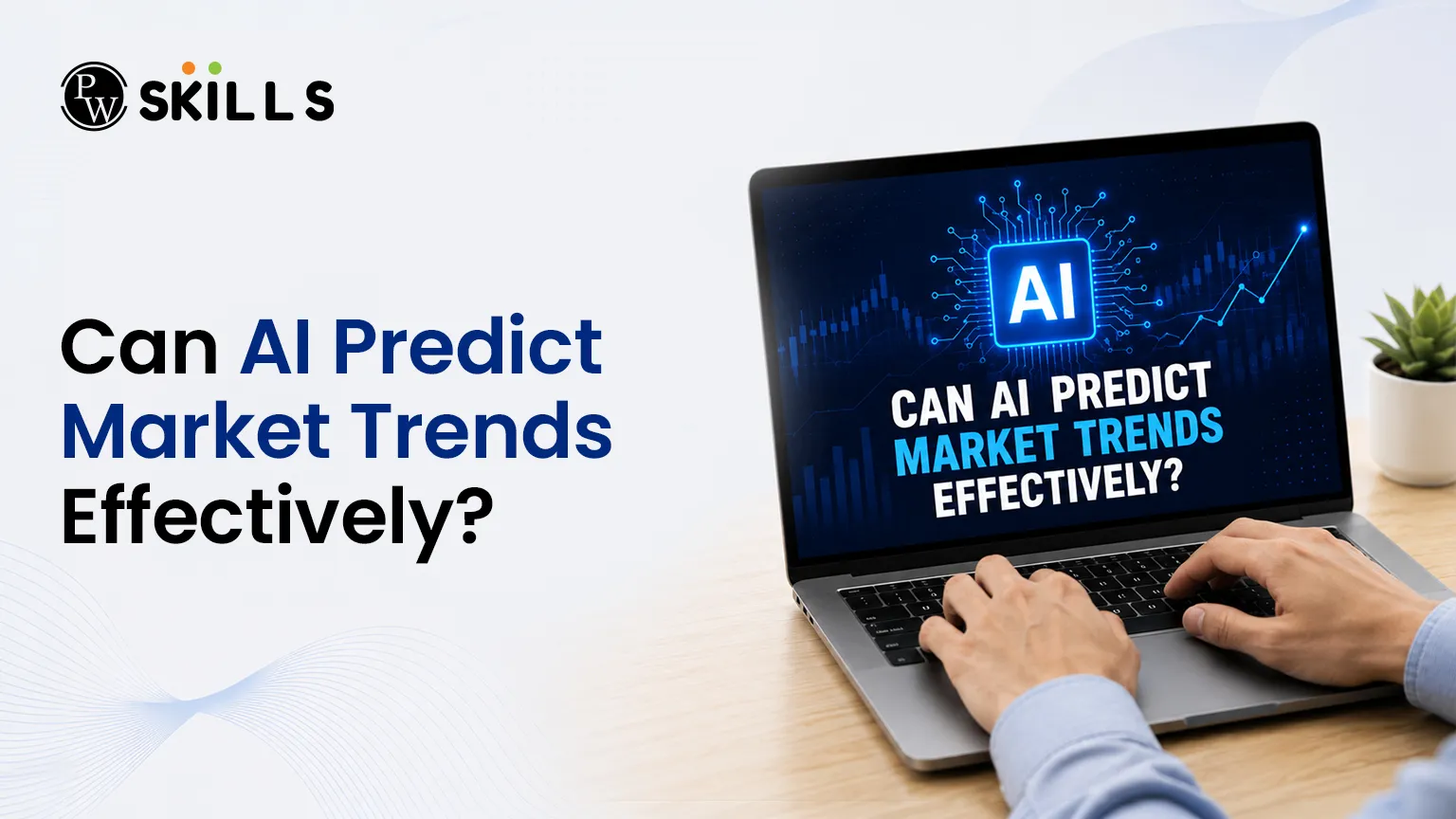
Many traders and investors now use AI Market Prediction tools to study market trends, find good trading chances, and make better investment decisions. These tools can process huge amounts of financial data in real time. They find patterns that people may miss because the data is too large or changes too quickly. This article explains how AI-powered Market Prediction works, how reliable it is, its main benefits, and the challenges of using AI in financial markets.
Is AI Market Prediction Reliable?
The success of Market Prediction depends on the quality of the data used to train the system. AI studies historical data, market movements, and different financial signals to estimate future price changes. Recent research from Grand View Research shows that the global artificial intelligence market was worth USD 390.9 billion in 2025. It is expected to reach USD 3,497.3 billion by 2033, growing at a 30.6% CAGR. This strong growth shows that businesses across many industries are using AI more than ever, including the financial sector.
AI systems are good at finding hidden patterns in large amounts of data. They can study order books, trade volumes, market trends, and economic indicators at the same time. This allows them to process information much faster than traditional software.
However, AI also has limits. These systems mainly learn from past data. If a major financial crisis or global event happens that has never happened before, AI may not make accurate predictions because it has no similar example to learn from.
Global AI Market Growth (2025–2033)
The global AI market is growing rapidly as businesses invest more in AI technologies for automation, analytics, and data-driven decision-making across industries.
|
Year |
Market Value |
|
2025 |
USD 390.9 Billion |
|
2026 |
USD 539.5 Billion (Estimated) |
|
2033 |
USD 3,497.3 Billion (Projected) |
The growth of AI also supports many business operations.
-
Deep Learning Frameworks: These systems study complex data and identify patterns that are difficult for humans to find.
-
Service Integration: Many businesses invest in AI consulting, setup, and maintenance to improve daily operations.
-
Business Automation: AI automates regular tasks, helping companies work faster and improve productivity.
How Does AI Market Prediction Help Stock Market Forecasting?
Today, many financial companies use Market Prediction to improve forecasting. Instead of checking reports manually, AI studies many types of data at the same time. It can analyze shipping records, satellite images of shopping centers, company reports, market prices, and financial news within seconds.
This gives investors a much wider view of the market than traditional methods.
AI also handles different types of financial data.
-
Different Data Formats: AI can read both structured data like stock prices and unstructured data like news articles and reports.
-
Data Cleaning: It removes incorrect or unusual values that could reduce prediction quality.
-
Real-Time Analysis: AI combines information from different countries to detect global market changes quickly.
One major advantage of stock market prediction with AI is that it reduces emotional decision-making. Human investors often make mistakes because of fear or greed. AI follows data and mathematical rules instead of emotions. This helps create more consistent trading strategies.
Top AI Trading Tools Used for Predictive Analytics
Many companies now use advanced AI tools for predictive analysis and risk management. Banks, investment firms, and insurance companies rely on these systems to study financial markets and improve portfolio performance. Instead of using simple software, they use complete AI platforms powered by high-performance hardware.
Hardware Used for Predictive Analysis
The following hardware components power predictive analysis by supporting fast data processing and AI model performance:
|
Hardware |
Main Purpose |
|
Processors |
Handle general computing tasks |
|
Accelerators |
Speed up AI and deep learning calculations |
|
Memory Units |
Provide fast access to financial data |
|
Network Nodes |
Support quick data transfer with low delay |
These powerful systems support many important financial tasks.
-
Algorithmic Trading Platforms: These AI-powered trading tools split large orders into smaller trades to reduce market impact and improve pricing.
-
Portfolio Management Systems: AI automatically adjusts investments when market conditions change while keeping risk within set limits.
-
Fraud Detection Systems: AI monitors financial transactions in real time to identify suspicious activities and reduce fraud.
Modern predictive analysis platforms use advanced hardware with deep learning models to process millions of market calculations at the same time. This allows financial companies to test different market situations, measure possible risks, and make faster investment decisions based on data instead of guesswork.
Read In Detail: Predictive Analysis: Predicting the Future with Data
Can AI Market Prediction Handle Economic Shocks?
Although Market Prediction tools can study market data quickly, it still finds it difficult to predict sudden economic shocks. Events like wars, natural disasters, policy changes, or global health emergencies can change financial markets without warning. Since AI mostly learns from historical data, it may struggle when a completely new event happens.
Limits of Market Prediction tools
Despite its advantages, AI Market Prediction has several limitations that can affect the accuracy of financial forecasts.
|
Challenge |
Effect on Prediction |
|
Data Dependence |
Needs clean and accurate historical data to work well |
|
Market Changes |
May struggle when market conditions change suddenly |
|
Overfitting |
Can mistake random price movements for real market trends |
During these situations, human experts become very important. Experienced investors can understand political events, economic policies, and business decisions that AI may not fully understand. The best results often come from using Market Prediction tools together with human knowledge instead of depending on AI alone.
Why Do Businesses Invest in AI Market Prediction?
Businesses around the world continue to spend more money on Market Prediction tools because it helps them work faster, reduce costs, and improve decision-making. Large technology companies like Microsoft and Google continue to build better AI systems and cloud platforms that make advanced tools available to businesses of all sizes.
Companies use these AI systems to improve old business processes, manage large amounts of data, and make better financial decisions. As AI becomes more powerful, more industries are adding it to their daily operations.
AI Market Growth by Region
The table below highlights the major regions driving global AI market growth and adoption across industries.
|
Region |
Growth Highlights |
|
North America |
Held 35.5% of global AI revenue in 2025 |
|
Asia Pacific |
Fastest-growing AI market across many industries |
|
India |
Expected to reach US$325,344.5 million by 2033 with a 38.1% CAGR |
Businesses use AI in several important areas.
-
Process Automation: AI handles repetitive tasks quickly, allowing employees to focus on important business work.
-
Supply Chain Management: AI predicts customer demand and helps companies manage inventory more efficiently.
-
Customer Experience: AI studies customer behavior and provides more personalized product recommendations.
These improvements help businesses make better use of data, improve daily operations, and stay competitive even when market conditions change.
Benefits of AI Market Prediction
Using Market Prediction tools offers many advantages for traders, investors, and businesses.
-
Studies large amounts of financial data in real time.
-
Improves stock market prediction by finding hidden market patterns.
-
Reduces emotional trading decisions based on fear or greed.
-
Supports faster and better investment decisions.
-
Helps manage portfolio risk more effectively.
-
Strengthens predictive analysis by combining different data sources.
-
Allows AI-powered trading tools to automate trading based on predefined rules.
-
Helps financial companies improve efficiency and lower operating costs.
Even with these benefits, AI should be viewed as a decision-support tool rather than a system that guarantees success.





Can AI Predict Market Trends Effectively FAQs
Can AI Market Prediction guarantee profits?
How is AI used for stock market forecasting?
Why do AI trading tools fail during financial crises?
Why is hardware important for predictive analytics?
Will AI replace financial advisors?







Get Free Counselling Today
and Clear up all your Doubts
 Live & recorded classes available at easeDashboard for progress trackingLakhs of practice questions

