

The Future of Financial Decision-Making with AI
 Hardik Gupta8 Jul, 2026
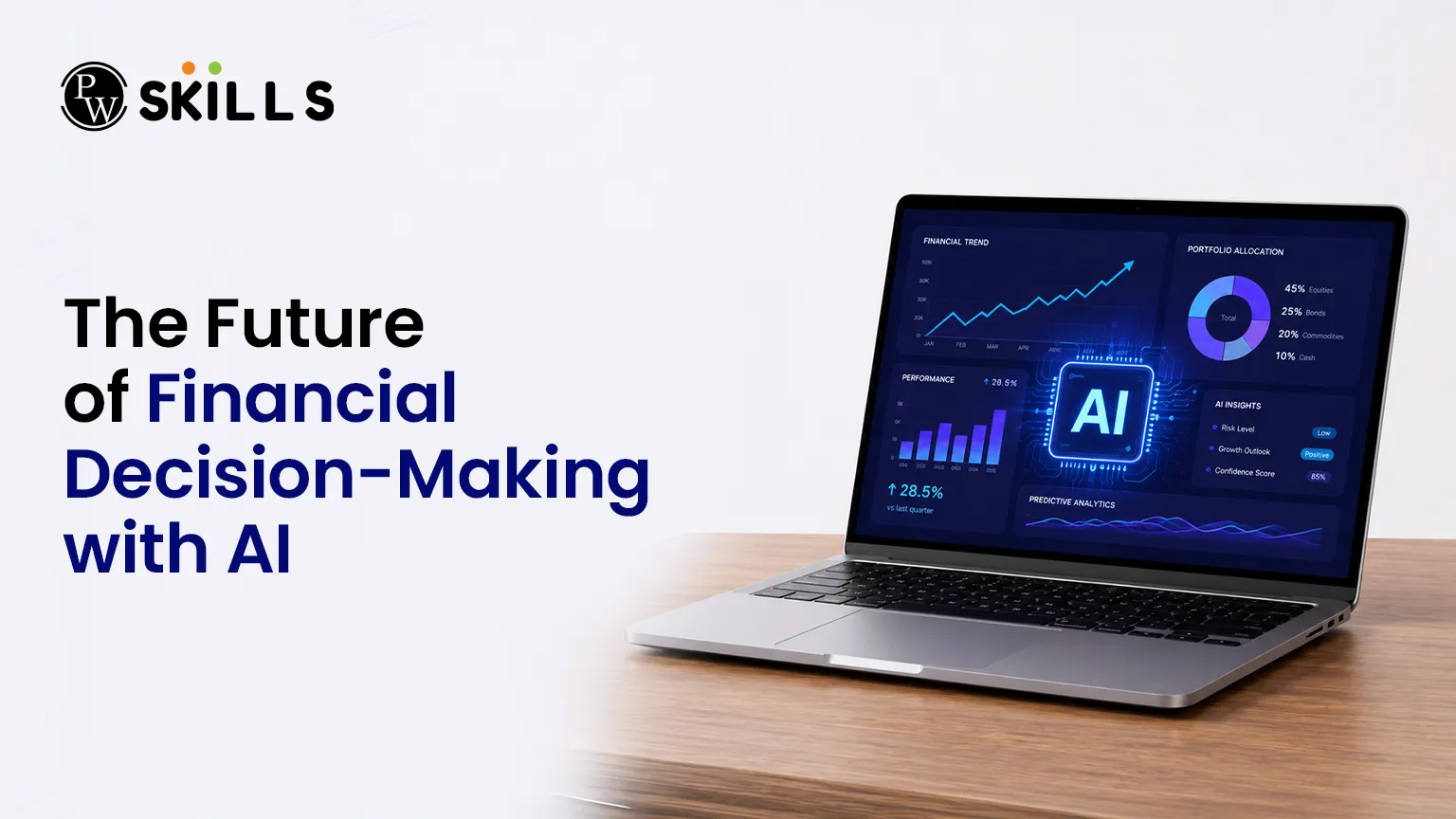
Financial markets are growing faster than ever, creating huge amounts of data every second. Traditional statistical tools often cannot handle complex market patterns, which can lead to poor predictions and wrong decisions. Human emotions and personal opinions can also affect financial choices. This is why many businesses are now using AI in Financial Decision Making. AI helps process large amounts of information quickly and builds smarter systems that support better business and investment decisions.
Importance of AI in Financial Decision Making
Today's financial world changes every second. Markets move quickly, customer behavior changes, and global events affect investments almost instantly. Because of this, businesses need technology that can work much faster than people.
In the past, financial decisions depended mainly on human knowledge, experience, and traditional statistical models. These methods helped build the modern banking system, but they also had many limits. People can become tired, emotional, or miss important information when studying large amounts of data. Even experienced analysts can make mistakes after working for long hours or during stressful market conditions.
Today, financial companies create massive amounts of digital information every second. This includes payment records, investment data, customer transactions, online news, and even social media posts. Traditional systems cannot study all this information quickly enough. As a result, important market signals may be missed.
Read In Detail: What Is Financial Data Analysis?
Human Intuition
People often make financial decisions based on emotions, personal opinions, or past experiences. Fear, excitement, or overconfidence can affect investment choices and risk analysis.
AI systems do not rely on emotions. Instead, machine learning models study both historical market data and real-time financial information before making recommendations. Every decision is based on facts and data rather than personal feelings.
Modern AI systems also use technologies like natural language processing and cognitive computing. These technologies can read financial reports, company news, earnings announcements, and other important documents to understand how they may affect investments.
Because AI removes emotional thinking, businesses can make more balanced financial decisions that are supported by reliable information.
AI also helps risk managers discover hidden connections between different financial markets.
Traditional analysis often looks at one market at a time. However, many financial events are connected in ways that are difficult for humans to recognize.
AI studies thousands of market relationships at once. It can find hidden links between stocks, bonds, currencies, commodities, and other financial assets. This gives businesses a better understanding of possible risks before problems become larger.
Digital Data
Modern financial markets create enormous amounts of information every day.
Banks, investment firms, insurance companies, and online payment platforms generate millions of transactions every hour. Managing this information manually is almost impossible.
Advanced AI systems can process gigabytes of financial data within seconds. They continuously monitor markets without taking breaks and immediately update financial models whenever new information becomes available.
If an important global event happens, such as an interest rate change or a major economic announcement, AI systems can include that information in their analysis almost instantly.
This allows businesses to react much faster than traditional financial systems.
Another important benefit is automation.
Many financial professionals spend hours collecting data, preparing reports, and organizing spreadsheets.
Using AI-powered finance, these repetitive tasks can be completed automatically.
Instead of spending time on manual reporting, financial teams can focus on business strategy, investment planning, and solving complex problems.
This improves productivity while keeping financial reports accurate and up to date.
Applications of AI in Financial Decision Making
Banks, investment firms, insurance companies, and financial service providers use AI to improve customer service, manage investments, reduce risks, detect fraud, and automate daily operations.
These practical applications show how AI helps businesses complete financial tasks with greater speed, accuracy, and efficiency.
Investment Management and Portfolio Optimization
Investment management has changed significantly because of AI.
Modern investment platforms use machine learning algorithms to study market trends, predict future prices, and build stronger investment portfolios.
Instead of only looking at past market performance, AI studies many different factors at the same time.
These include:
-
Historical price movements
-
Market trends
-
Economic conditions
-
Company performance
-
Global financial events
-
Investor behavior
By studying all these factors together, AI can make more accurate predictions about future investment opportunities.
|
Strategy Component |
Traditional Methodology |
AI-Driven Methodology |
|
Data Processing |
Manual spreadsheet analysis and historical charts |
Automatic analysis of large structured and unstructured datasets |
|
Portfolio Rebalancing |
Manual updates at scheduled times |
Automatic portfolio changes based on live market conditions |
|
Trend Identification |
Basic statistical models |
Neural networks that find hidden market patterns |
Modern portfolio management systems automatically adjust investments based on changing market conditions.
If the market becomes risky, AI can reduce exposure to certain assets.
If new opportunities appear, the system can quickly increase investments where higher returns are expected.
This continuous monitoring helps protect investments during market uncertainty while also improving long-term returns.
Using financial planning technology, both large financial institutions and individual investors can build investment portfolios that match their financial goals and risk levels.
AI also helps wealth managers create more personalized investment plans by studying each client's financial needs, investment history, and future goals.
Credit Scoring and Risk Assessment
Traditional credit scoring systems usually look at only a few factors, such as income, repayment history, and existing loans.
While these methods work well for many customers, they often fail to evaluate people who have limited banking history.
As a result, many individuals struggle to receive loans even if they are financially responsible.
Modern AI systems use predictive analytics to study a much wider range of information.
Instead of looking at only traditional credit reports, they can also analyze:
-
Spending habits
-
Monthly income patterns
-
Bill payment behavior
-
Employment history
-
Financial stability
-
Other socioeconomic information
This gives lenders a more complete picture of each borrower.
Because AI studies many different data sources, it can predict the chances of loan repayment more accurately than traditional credit scoring models.
This reduces financial risk for banks while also giving more people access to loans.
Using these analytics, financial institutions can safely approve loans for customers who may have been rejected under older scoring systems.
This creates a more inclusive financial system while still protecting lenders from unnecessary risk.
Algorithmic and High-Frequency Trading
High-frequency trading is one of the biggest uses of AI in Decision Making. These trading systems use advanced AI models and deep reinforcement learning to study live market data and make trading decisions within milliseconds.
AI can quickly find small market opportunities that human traders cannot see. Since these opportunities often disappear in a fraction of a second, speed is very important.
[Real-Time Market Data Ingestion]
│
▼
[AI Trading Algorithm / Reinforcement Learning]
│
▼
[Instantaneous Order Execution (Microseconds)]
│
▼
[Transaction Cost Minimisation & Profit Capture]
These AI trading systems continue learning from new market data every day. As market conditions change, the algorithms automatically update their trading strategies to improve performance.
They can also reduce trading costs by choosing the best time to buy or sell assets. This helps businesses increase profits while lowering unnecessary expenses.
Another benefit is improved market liquidity. Since AI systems place orders very quickly, buyers and sellers can trade more easily. This helps keep bid and ask prices closer together across major financial markets.
Fraud Detection and Financial Security
Protecting financial systems has become more difficult because online fraud continues to increase every year. Financial institutions now use AI to monitor transactions all day without stopping.
Machine learning models study millions of transactions and learn what normal customer behavior looks like.
When unusual activity appears, the system immediately detects it.
[Incoming Transaction Data]
│
▼
[Behavioral Analytics Engine]
│
┌──────────────┴──────────────┐
▼ ▼
[Normal Patterns] [Anomalous Behavior]
│ │
▼ ▼
[Approved Execution] [Immediate Alert & Block]
These systems can identify many types of financial crimes, including:
-
Identity theft
-
Credit card fraud
-
Money laundering
-
Fake account activity
-
Unauthorized transactions
Because AI continuously learns from new fraud methods, it becomes better at detecting attacks over time.
Instead of relying only on fixed security rules, AI adjusts itself whenever criminals develop new techniques.
This helps financial companies reduce losses, improve customer safety, and meet government security requirements.
Benefits of AI in Financial Decision Making
Using AI gives financial institutions many important advantages. These systems improve decision-making, reduce mistakes, and help businesses respond faster to changing market conditions.
Higher Predictive Accuracy
AI studies large amounts of complex financial data much faster than traditional software.
Because it can analyze hidden market patterns and non-linear relationships, it often predicts future market movements more accurately.
This helps businesses make smarter investment and business decisions.
Minimized Human Bias
Human emotions like fear, excitement, or overconfidence can affect financial decisions.
AI removes these emotional influences by making decisions based on data instead of personal opinions.
This creates more objective investment strategies and risk assessments.
Optimal Resource Allocation
Many financial tasks involve repetitive work such as collecting data, cleaning spreadsheets, and preparing reports.
Using AI-powered finance, these tasks can be completed automatically.
This allows employees to spend more time on planning, customer service, and solving complex financial problems.
Lower Transaction Costs
AI trading systems study market prices in real time and choose the best moments to buy or sell.
This reduces unnecessary trading costs while improving returns for businesses and investors.
Broader Financial Inclusion
Modern AI systems study many different types of financial information instead of relying only on traditional credit history.
This allows lenders to approve loans for people with limited banking records while still managing financial risk effectively.
These advantages show why many financial organizations are replacing older systems with AI finance. AI creates faster, smarter, and more reliable financial operations that support long-term business growth.
Also Check: Financial Management Explained: Scope, Objectives & Importance
Challenges of AI in Financial Decision Making
Although AI offers many benefits, it also creates new challenges that financial institutions must manage carefully.
Businesses need strong rules, security systems, and ethical practices to ensure AI is used safely and fairly.
Algorithmic Transparency and Explainable AI
One major challenge is understanding how AI makes decisions.
Traditional computer programs follow clear instructions written by developers.
Deep learning models are much more complex.
They process information through thousands of hidden calculations, making it difficult to explain why a loan was rejected or why a certain investment recommendation was made.
This is often called the "black box" problem.
To solve this issue, many financial companies now use Explainable AI.
Explainable AI provides simple explanations showing which factors influenced each decision.
This helps:
-
Build customer trust.
-
Improve transparency.
-
Support government regulations.
-
Reduce unfair decision-making.
When customers understand how decisions are made, they are more likely to trust AI systems.
Ethical Concerns and Data Security Risks
AI systems need large amounts of customer information to work properly.
This includes financial records, payment history, spending behavior, and many other personal details.
If training data contains old human bias, AI models may accidentally repeat unfair decisions.
For example, an AI system could incorrectly reduce loan approvals for certain groups if it learns from biased historical data.
This makes fairness an important part of AI development.
Protecting customer information is also a major responsibility.
Because financial databases contain sensitive personal information, they are attractive targets for cybercriminals.
Financial institutions protect these systems by using:
-
Advanced encryption
-
Secure data storage
-
Multi-level access controls
-
Continuous security monitoring
-
Strong cybersecurity policies
These protections help keep customer information safe while maintaining trust.
Regulatory Compliance and Standards
Governments around the world continue to introduce new rules for AI systems used in finance.
Financial institutions must make sure their AI models follow these regulations.
Regulators often require businesses to explain:
-
How automated lending decisions are made.
-
How AI trading systems work.
-
How customer data is protected.
-
How AI avoids discrimination.
Because regulations continue to change, companies regularly test and review their AI systems.
This requires close cooperation between:
-
AI engineers
-
Financial experts
-
Risk managers
-
Legal teams
-
Government regulators
Working together helps businesses use AI safely while protecting customers and keeping financial markets stable.





FAQs
How does the use of AI in Financial Decision Making improve modern investment strategies?
What role does predictive analytics play in modern credit risk assessment?
Why is explainability critical when deploying AI in Financial Decision Making?
How do modern automated models protect banking systems from transactional fraud?
Can financial planning technology expand access to capital for underserved populations?







Get Free Counselling Today
and Clear up all your Doubts
 Live & recorded classes available at easeDashboard for progress trackingLakhs of practice questions

