

NSDC Update 2026: What It Means for Data Science Learners
 Hardik Gupta28 Oct, 2026
The NSDC Updates 2026 are worth following if you are planning your skill development. The National Skill Development Corporation (NSDC) works with partners to support skill development in India. However, not every private training course is automatically approved or certified by NSDC. Learners should verify the details of a course before enrolling.
What Are the Main NSDC Updates 2026 for Technical Education?
The National Skill Development Corporation supports skill development and vocational training through different partnerships and programmes. Its work is connected to India's wider efforts to improve workforce skills and make training more useful for employers.
Learners should seek formal information about changes in credentials, training programmes, assessment techniques, and certification requirements while following the NSDC Updates 2026. They should not assume that every new technology or course feature is a required national standard.
Learners can visit the official National Skill Development Corporation (NSDC) website to review information about its skill development initiatives, training programmes, and industry partnerships before enrolling in a course.
There are several useful areas to check when reviewing a training programme:
-
Course learning outcomes: Check whether the course clearly explains what students should know and be able to do after completing it.
-
Practical assessments: Find out whether students must complete assignments, coding exercises, or projects to demonstrate their skills.
-
Certification details: Confirm which organisation issues the certificate and whether the programme has official recognition.
-
Industry relevance: Review whether the topics match the skills used in current data and technology roles.
-
Training quality: Check the trainers' experience, course material, project support, and assessment process.
These checks can help learners compare different programmes. They also reduce the risk of choosing a course based only on claims about government recognition or job placement.
How Can NSDC Updates 2026 Affect a Data Science with Generative AI Course?
A Data Science with Generative AI Course helps learners understand data science and emerging AI tools. The syllabus depends on the training provider, so students should check the course details before joining.
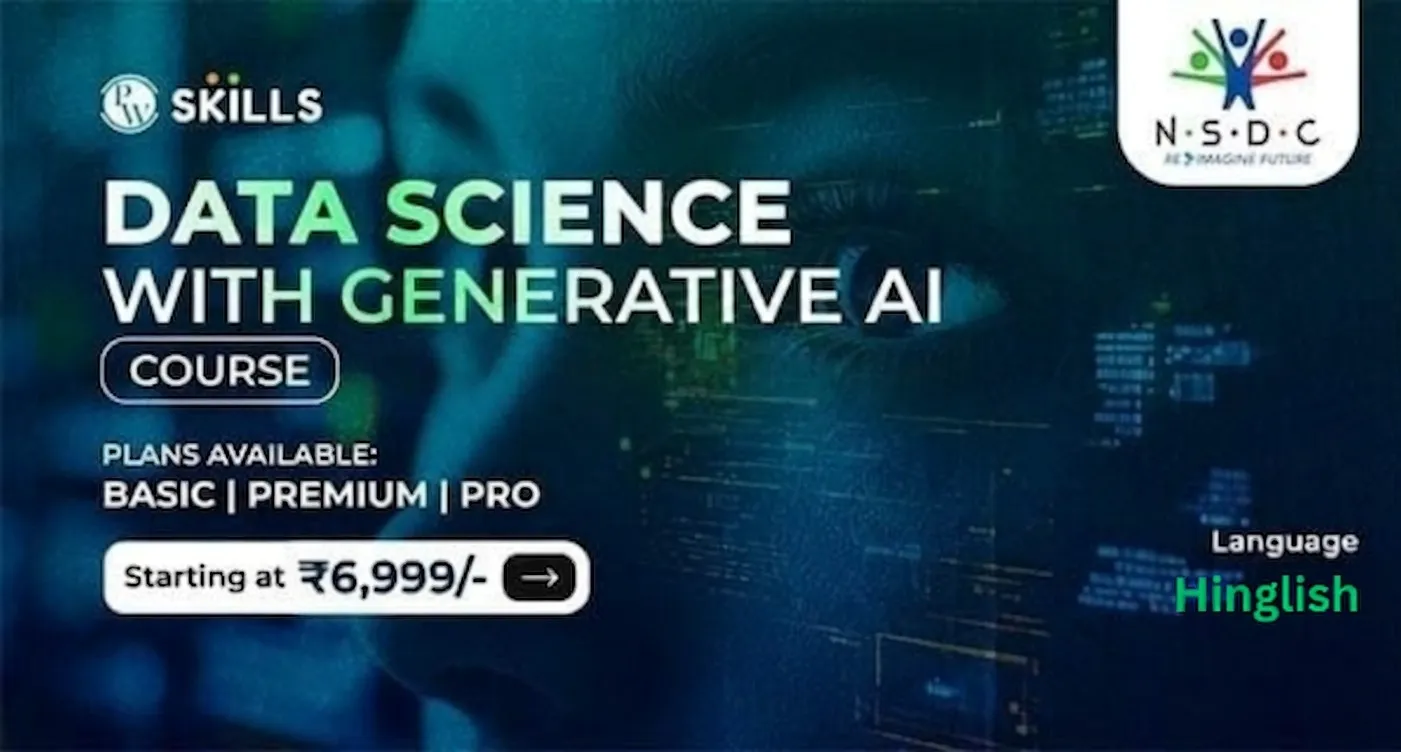
For example, the Data Science with Generative AI course covers areas such as programming, statistics, machine learning, deep learning, Natural Language Processing (NLP), and Generative AI. Reviewing a programme's curriculum can help learners understand how its topics relate to their career goals.
A good course may cover these topics.
1. Data foundations
Students learn Python, SQL, spreadsheets, and basic statistics. These skills help them collect, clean, organise, and study data. They are useful for many data-related jobs.
Beginners can explore a Data Science course in Python to understand how programming, data handling, and Python libraries contribute to practical data science work.
2. Machine learning
Machine learning allows computers to identify patterns in data and make predictions. Students may study regression, classification, model testing, and methods for training and evaluating models.
Learners can read about a Python machine learning course to understand how Python supports machine learning concepts and model development.
3. Generative AI
Generative AI technologies can generate text, code, summaries, and other types of information. Students may learn about large language models (LLMs), prompt engineering, and how to use AI models in business applications.
4. Retrieval-Augmented Generation
Retrieval-Augmented Generation, also called RAG, combines information retrieval with a language model. It helps AI applications answer questions using selected documents or other sources. Students should also learn that AI can give incorrect answers and understand privacy risks and the importance of checking results carefully.
5. Deployment and maintenance
More advanced courses may include Git, Docker, cloud services, and machine learning operations (MLOps). These technologies help teams manage and deploy machine learning models. The level of training depends on the programme.
Learners should confirm which topics are included in their chosen programme. They should also check whether the course offers guided practice instead of only recorded lessons or theory. A Data Science with Generative AI course checklist can help learners review the curriculum, tools, projects, and learning components before making a decision.
Importance of NSDC Updates 2026 for Applied Data Scientist Jobs News
Data Science with Generative AI Course and Applied Data Scientist Jobs News can help learners understand the changing skills employers seek. However, job trends should be checked against actual job listings and reliable hiring reports rather than broad claims about demand.
Applied data scientists often work with data to solve business problems. Their tasks may include preparing datasets, building models, measuring results, and explaining findings to other teams. In some roles, they may also work with Generative AI applications.
Employers may look for skills such as:
-
Python programming and SQL queries.
-
Statistics and data analysis.
-
Machine learning and model evaluation.
-
Data visualisation and clear reporting.
-
Problem-solving and communication.
-
Knowledge of AI tools and their limitations.
Some roles also require experience with cloud platforms, deployment, or large language models. These requirements depend on the company and the level of the position.
A certificate can demonstrate that a learner has completed a programme, but employers may also examine practical experience, project quality, interview performance, and the ability to explain technical decisions.
To prepare for job applications, learners should build projects that solve clear problems. For example, they could create a customer churn model, analyse sales trends, or build a document-based question-answering tool. Each project should explain the problem, data used, method, results, and limitations.
Statistics is particularly useful when interpreting data and evaluating model performance. Learners can explore how statistics applies on the job to understand how statistical concepts support practical analysis and business decisions.
How Should Learners Check Regulatory Requirements for AI Training?
The term regulatory requirements refers here to regulations and responsible AI practices. It should not be treated as the name of an official NSDC rule unless an authoritative source confirms that meaning.
Artificial intelligence systems carry risks when they handle private information, provide misleading answers, or produce biased conclusions. Students should be aware of these risks when learning to build data science applications.
Important areas include:
-
Data privacy: Learn how to handle personal and confidential information carefully.
-
Bias and fairness: Understand how data and model design can lead to unfair outcomes.
-
Accuracy checks: Test model results instead of accepting every prediction or AI-generated answer.
-
Human review: Keep people involved when AI outputs affect important decisions.
-
Clear documentation: Record the data, methods, assumptions, and limitations of a project.
Learners should also check the rules that apply to their specific work and location. The relevant legal requirements can depend on the type of data, application, organisation, and sector.
Following responsible practices can make projects stronger and help learners understand the expectations they may face in a professional setting. It does not, by itself, prove that a course or certificate has official regulatory approval.
What Does the LinkedIn Emerging Jobs Report India Tell Data Science Learners?
This report is relevant to research on changing job roles. Before using a particular report to make claims about hiring in 2026, readers should check its publication date, methodology, and findings. A report from an earlier year should not automatically be treated as evidence of current hiring conditions.
In general, data and AI skills can be useful across several industries. The work and technical requirements differ from one sector to another.
Banking and financial services: Data teams may study transactions, assess risk, identify unusual activity, and support customer analysis. These roles can require knowledge of statistics, data security, and financial processes.
E-commerce and retail: Companies may analyse sales, customer behaviour, stock levels, and demand. Machine learning can support recommendations and forecasting, although results need regular testing.
Healthcare: Data analysis may help researchers and healthcare organisations study information and improve planning. Work involving patient data requires particular care with privacy, accuracy, and applicable rules.
Enterprise software: Technology companies may develop data platforms, AI assistants, and automated workflows. Some positions require experience with APIs, databases, cloud tools, or model deployment.
These examples show why learners should combine technical knowledge with an understanding of the problem they want to solve. They should not be taken as proof that every sector is currently increasing its hiring or that a particular certificate will lead to employment.
Skill development can also take place through structured academic programmes. For example, add-on courses for MBU students describe technical learning tracks that include data analytics, data science, AI and machine learning, and full-stack development. Such options illustrate how different learning pathways can address different technical interests.
How Do NSDC Updates 2026 Help Learners Compare Training Courses?
Learners can compare programmes by checking the syllabus, assessment method, practical work, and certificate issuer. The table below provides a general checklist. It does not claim that every item is a new NSDC requirement.
| Feature | What to check before enrolling |
|---|---|
| Core subjects | Python, SQL, statistics, and data analysis |
| Machine learning | Model training, testing, and evaluation |
| Generative AI | LLMs, prompting, and practical applications |
| Projects | Clear tasks with measurable results |
| Deployment | Whether Git, Docker, or MLOps are covered |
| Assessments | Assignments, tests, and project reviews |
| Certification | The issuing organisation and verified recognition |
| Career support | The actual services offered and any stated conditions |
Be careful with claims such as guaranteed jobs, mandatory projects, or automatic government recognition. Ask the training provider for written details and verify official claims through the relevant organisation.
Learners should also review the Data Science course outline to understand how topics such as Python, databases, statistics, machine learning, and other technical subjects may be organised into a learning pathway.
When comparing programmes, consider whether the content matches your intended role. Someone interested in data analysis may prioritise Python, SQL, and statistics, while someone interested in AI application development may need additional knowledge of LLMs, RAG, and deployment.
How Can Students Prepare for Data Science Jobs After NSDC Updates 2026?
Students can follow a simple plan to develop their skills and prepare for entry-level opportunities.
Step 1: Learn the basics. Start with Python, SQL, statistics, and data cleaning. Practise using small datasets until you can explain your work clearly.
Step 2: Build machine learning knowledge. Learn how to select a model, split data into training and test sets, measure performance, and identify common errors.
Step 3: Explore Generative AI. Understand prompts, model limitations, and how applications use external information. Build a small project and test its answers carefully.
Step 4: Create a portfolio. Complete a few well-documented projects. Explain the problem, the steps you followed, the results, and what you would improve.
Step 5: Review job descriptions. Compare entry-level data analyst and applied data scientist roles. Make a list of repeated skills and use it to guide your learning.
Step 6: Check the credentials. If a course claims to be NSDC-aligned or government-recognised, check the issuing body, course name, and official details before paying.
Step 7: Compare career support carefully. Learners should check what a training provider actually offers, including interview preparation, mentorship, and placement assistance where applicable. The Data Science with Generative AI course placement support guide explains the types of career support learners should review before enrolling. Read the eligibility conditions and distinguish interview assistance from a guarantee of employment.









Get Free Counselling Today
and Clear up all your Doubts
 Live & recorded classes available at easeDashboard for progress trackingLakhs of practice questions


