

Data Science with Generative AI Course Checklist: Is This Career Path Right for You in 2026?



Many professionals and students struggle to choose between traditional data analytics and emerging artificial intelligence tracks, wondering if learning advanced AI tools is truly worth the time and financial investment. A complete Data Science with Generative AI Course bridges this exact gap by taking you from foundational programming to deploying production-ready Large Language Models.
What Is a Data Science with Generative AI Course?
This course is an 8-month training program designed to teach foundational data analytics, statistical modeling, machine learning algorithms, deep learning, and practical artificial intelligence concepts. Unlike traditional analytics programs that focus solely on descriptive or predictive modeling, this curriculum incorporates advanced topics like Large Language Models (LLMs), Prompt Engineering, Retrieval-Augmented Generation (RAG), and vector databases.
It fills the gap between direct manipulation of data and sophisticated autonomous systems. Learners go through a planned pathway covering essential industrial tools:
- Foundational Analytics: Excel, SQL, and database concepts (NoSQL) for raw data handling.
- Core Programming: Python libraries including Pandas, NumPy, Matplotlib, and Seaborn for data manipulation and Exploratory Data Analysis (EDA).
- Machine Learning & Deep Learning: Regression, classification, clustering, Neural Networks (ANN, CNN, RNN), and MLOps tools like Docker.
- Generative AI Stack: LangChain, Hugging Face, vector databases, model fine-tuning, and LLM evaluation frameworks.
By blending standard data infrastructure skills with cutting-edge artificial intelligence, the course equips you to solve real-world industry problems end-to-end.
Who Should Enroll in the Data Science with Generative AI Course?
Understanding who benefits most helps you determine if your background fits the program. The curriculum is built to accommodate learners at varying stages of their career journey through progressive step-by-step instruction.
The course serves three primary learner profiles:
1. Complete Beginners and Fresh Graduates
If you are starting from scratch, the curriculum begins with fundamental computational principles, basic logic building, and introductory mathematics. You do not need a prior degree in computer science, though a basic comfort level with quantitative reasoning is helpful.
2. Working Professionals Seeking a Career Switch
IT professionals, software testers, system administrators, and domain specialists looking to pivot into higher-growth technical tracks can leverage this training to transition into data-driven roles without starting over from entry-level positions.
3. Traditional Analysts and Data Engineers
Data analysts working primarily with legacy tools like Excel or basic SQL can use this curriculum to learn predictive modeling, Deep Learning, MLOps, and generative workflows, elevating their position in the modern tech market.
What Are the Prerequisites for a Data Science Course?
Before signing up, review this practical checklist to ensure you meet the baseline requirements for a smooth learning experience:
- Basic Programming Knowledge: Familiarity with basic logic building or any object-oriented language is helpful, though foundational Python is taught during early modules.
- Mathematical & Statistical Concepts: Comfort with high-school level algebra, basic calculus, linear algebra, probability, and inferential statistics.
- System Hardware: A reliable computer setup with at least 8 GB of RAM and a stable internet connection to run local environments, Jupyter Notebooks, and cloud-based IDEs.
- Weekly Time Commitment: Ability to dedicate 8 to 10 hours per week across live weekend sessions, assignments, and self-directed practice.
- Analytical Mindset: Curiosity for solving unstructured business problems, working with complex datasets, and testing hypothesis-driven models.
How Does a Data Science with Generative AI Course Teach NLP?
Understanding NLP concepts is vital because Natural Language Processing serves as the core framework for all modern generative systems. Before an AI model can summarize text or write code, it relies on structured NLP pipelines to process human language into mathematical representations.
Key Topics in the Curriculum
- Text Preprocessing & Tokenisation: Cleaning unstructured text data, stop-word removal, lemmatization, and tokenization techniques.
- Feature Extraction & Embeddings: TF-IDF, Word2Vec, and modern transformer-based contextual embeddings.
- Sequential Architectures: Recurrent Neural Networks (RNNs) and Long Short-Term Memory (LSTM) networks for sequence modeling.
- Attention Mechanisms & Transformers: Understanding how attention layers allow language models to parse context across long text sequences.
- Retrieval-Augmented Generation (RAG): Connecting LLMs to private vector databases so models deliver domain-specific, accurate responses without hallucinations.
What Jobs Can You Get After a Data Science with Generative AI Course?
Enrolling in a comprehensive Data Science with Generative AI Course + NLP Engineer Jobs path prepares you for specialized technical positions across industries like finance, healthcare, e-commerce, and software services.
|
Job Title |
Core Responsibilities |
Key Technologies Used |
|
Data Scientist |
Predictive modeling, exploratory data analysis, and business insight generation |
Python, SQL, Scikit-Learn, Pandas |
|
NLP Engineer |
Designing, training, and deploying human language processing models |
Transformers, Hugging Face, PyTorch, NLTK |
|
Generative AI Developer |
Building applications using LLMs, fine-tuning pretrained models, and constructing RAG architecture |
LangChain, Vector DBs (Pinecone/Chroma), OpenAI API |
|
MLOps Engineer |
Automating machine learning pipelines, model monitoring, containerization, and cloud deployment |
Docker, CI/CD, Git/GitHub, MLflow |
Which Data Science with Generative AI Course Plan Should You Choose?
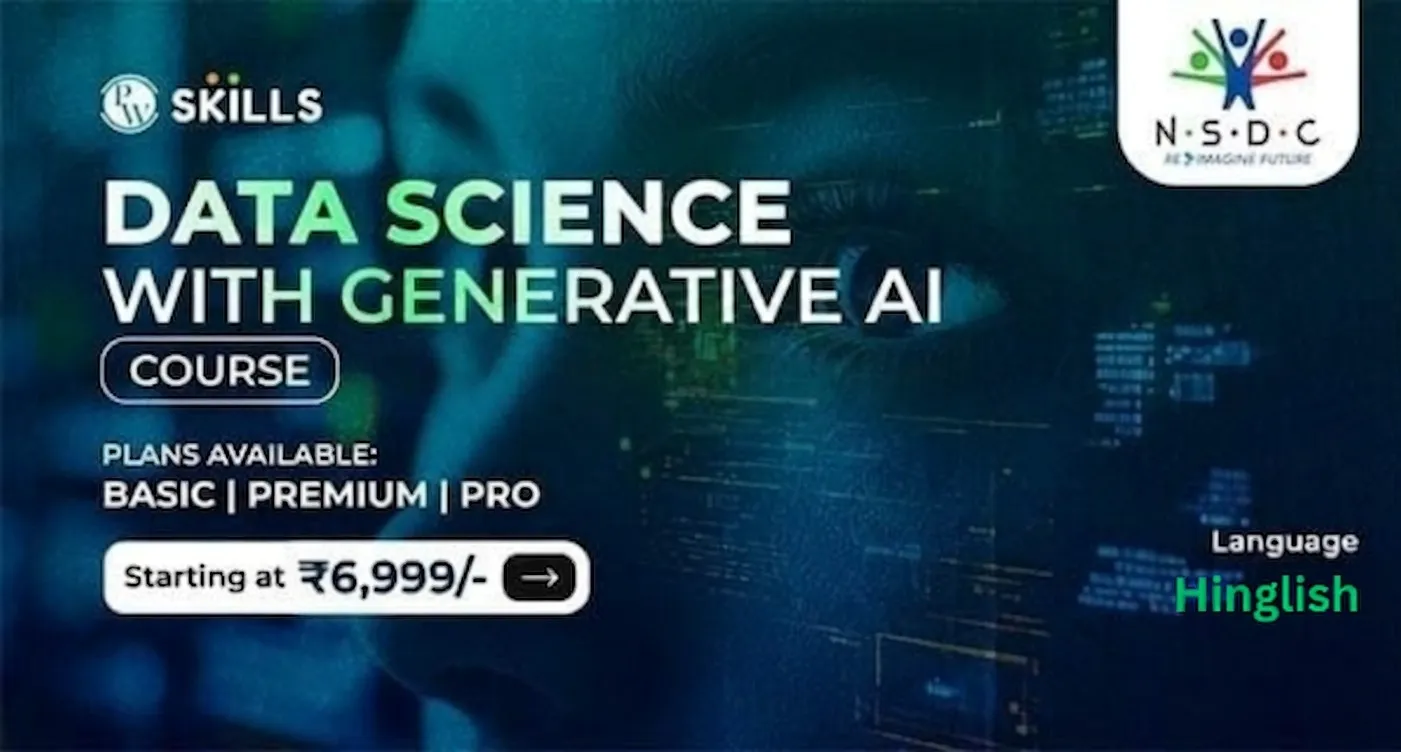
Selecting the correct learning format depends on your schedule, budget, and level of guidance required. The course structure offers three distinct tiers:
1. Basic Plan (Self-Paced Learning)
- Duration: 8 Months (24 months total access to recorded content).
- Format: Recorded video lectures for independent study.
- Key Features: Full access to core curriculum, industry project walkthroughs, weekly Sunday live doubt support (4:00 PM to 8:00 PM), and certification.
- Fee: ₹6,999.
2. Premium Plan (Interactive Live Learning)
- Duration: 8 Months (24 months content access).
- Format: Live weekend interactive classes (Saturday and Sunday).
- Key Features: Live doubt resolution 5 days a week (Wednesday to Sunday, 4:00 PM to 8:00 PM), evaluated assignments with written feedback, career profile building (Resume & LinkedIn), access to the certification.
- Fee: ₹34,999.
3. Pro Plan (Complete Job Readiness)
- Duration: 8 Months (24 months content access).
- Format: Live weekend sessions with complete placement assistance.
- Key Features: Includes everything in Premium, plus soft skills and aptitude training, 2 AI-based mock interviews, 2 human-led mock interviews, career mentorship, and 5 guaranteed interview opportunities upon clearing the mandatory Employability Test.
- Fee: ₹39,999.



FAQs
What is covered in a Gen AI data science course?
Who can enroll in the Data Science with Generative AI Course + Who is it suitable for?
How does learning NLP in a data science course help my career?
What career roles can I target with a NLP Engineer Jobs background?
Does the Gen AI data science course offer job placement assistance?





Get Free Counselling Today
and Clear up all your Doubts
 Live & recorded classes available at easeDashboard for progress trackingLakhs of practice questions

