
Pattern Printing in One Video | Lecture 4 | C Programming Series
 Varun Saharawat23 Jun, 2026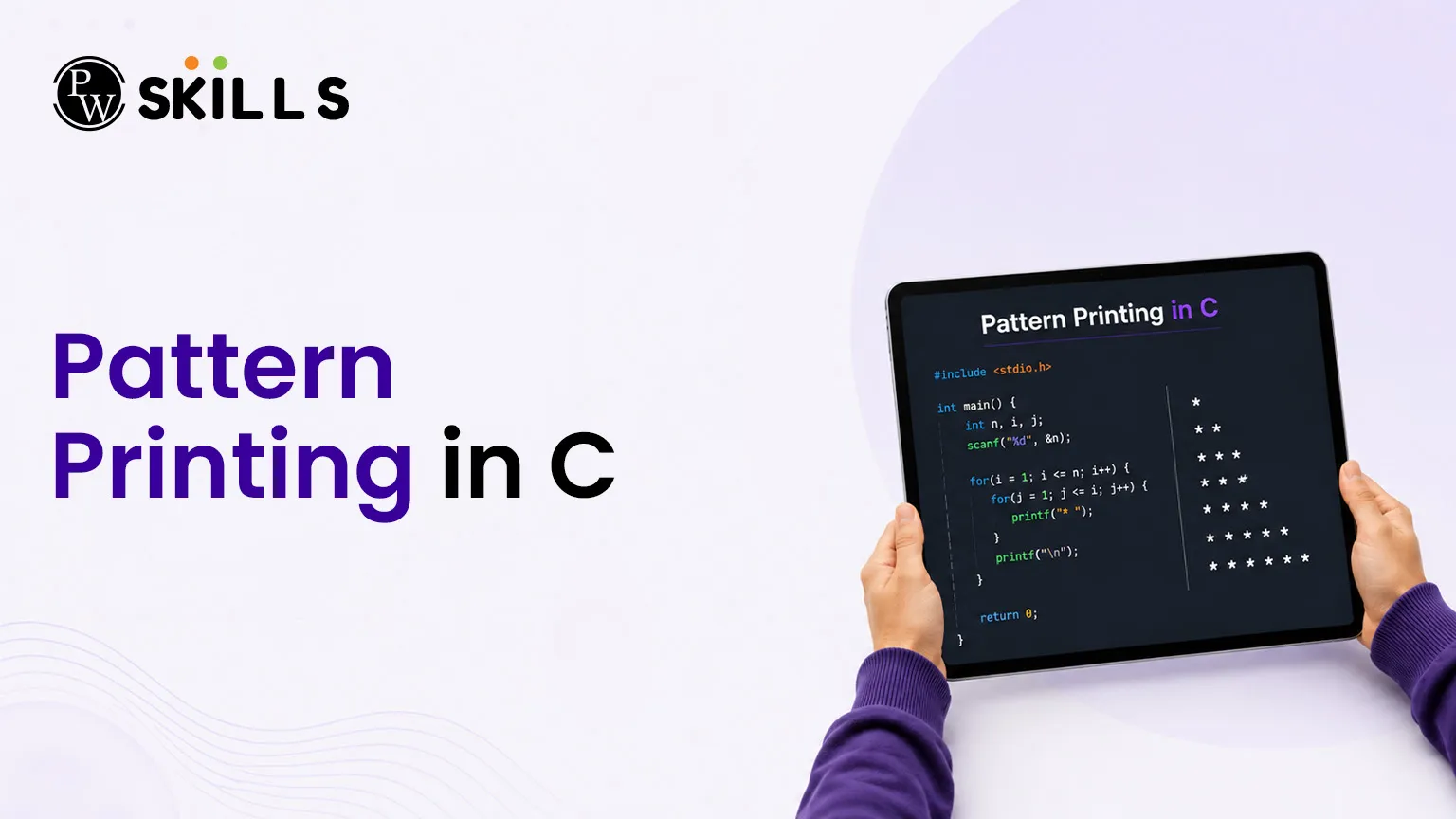
Many engineering students find themselves trapped when translating mental logic into working code. Grasping loop declarations can be straightforward, but configuring multiple loops to output complex shapes often feels confusing. If you struggle to place spaces correctly or manage changing row variables, you are experiencing a common hurdle in your coding journey.
This structural article simplifies Pattern Printing in C by breaking down grids into clear mathematical coordinates. By learning how to alter the relationship between rows and columns, you will gain the skills needed to solve any structural coding challenge.
What is Pattern Printing in C?
Building shape grids relies completely on the arrangement of rows and columns. When working with C pattern programs, you must treat your output screen like a two-dimensional grid system. Each line represents a distinct row, and every symbol inside that line marks a specific column.
To achieve standard alignment, you should systematically map out the required lines before writing code. Consider a basic rectangle of symbols; the height dictates how many times your program must move down a line, while the width dictates how many characters print side by side. Mastering this coordination helps you bridge the gap between abstract mathematical concepts and execution on a terminal screen.
How do nested loops in Pattern Printing in C Manage Grid Outputs?
To manage rows and columns simultaneously, programmers rely heavily on nested loops in C. A nested loop setup puts one loop controller directly inside another. The system executes the entire inner loop cycle for every single step of the outer loop.
Outer Loop Control
The outermost loop manages the vertical progression of your terminal output. It decides the total number of lines or rows that appear on the screen. The loop tracking variable moves downwards from the top row to the final row limit.
Inner Loop Control
The loop placed inside handles the horizontal movement across a single line. It determines how many characters, symbols, or blank spaces print across the active row.
Line Control Mechanics
After the inner loop completes its work on a specific row, control returns to the outer loop block. At this exact point, a newline command shifts the cursor down to clear the previous line and start fresh.
Basic Examples of Pattern Printing in C
Practising foundational layouts is ideal for strengthening your logic framework. These structural setups use straightforward rules where column limits stay steady or change proportionally based on the active row number.
1. The Right-Angled Triangle Setup
In this structural layout, the number of symbols printed matches the current row number exactly. Row one displays one symbol, row two prints two symbols, and the process repeats until the base is reached.
-
Logic Framework: Outer loop iterates from 1 up to total rows. Inner loop runs from 1 up to the current row index.
-
Variable State: The column threshold equals the value of the active row counter.
-
Symbol Type: Standard character outputs like asterisks.
2. The Inverted Triangle Structure
This configuration flips the right-angled layout upside down. The longest horizontal line prints at the very top, and subsequent lines steadily shrink down to a single symbol at the bottom.
-
Logic Framework: Outer loop steps backward from the max row limit down to 1. Inner loop prints symbols up to the current decreasing row counter value.
-
Variable State: Row thresholds begin at maximum capacity and count downward.
Advanced Pattern Printing in C Programs with Blank Spaces
Centred structures, like full pyramids or diamonds, require careful placement of empty padding spaces before printing symbols. Managing these spaces requires an extra inner loop to shift your characters into the correct positions.
|
Grid Line Number |
Required Blank Spaces |
Character Counts |
Combined Total Items |
|
Row 1 |
Max Rows - 1 |
1 |
Total Offset Max |
|
Row 2 |
Max Rows - 2 |
3 |
Total Offset Max |
|
Row 3 |
Max Rows - 3 |
5 |
Total Offset Max |
|
Row 4 |
Max Rows - 4 |
7 |
Total Offset Max |
To print a balanced full pyramid, your outer loop must run an inner space loop followed immediately by a symbol loop. The empty spaces decrease by one with each row, while the characters increase by odd increments like two times the row index minus one.
How to do Pattern Printing in C Programs?
Let us look at actual implementations of these structures. These standard templates provide solid coding practice to help you understand how variables interact within loops.
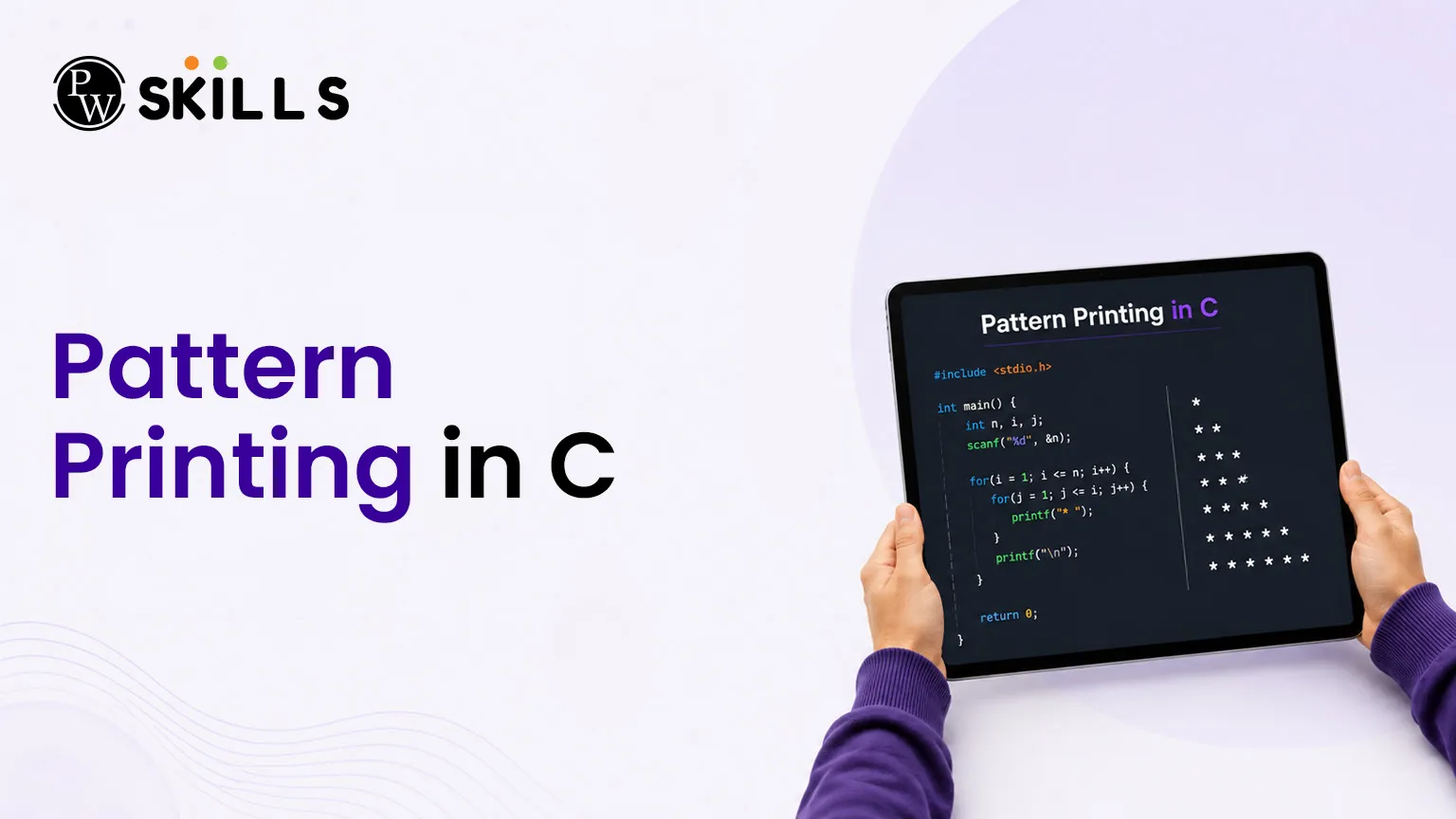
Code Blueprint: Right-Angled Triangle
C
#include <stdio.h>
int main() {
int rows = 5;
// Outer loop controls rows
for (int i = 1; i <= rows; ++i) {
// Inner loop controls column printing
for (int j = 1; j <= i; ++j) {
printf("* ");
}
// Move to the next row
printf("\n");
}
return 0;
}
Code Blueprint: Full Pyramid Structure
C
#include <stdio.h>
int main() {
int rows = 5;
for (int i = 1; i <= rows; ++i) {
// Loop to generate alignment spaces
for (int space = 1; space <= rows - i; ++space) {
printf(" ");
}
// Loop to generate character output
for (int j = 1; j <= (2 * i - 1); ++j) {
printf("* ");
}
printf("\n");
}
return 0;
}
Number and Alphabet Variations in Pattern Printing in C
Once you can create star shapes confidently, you can transition to printing data values. By substituting asterisks with loop counters or character variables, you can display numbers or letters.
Continuous Sequential Grids
Instead of resetting values on each row, you can print a continuously rising counter. For example, Floyd’s Triangle displays integers sequentially from one onwards across a triangular grid.
Fixed Row Characters
If you pass the outer loop variable to your print statement, every column in a row displays the identical number or symbol.
Alternating Column Variations
Printing the inner loop variable causes values to count upward across the row, resetting to the starting point on each new line.
Working with Alphabet Characters
In C, character symbols map directly to integer ASCII values. By tracking characters like 'A' and incrementing them inside your loops, you can build clean, alphabetic pyramids.
Effective Coding Practice Strategies for Complex Layouts
Solving intricate grid designs requires breaking the problem down systematically. Use this clear checklist to build your layout logic step by step:
-
Count Total Rows: Check the total height of the layout to set your outer loop boundaries.
-
Track Blank Spaces: Look at how empty padding changes from line to line, and find the mathematical link between your row counter and space counts.
-
Calculate Symbol Behavior: Figure out the exact formula for character counts on each row.
-
Trace Variable Values: Use a pen and paper to manually track your loop indexes through the first three rows before writing any code.
Common Debugging Traps in Pattern Printing in C
If your console outputs look broken or disorganized, look out for these common loop mistakes:
-
Missing Newline Commands: Forgetting to print a newline character after the inner loop finishes causes the entire pattern to print on a single row.
-
Incorrect Loop Limits: Using a less-than sign instead of a less-than-or-equal sign can cut your rows short or leave patterns incomplete.
-
Mismanaging Loop Variables: Accidentally modifying your outer loop variable inside an inner loop breaks your code flow and causes infinite loops.
-
Unintended Spaces: Adding accidental extra spaces inside print statements can throw off your pyramid's alignment.




FAQs
How do nested loops in C determine row and column positions?
Why does my pyramid pattern skew to one side?
How do you convert a star pattern program into an alphabet layout?
What is the ideal way to master complex C pattern programs?
Why do interviewers prioritize pattern questions during technical rounds?





Get Free Counselling Today
and Clear up all your Doubts
 Live & recorded classes available at easeDashboard for progress trackingLakhs of practice questions

