
Arrays in One Shot | C Programming | Lecture 7
 Varun Saharawat18 Jun, 2026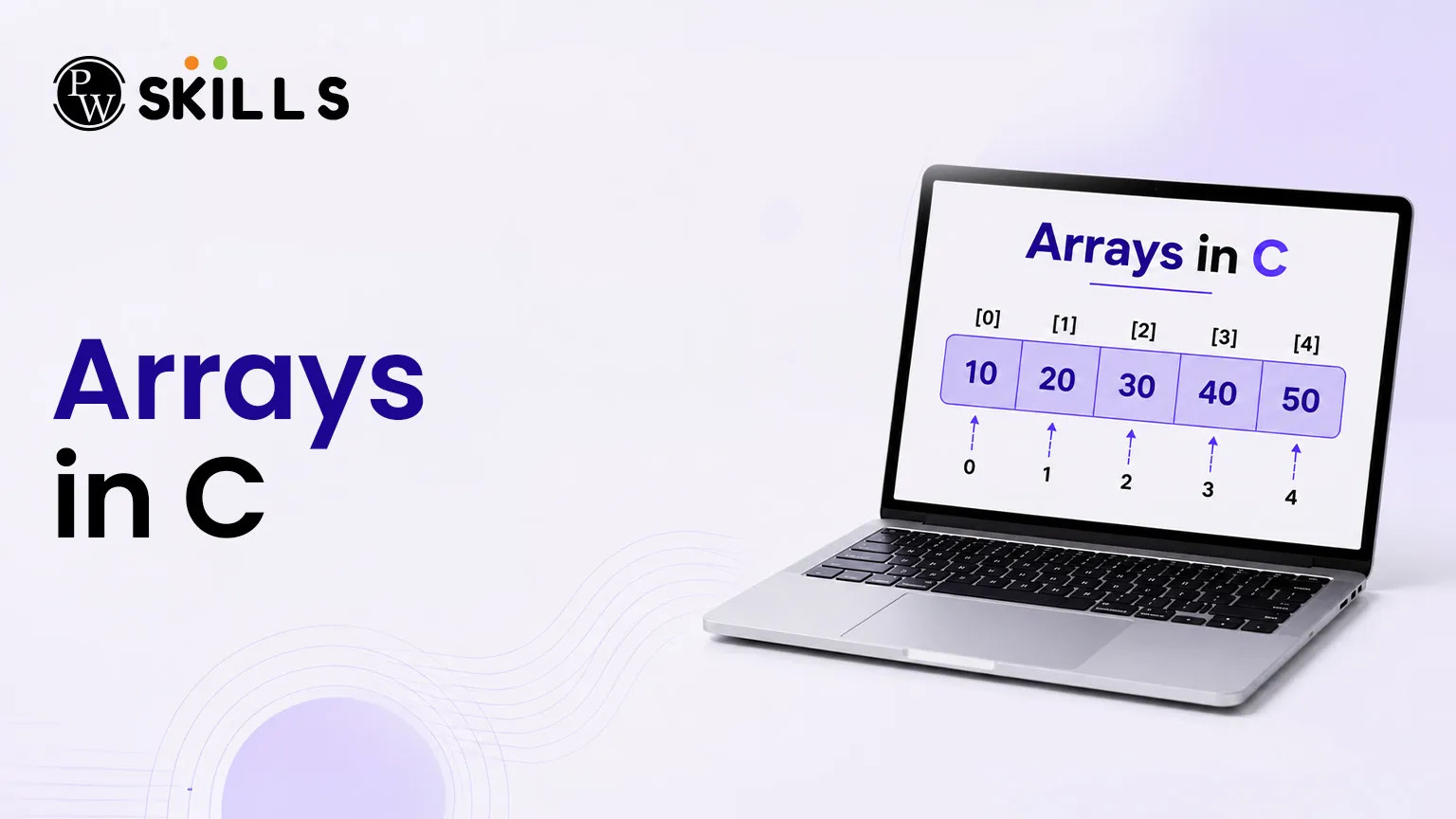
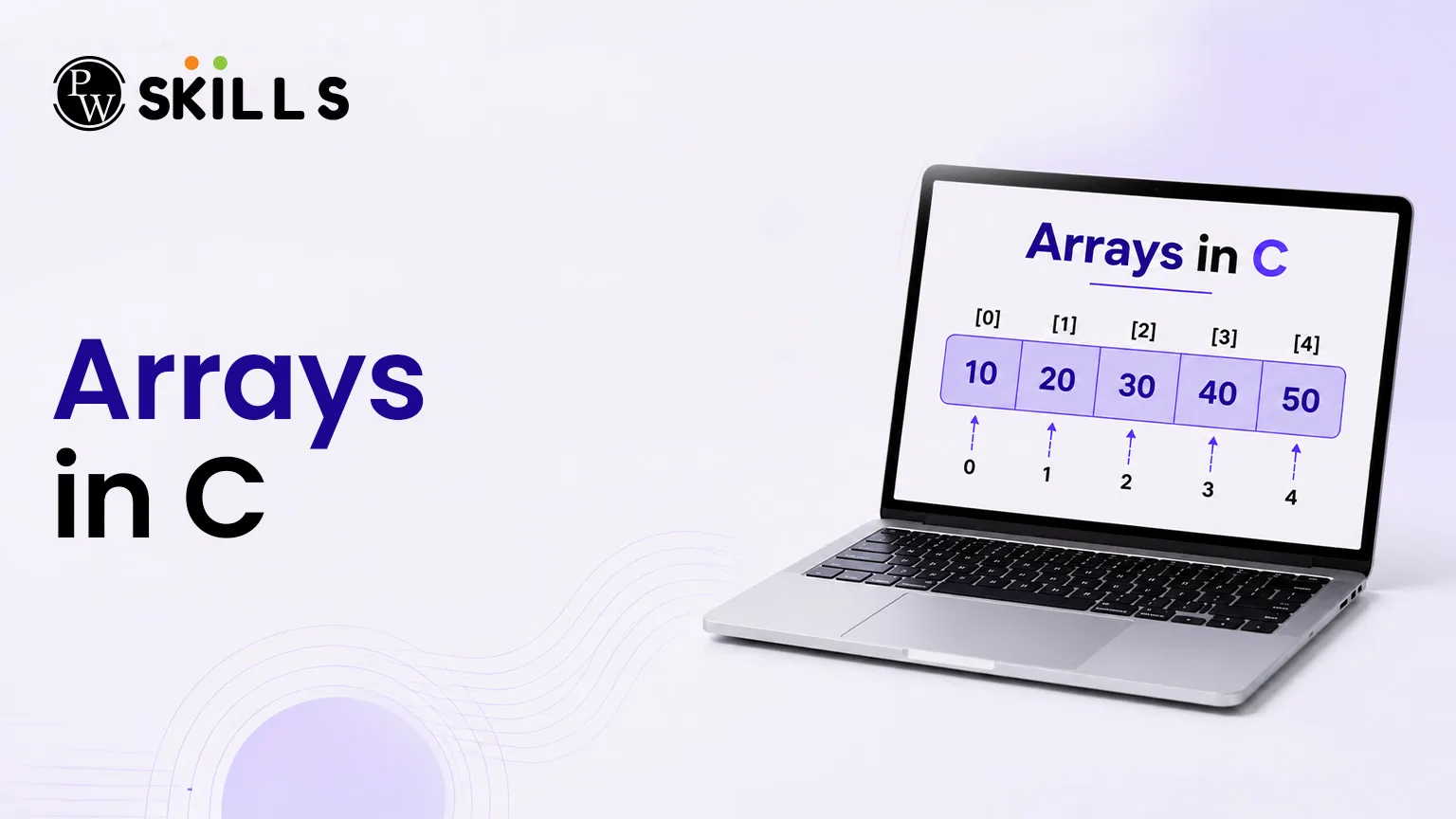
Arrays in C help programmers store multiple values of the same data type under a single variable name, making code more organized and efficient. Instead of creating separate variables for related data, arrays simplify storage and access. In this article, you'll learn the basics of Arrays in C, including declaration, initialization, element access, and practical applications in programming.
What are Arrays in C?
An array behaves like a collection of data pieces stored across a single continuous memory block. Every single item stored within this block must belong to the exact same datatype, such as matching integer blocks (int) or character bytes (char).
Important Architectural Attributes
-
Continuous Address Layout: Every item sits right next to the adjacent one inside memory, leaving zero unallocated bytes in between rows.
-
Static Bounds Configuration: The complete size must be determined beforehand during standard code compilation. It remains unchangeable throughout application runtimes.
-
Randomized Element Offsets: System processors can instantly pinpoint any isolated entry location without iterating through prior memory structures.
Simple Methods for Arrays in C
Before allocating spaces inside memory pipelines, the compiler needs visibility into both your target primitive data type and the overall space reservation boundaries. Let us look at standard layout mechanisms.
Basic Syntax Structure
-
data_type: The concrete classification rule for items, such as int, float, or char.
-
array_name: A distinct identifier label used across code calculations.
-
array_size: A constant integer defining the actual structural depth limits.
Code Initialization Variations
You can establish structures through several configuration setups based on runtime logic:
C
// Method 1: Absolute declaration without initializing values immediately
int userAgeList[5];
// Method 2: Defining complete boundaries with immediate default values
int pointMatrix[5] = {12, 24, 48, 96, 192};
// Method 3: Dynamic compilation tracking without manual dimension constraints
int sequenceNumbers[] = {5, 10, 15, 20};
Arrays in C Indexing and Bounds
The tracking of values is purely based on tracking explicit offsets across structural sequences. The C programming basics require strict tracking because indices run strictly between 0 and (N-1) where N is the total allocated limit.
Index Reference Mechanics
|
Position Name |
Underlying Offset Reference |
Actual Stored Value Example |
|
First Allocated Slot |
array_name[0] |
First value in the block |
|
Second Allocated Slot |
array_name[1] |
Second value in the block |
|
Final Boundary Position |
array_name[Size - 1] |
Last value in the block |
The Risks of Index Out of Bounds
The C compiler does not actively check that your references are within valid allocations at run time. Writing into an offset past the end of the defined position violates spatial safety.
C
int briefDef[3] = {10, 20, 30};
// CRITICAL FAULT: Accesses unreserved memory segments
briefDef[5] = 500;
The structural fault corrupts neighbouring variables, causes unexpected segmentation errors, or results in critical systemic bugs within the execution loops.
One-Dimensional Arrays in C
Operating on one-dimensional arrays involves executing tasks like loop iterations, input scanning, and conditional state evaluation across single-layer rows.
Tracking Values via Loop Pipelines
The absolute clearest approach for modifying value loops involves running structured for increments. The following implementation shows how to cleanly accept entries and print results:
C
#include <stdio.h>
int main() {
int collectionData[5];
// Capturing systemic entries via scanner routines
for(int step = 0; step < 5; step++) {
scanf("%d", &collectionData[step]);
}
// Direct value display output sequence
for(int step = 0; step < 5; step++) {
printf("%d ", collectionData[step]);
}
return 0;
}
Memory Allocation for Arrays in C
Whenever you execute an array declaration in C, the machine claims an undivided block of storage. The total footprint matches the item limit multiplied by the individual data type size.
System Size Calculations
On a modern 64-bit architecture, an integer block that covers 5 entries takes exactly 5 \times 4 = 20 individual bytes.
Address Continuity Validation
Each step in the interior of an allocation counts straight according to the width rules of the data type. An integer series beginning at base tracking address 0x7ffee3b4 spaced out exactly like this:
-
Entry [0]: 0x7ffee3b4
-
Entry [1]: 0x7ffee3b8
-
Entry [2]: 0x7ffee3bc
Passing Arrays in C to Functions
Passing data blocks into standard runtime functions works differently than processing simple variables. Passing an array passes the base memory address of its first index rather than copying the entire array structure.
Essential Architectural Rules
-
Pass-by-Reference Performance: Because references resolve directly to active structural memories, updates made within target execution blocks apply system-wide.
-
Explicit Dimension Tracking: Since functions receive simple base pointers, you must pass tracking size variables explicitly to prevent boundary overruns.
Code Processing Implementation
C
#include <stdio.h>
void modifyElements(int targetArray[], int limit) {
for(int phase = 0; phase < limit; phase++) {
targetArray[phase] *= 2;
}
}
int main() {
int baselineSet[3] = {10, 20, 30};
modifyElements(baselineSet, 3);
// Outputs updated values: 20 40 60
printf("%d %d %d", baselineSet[0], baselineSet[1], baselineSet[2]);
return 0;
}




FAQs
What will happen if I declare an array and do not initialize it?
Can an array size be expanded after compilation finishes?
Why do arrays begin numbering positions at zero, not one?
An array cannot hold multiple data types at the same time.
What is the best way to clear or reset an allocated array?





Get Free Counselling Today
and Clear up all your Doubts
 Live & recorded classes available at easeDashboard for progress trackingLakhs of practice questions

