
Generative AI vs Machine Learning - Key Differences & Examples
 Varun Saharawat30 Oct, 2025
Generative AI vs Machine Learning: Are you confused by all the technical terms used in today’s AI technologies? Words like generative AI and machine learning can seem confusing and difficult to understand.
That is why we are here today! In this blog post, we’ll explain what Generative AI and Machine Learning are, and how they differ, so you can feel confident when choosing the best solution for your needs. We know that these topics can seem complicated, but with our simple explanations, you will quickly understand the basics of each. We will also provide tips on how to choose the right technology for yourself or your business.
If you are interested in learning more, starting with a course like Master Generative AI: Data Science by Physics Wallah is a great first step. Plus, we have a special reader coupon to get you a great discount!
Also read: Top 10 Generative AI Startups in the World
What is Machine Learning?
Machine learning is a part of artificial intelligence that helps computers to learn from data and make decisions or predictions. Instead of programming at every step, machine learning algorithms can improve automatically by learning from experience. These ML algorithms study data to find unique patterns, understand relationships, and make sense of inputs and outputs. As they get new data, they keep updating and getting better at making predictions. Machine learning allows computers to solve problems in a way similar to how humans learn. It works with large amounts of data, which would be too difficult to program manually. Machine learning is used in many areas, like in healthcare discovering new medicines, in finance is is used in detecting fraud, and giving personalized recommendations in online stores. This technology is rapidly growing and will not slow down anytime soon.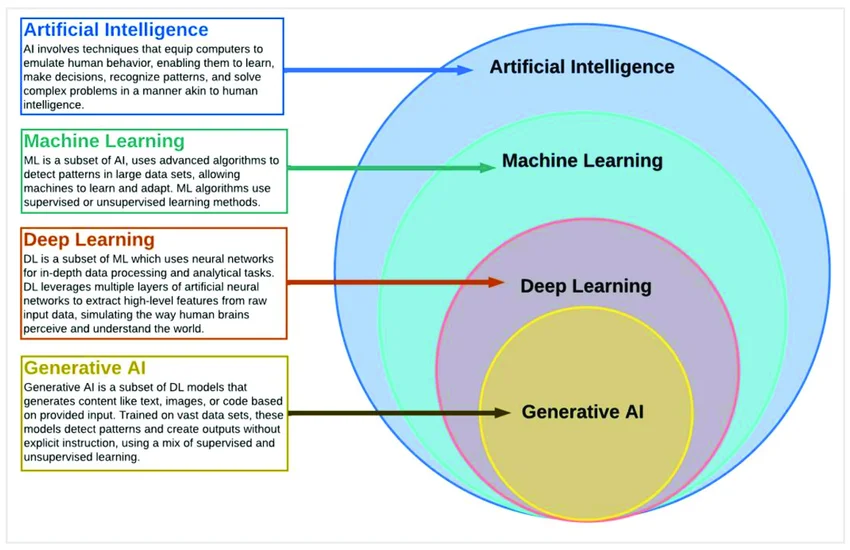 Also read: Quantum Machine Learning: Uses, Applications, Examples
What is Generative AI?
Generative AI is a type of artificial intelligence that uses machine learning to create new content, like images, text, audio, and video, based on the data it has learned from. The main idea is that these AI models is to learn patterns in data and can use that knowledge to generate something new that still follows the same patterns. Generative AI has become possible due to improvements in deep learning methods like Generative Adversarial Networks (GANs) and Variational Autoencoders (VAEs). These methods help the models to understand large amounts of data and create realistic synthetic content. Generative AI offers many opportunities in different industries. For example, Gen AI in healthcare, where there is a lot of data like clinical notes, diagnostic images, and medical records, Generative AI can organize this unstructured data or work with large, structured datasets like insurance claims to create new, useful data.Generative AI vs. Machine Learning: Key Differences B/W Generative AI and Machine Learning
Generative AI and Machine Learning are concepts with which people often get confused, so for your easy understanding of the concept, here are the key differences between generative AI and machine learning given in the table below:| Generative AI vs. Machine Learning | ||
| Criteria | Generative AI | Machine Learning |
| Objective | Creates new data instances, generates content | The general approach to learning patterns from data |
| Learning Type | Based on Generative Models like GANs, VAEs | Supervised, Unsupervised, Reinforcement Learning |
| Customization | Highly customizable for various creative applications | Customizable based on task requirements and choice of algorithms |
| Training Data | Requires diverse training data for creative output | Trained on specific datasets for defined tasks |
| Training Time | May require extensive training time for creative tasks | Training time depends on dataset size and complexity of the model |
| Use Cases | Creative tasks, content generation, artistic applications | Predictive modeling, prescriptive analytics, descriptive analytics, classification, pattern recognition |
| Output | Generates new, original data instances | Predicts or classifies based on learned patterns |
| Example Applications | Gen AI examples include: DALL-E for image generation, ChatGPT for text generation | Machine Learning examples include: Image classification, Speech recognition, Recommendation systems |
| Complexity | High complexity due to creative nature and diversity of outputs | Varies based on the specific machine learning algorithm used |
| Interpretability | Often lacks clear interpretability due to creative outputs | Models may offer interpretability based on the algorithm used |
| Resource Intensity | Demands significant computational resources for training | Resource requirements vary based on the ML algorithm and dataset |
Generative AI vs. Machine Learning Examples
Here are some of the Generative AI vs Machine Learning examples that will help you to understand the concept better:| Generative AI vs. Machine Learning Examples | ||
| Application | Generative AI Examples | Machine Learning Examples |
| Image Generation | DALL-E by OpenAI, DeepArt.io | Image Classification, Object Detection |
| Music Composition | Google's Magenta, AIVA | Recommendation Systems, Predictive Analytics |
| Artistic Style Transfer | Neural Style Transfer algorithms | StyleGAN for Image Synthesis |
| Game Content Generation | Procedural Content Generation in games | Reinforcement Learning for Game AI |
| Video Synthesis | Deepfake technology using GANs | Video Classification, Video Analysis |
| Voice Generation | Lyrebird, Descript | Speech Recognition, Voice Biometrics |
| Text Generation | GPT-3 by OpenAI, ChatGPT | Natural Language Processing (NLP), Sentiment Analysis |
Generative AI vs Machine Learning vs Deep Learning
Below is a table outlining the distinctions between Generative AI, Machine Learning, and Deep Learning:| Generative AI vs Machine Learning vs Deep Learning | |||
| Feature | Generative AI | Machine Learning | Deep Learning |
| Definition | Utilizes AI, algorithms, and large language models to generate content based on patterns observed in existing content. | A subset of AI that employs algorithms to analyze data, learn from it, and make predictions based on the learned patterns. | A subset of machine learning that involves neural networks with multiple layers (deep neural networks) to learn and make decisions. |
| Scope of Learning | Mimics human creativity by analyzing and replicating patterns from extensive repositories of content. | Learns from data and experience to make predictions, recognize patterns, and inform decisions. | Involves hierarchical learning with multiple layers of neural networks learning hierarchical features from data. |
| Applications | Content generation, creative tasks, style imitation, and artistic pursuits. | Predictive analytics, recommendation systems, image and speech recognition, and natural language processing. | Image and speech recognition, language translation, autonomous vehicles, and advanced pattern recognition. |
| Training Data | Relies on large datasets for understanding patterns and generating creative outputs. | Trains on labeled datasets to learn patterns, correlations, and features. | Requires massive datasets for learning hierarchical representations of data. |
| Complexity | Offers advanced capabilities in creative tasks but may not always adhere to real-world logic. | Adaptable and widely used for a variety of tasks, balancing simplicity and effectiveness. | Handles complex tasks by automatically learning hierarchical features, but may require substantial computational resources. |
| Common Algorithms | GPT (Generative Pre-trained Transformer) models, VAEs (Variational Autoencoders). | Decision trees, support vector machines, k-nearest neighbors, neural networks. | Convolutional Neural Networks (CNNs), Recurrent Neural Networks (RNNs), Transformers. |
| Training Process | Trained on diverse datasets to understand different styles and patterns. | Trained iteratively with labeled datasets to optimize predictive accuracy. | Involves deep neural networks trained layer by layer using backpropagation and optimization techniques. |
| Use Cases | Content creation, style transfer, text generation, art synthesis. | Predictive analytics, recommendation systems, fraud detection, and language translation. | Image and speech recognition, natural language processing, autonomous vehicles, and healthcare diagnostics. |
Learn Generative AI With PW Skills
If you are looking for ways to get started with Generative AI, Generative AI Course by Physics Wallah is the best course that will provide everything from basic theory introduction through advanced understanding. This course will provide you with features like- Live instructor led sessions, daily practice sheets, doubt clearing sessions, 10+ practical projects, 100% job assistance guarantee, soft skills training and much more. So, what are you waiting for? Visit PWSkills.com and Let’s move one step closer towards building the future of AI!Also read: 15 Best Generative AI Tools To Check Out In 2024!



FAQs
What is the primary difference between Generative AI and Machine Learning?
How does Generative AI create new data, and what role does it play in Machine Learning?
What are some common applications of Generative AI?
Can you provide an example of a Generative AI model?
Is Generative AI the same as Machine Learning?





Get Free Counselling Today
and Clear up all your Doubts
 Live & recorded classes available at easeDashboard for progress trackingLakhs of practice questions

