
Input Tax Credit Explained: How Businesses Reduce GST Liability

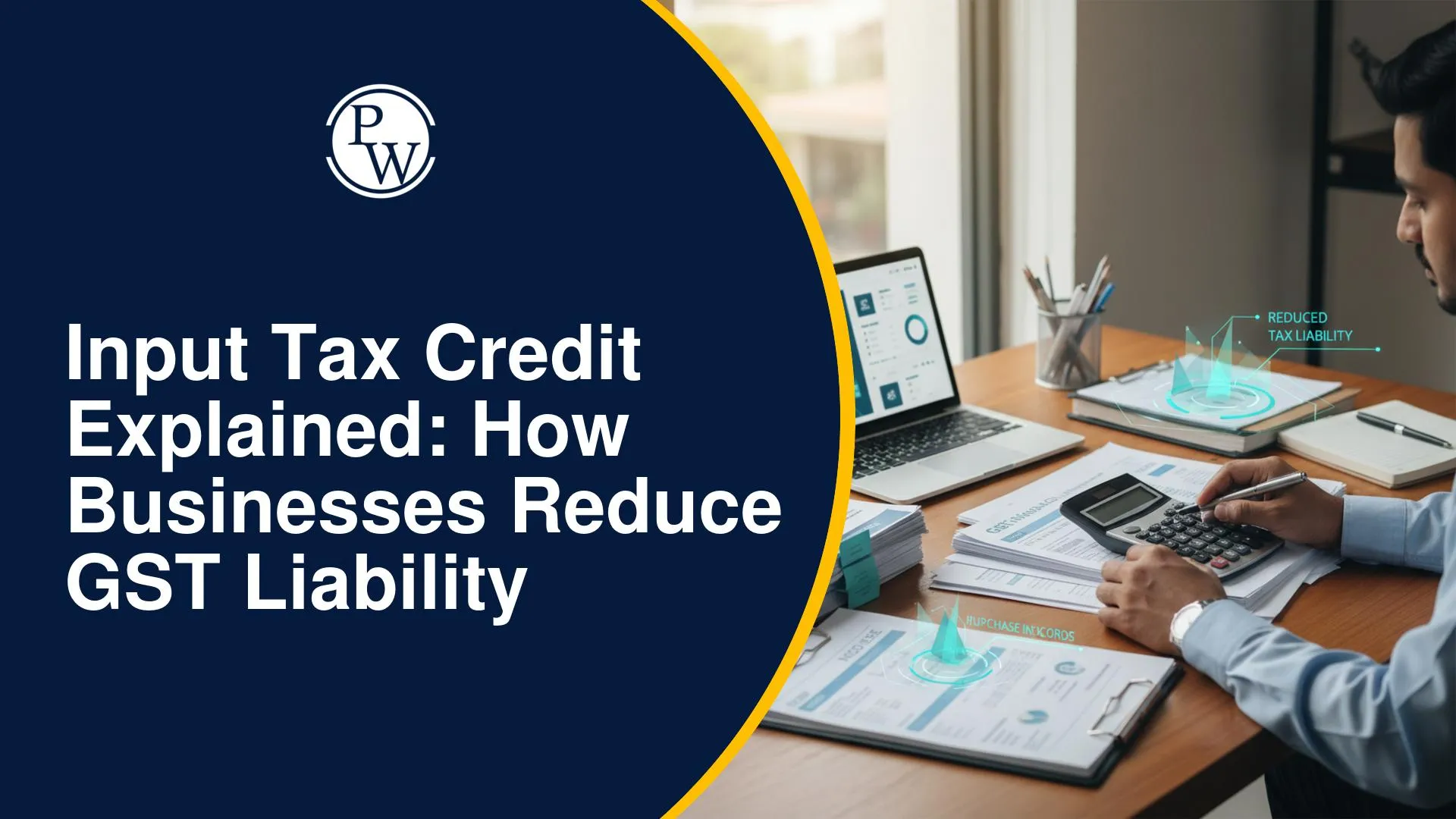
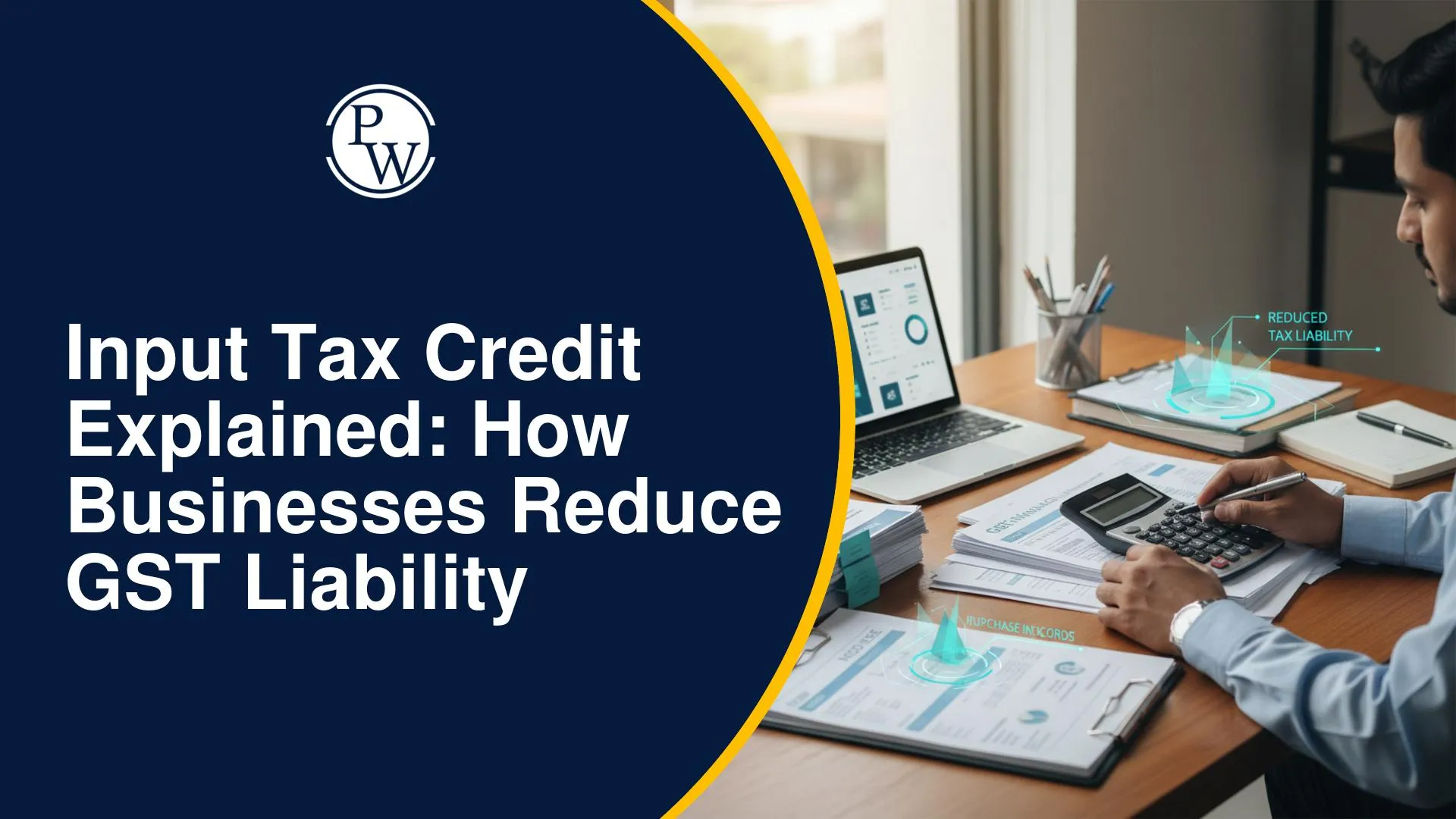
Businesses may end up paying more GST than necessary if they do not account for eligible tax credits on their purchases. Understanding Input Tax Credit (ITC) helps businesses calculate their actual GST liability, reduce the cascading effect of taxes and maintain accurate tax records.
Under GST, eligible registered businesses can adjust the tax paid on qualifying purchases against the GST collected on sales, subject to applicable conditions. PW Skills provides learning resources in finance, tax and accounting, covering industry-aligned concepts, real-world case studies and practical applications to help you develop relevant knowledge.
What Is Input Tax Credit Under GST?
Input Tax Credit (ITC) is the credit available to an eligible registered taxpayer for GST paid on business purchases of goods or services. Businesses can use this credit to offset their output GST liability, subject to the conditions and restrictions prescribed under GST law.
For example, a business purchasing inventory may pay GST to its supplier. When it sells that inventory, it charges GST to its customer. Instead of paying the entire output GST collected to the government, the business can utilise eligible input tax credit to reduce its tax liability.
ITC is an important feature of the Goods and Services Tax (GST) system because it helps prevent the cascading effect of taxes, where tax costs accumulate at successive stages of the supply chain.
How Does Input Tax Credit Reduce GST Liability?
Businesses reduce their GST liability by setting off eligible input GST against output GST. The difference between the output tax liability and the input tax credit available for utilisation determines the remaining tax payable, subject to the applicable GST rules.
Basic formula:
Net GST Payable = Output GST Liability − Eligible ITC Utilised
Consider the following example of a business purchasing and reselling goods.
|
Particulars |
Amount |
|
Purchase value excluding GST |
Rs. 8,000 |
|
GST paid on purchases at 18% |
Rs. 1,440 |
|
Sale value excluding GST |
Rs. 10,000 |
|
GST collected on sales at 18% |
Rs. 1,800 |
|
Less: Eligible ITC utilised |
Rs. 1,440 |
|
Net GST payable |
Rs. 360 |
In this example, the business collects Rs. 1,800 as output GST and has Rs. 1,440 in eligible input tax credit. After utilising the credit, it pays Rs. 360 to the government.
The business has added Rs. 2,000 to the value of the goods before GST. The Rs. 360 tax payable represents 18% of this additional value, assuming the stated purchase and sale values, tax rates and credit eligibility.
Without ITC, the business would have to bear the full output tax liability without deducting the eligible GST already paid on purchases. ITC therefore prevents the repeated accumulation of tax across the supply chain.
Eligibility Conditions for Claiming Input Tax Credit
A registered business must meet the applicable requirements under Section 16 of the Central Goods and Services Tax (CGST) Act, 2017, before claiming ITC. The key conditions include the following:
-
GST registration: The claimant must be eligible to claim ITC under the GST framework. Businesses paying tax under the composition scheme generally cannot claim ITC.
-
Valid tax invoice or prescribed document: The business must possess the required tax invoice, debit note or other prescribed document.
-
Receipt of goods or services: The goods or services must have been received, subject to the statutory provisions applicable to deemed receipt and other specified cases.
-
Supplier-related compliance: The supplier must furnish the relevant invoice details as required, and the credit must satisfy the applicable conditions for communication and availability through the GST system.
-
Tax payment to the government: The tax charged on the supply must be paid to the government, subject to the applicable statutory provisions.
-
Required return filing: The recipient must furnish the applicable GST return to claim the credit.
-
Business use and eligibility: The purchase must qualify under GST law, and the credit must not fall within blocked-credit or other restriction provisions.
Businesses should also monitor the statutory time limit for claiming ITC. Under the general rule in Section 16(4), credit relating to an invoice or debit note cannot ordinarily be claimed after 30 November following the end of the relevant financial year or the date of furnishing the relevant annual return, whichever is earlier, subject to applicable exceptions and amendments.
Meeting these requirements helps businesses avoid ineligible claims, subsequent reversals, interest exposure and disputes during tax assessments.
How Can Businesses Claim Input Tax Credit?
Businesses can use accounting software to maintain purchase records, reconcile GST data and manage tax entries. You should learn how Tally with GST accounting applies on the job to understand how these tasks are handled in practical accounting scenarios.
-
Identify eligible purchases: Review purchases of goods and services on which GST has been charged and determine whether the credit is permitted.
-
Collect supporting documents: Maintain valid tax invoices, debit notes and other prescribed documents.
-
Reconcile purchase records: Compare purchase registers and supplier invoices with the relevant details available in the GST system, including GSTR-2B.
-
Verify eligibility: Check the applicable statutory conditions, blocked-credit provisions and any requirements for reversal.
-
Report the credit: Claim eligible ITC in the relevant GST return, following the prescribed procedure.
-
Utilise available credit: Set off eligible credit against output tax in the prescribed order.
-
Pay the balance liability: Discharge any remaining GST liability using eligible credit and, where required, the electronic cash ledger.
Regular reconciliation helps businesses identify missing invoices, supplier reporting discrepancies, duplicate entries and credits that may not be eligible for utilisation.
Rules for Utilising IGST, CGST and SGST Credit
GST credit is maintained under different tax heads. Businesses cannot freely use all credit balances against every type of output tax liability.
|
Credit available |
Permitted utilisation |
|
IGST credit |
First against IGST liability; any remaining credit against CGST and SGST/UTGST in the prescribed order |
|
CGST credit |
First against CGST liability, then against IGST liability, subject to the statutory order |
|
SGST credit |
First against SGST liability, then against IGST liability, subject to the statutory order |
|
CGST credit against SGST |
Not permitted directly |
|
SGST credit against CGST |
Not permitted directly |
For example, a business may have sufficient total ITC to cover its combined tax liability but still need to pay part of its liability in cash if the available credit cannot be used against a particular tax head.
The order of utilisation is governed by the applicable provisions, including Section 49 and related rules of the CGST Act. Businesses should verify the current requirements before making actual set-offs.
Which Input Tax Credits Are Blocked Under GST?
Section 17(5) of the CGST Act identifies categories of blocked credits. These restrictions mean that GST paid on certain purchases cannot ordinarily be claimed as ITC, even if the business has paid the tax.
Examples include:
-
Specified motor vehicles used for passenger transportation, subject to statutory exceptions.
-
Certain vessels and aircraft, subject to applicable exceptions.
-
Specified food and beverages, outdoor catering and related services.
-
Certain health and life insurance services, subject to applicable exceptions.
-
Membership of clubs and health or fitness centres.
-
Goods or services used for personal consumption.
-
Goods lost, stolen, destroyed, written off or disposed of as gifts or free samples, where the applicable reversal provisions apply.
Other restrictions may apply to particular transactions, including certain purchases used for exempt supplies or non-business purposes.
Eligibility depends on the specific facts and statutory provisions. Businesses should not assume that every GST amount shown on an invoice can be claimed as credit.
When Must Input Tax Credit Be Reversed?
ITC reversal occurs when previously claimed credit becomes ineligible or must be reversed under GST law. Businesses should review their transactions regularly to identify circumstances requiring an adjustment.
Common situations include:
-
Purchase returns: When purchased goods are returned and the transaction requires an adjustment to the claimed credit.
-
Personal use: When goods or services are used for purposes unrelated to the business.
-
Loss or destruction of goods: When goods are lost, stolen, destroyed or written off, or distributed as gifts or free samples, where reversal is required.
-
Exempt supplies or non-business use: When credit must be restricted or apportioned under the applicable provisions.
-
Non-payment to suppliers: Under the applicable rules, credit may need to be reversed if the recipient fails to pay the supplier the value of the supply and tax within 180 days from the invoice date, subject to prescribed exceptions. The credit may generally be re-availed after the required payment is made.
-
Other statutory adjustments: When a credit note, change in transaction details or another event requires an adjustment under GST law.
The accounting and return treatment depends on the reason for reversal. Businesses should maintain supporting records and calculate any applicable interest or other consequences under the relevant provisions.
What Happens When ITC Exceeds Output GST Liability?
A business may accumulate more eligible ITC than the output GST liability for a particular tax period. In such cases, the unused balance may generally remain available for future utilisation, subject to the applicable provisions and any restrictions.
For example, assume a business has Rs. 12,000 in eligible ITC and an output GST liability of Rs. 9,000.
|
Particulars |
Amount |
|
Eligible ITC available |
Rs. 12,000 |
|
Output GST liability |
Rs. 9,000 |
|
ITC utilised |
Rs. 9,000 |
|
Remaining ITC balance |
Rs. 3,000 |
The remaining Rs. 3,000 does not automatically become a cash refund. It may be carried forward for future utilisation, where permitted. Refunds are available only in eligible circumstances, such as qualifying zero-rated supplies or an inverted duty structure, subject to the applicable conditions and exceptions.
Businesses should distinguish between an unused credit balance and a refund claim because the two have different legal requirements.
Learn Input Tax Credit with PW Skills
Understanding Input Tax Credit (ITC) is important for learning how eligible businesses adjust GST paid on purchases against GST collected on sales. PW Skills’ Finance, Tax and Accounting Course covers GST, taxation and accounting concepts, helping you build relevant knowledge through industry-aligned learning and practical case studies.
The course includes:
-
GST and Taxation: Learn key concepts related to GST, Income Tax and taxation.
-
Accounting Software: Develop familiarity with Excel, Tally and Zoho Books.
-
Real-World Case Studies: Connect finance and accounting concepts with business scenarios.
-
AI in Finance: Learn about AI-powered tools used in finance-related tasks.
-
Live and Recorded Classes: Attend live sessions and revisit recordings for revision.
-
Advanced Learning in the Pro Path: Study additional areas such as financial modelling, Power BI and capstone projects.
The course runs for four months through online Hinglish classes on PW, with Premium and Pro learning paths to suit different learning goals.
Input Tax Credit helps eligible businesses reduce their GST liability by adjusting GST paid on qualifying purchases against output GST payable on sales. PW Skills provides learning resources in finance, tax and accounting, covering industry-aligned concepts, practical case studies, financial modelling and AI-powered tools. These resources can help you develop relevant knowledge for finance and accounting roles.



FAQs
1. What is Input Tax Credit under GST?
2. How is net GST liability calculated after ITC?
3. Can a business claim ITC on every purchase?
4. Is GSTR-2B important for claiming ITC?





Get Free Counselling Today
and Clear up all your Doubts
 Live & recorded classes available at easeDashboard for progress trackingLakhs of practice questions

