

AI Video Creation for Beginners: What You Need to Know

Have a great video idea but feel held back by scripting, voiceovers, visuals or editing? Creating a video can seem complicated when you are new to content production and do not know which tools to use or where to begin. AI video creation tools can simplify these tasks, but getting useful results still requires the right prompts, creative decisions and quality checks.
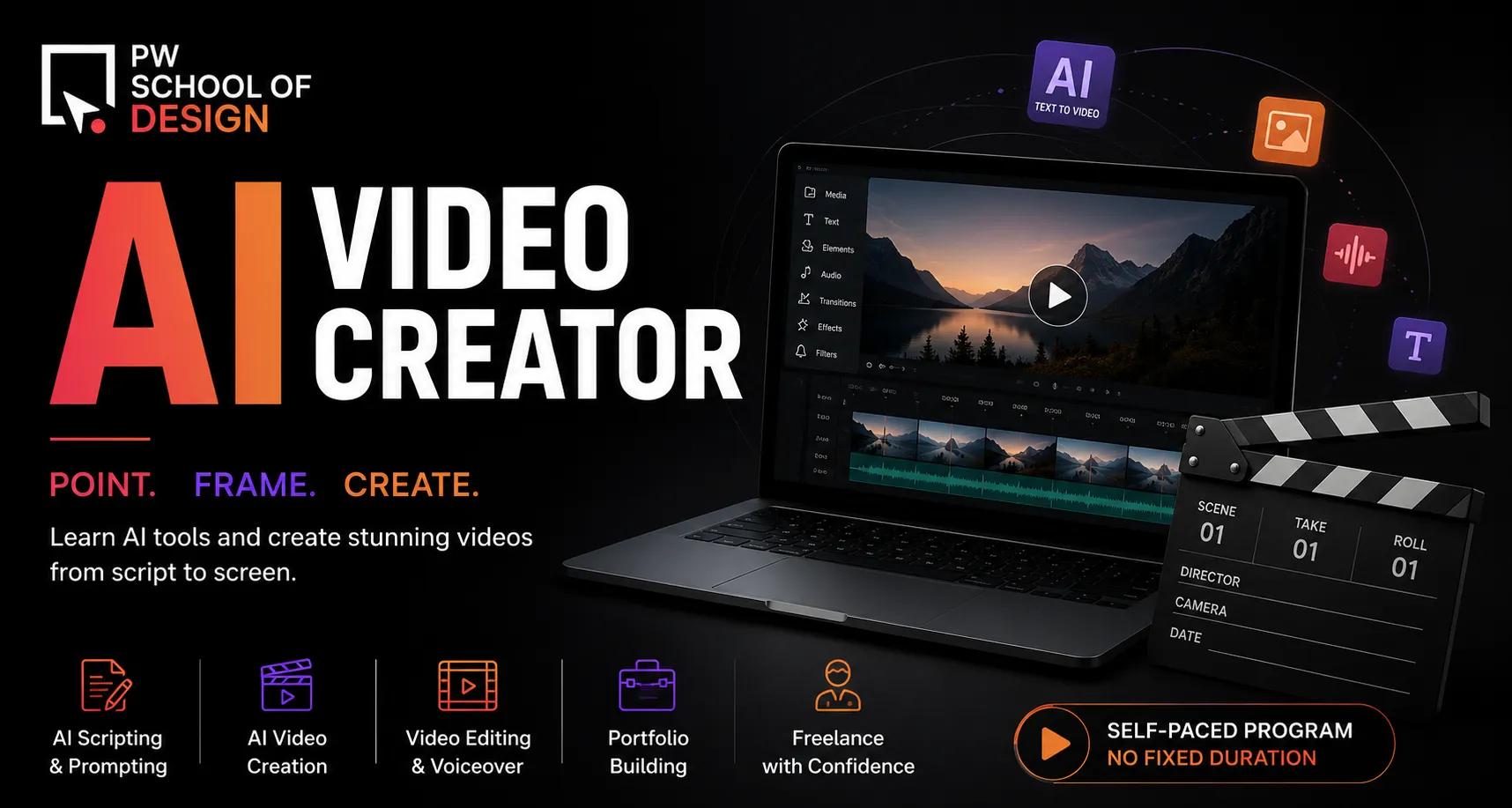
The AI Video Creator course by PW Skills helps you learn how to turn ideas into videos using AI-powered tools. Offered by PW School of Design, the self-paced, recorded course covers scripting, prompt engineering, voiceovers, image-to-video creation, editing and thumbnail design, along with practical projects to help you build a portfolio. No prior experience in design, editing or coding is required.
What Is AI Video Creation?
AI video creation is the use of artificial intelligence to generate, transform or assist with video content. Depending on the platform, a user may be able to turn text prompts into video clips, create narration from a script, animate still images or generate a virtual presenter.
For example, a creator making a product explainer could use AI to draft the script, generate supporting visuals and produce a voiceover before assembling the elements in a video editor. Some workflows automate several steps, while others require users to move between different tools.
How Does AI Video Creation Work?
The production process varies depending on the format and software used. However, a workflow includes content planning, script development, visual generation, narration and editing.
1. Develop the Script
Start by identifying the topic, intended audience and main message. An AI writing assistant can help create an outline or draft a script based on these requirements.
Review the draft before production. Correct factual errors, remove repetitive sentences and ensure that the narration follows a logical sequence.
2. Generate Visuals Using Prompts
AI image and video tools can create visuals from written descriptions. A useful prompt identifies the subject, setting, action and desired visual style.
For instance, a video about renewable energy could include scenes of solar panels, wind turbines and electric transport. Clear instructions can help maintain consistency, although some scenes may need to be regenerated or edited.
3. Create the Voiceover
Text-to-speech tools convert written scripts into spoken narration. Depending on the platform, users may be able to select a voice, language, accent or speaking style.
Listen to the output before using it. Check pronunciation, pacing, pauses and technical terminology. If you use a real person's voice or a voice clone, obtain the appropriate permission.
4. Create a Digital Presenter or Animate Images
Some tools generate virtual presenters that deliver scripts, while image-to-video tools add movement to still images. These features can be useful for tutorials, presentations and explainer videos.
Generated footage may contain unnatural movements, inconsistent facial features or imperfect lip synchronisation. Review the output and replace or correct scenes that do not meet the project's requirements.
5. Edit and Review the Final Video
Combine the visuals, narration and other assets in a video editor. Add captions, transitions, background music and thumbnails where appropriate.
Before publishing, verify factual claims, check the audio and visual quality, and review the licensing and consent requirements for the assets used.
What Does Research Say About Learning from AI-Generated Videos?
The study by Tao Xu and colleagues compared AI-generated instructional videos with traditionally recorded videos to assess English vocabulary learning and learners' experiences.
The experiment involved 76 university students who were randomly assigned to two groups. One group watched an AI-generated video, while the other watched a recorded video. Both videos taught eight English words, and the study assessed retention, transfer performance and subjective learning experiences.
Key Findings
|
Measure |
AI-generated video |
Recorded video |
|
Vocabulary retention, out of 8 |
7.50 |
6.53 |
|
Transfer score, out of 24 |
18.11 |
16.87 |
|
Overall performance |
25.60 |
23.39 |
The AI-generated video group scored higher on the vocabulary retention test, and the difference was statistically significant. However, the differences in transfer scores and overall learning performance were not statistically significant.
It is also found that participants reported a significantly lower sense of social presence with the AI instructor. Motivation, satisfaction, emotional responses and most other subjective measures did not differ significantly between the two groups.
It is suggested that consistent pronunciation, clear articulation and well-organised scripts may have contributed to the retention results. However, the experiment focused on a short English vocabulary lesson, so its findings do not establish that AI-generated videos are more effective for every subject or learning objective.
What Are the Limitations of AI Video Creation?
AI tools can simplify some production tasks, but their outputs may still require significant review. Research also shows that it has limitations that you should understand before drawing conclusions about the effectiveness of AI-generated videos.
Accuracy and Visual Consistency
AI-generated scripts may contain incorrect information, while visuals can include inconsistencies between scenes. Synthetic voices may mispronounce words, and digital presenters may display unnatural movements.
Creators should verify information, review every scene and correct errors before publishing.
Privacy, Consent and Licensing
Uploading photographs, recordings or voice samples can raise privacy concerns. Obtain permission before using another person's likeness or voice, and review how a platform handles uploaded data.
Check the licensing terms for generated visuals, music, stock footage and other assets, particularly when creating videos for commercial use.
Research Limitations
The 2025 study had several limitations that affect how its findings should be interpreted:
-
Narrow learning context: The experiment examined English vocabulary learning, not complex conceptual subjects, technical demonstrations or practical skill acquisition.
-
Short-term assessment: The study focused on immediate learning outcomes, so it could not establish whether the results would persist over a longer period.
-
Combined AI components: The study did not independently test the effects of AI-generated text, voice and instructor imagery.
-
Potential novelty effect: Participants' responses may have been influenced by the novelty of the AI-generated instructor.
-
Need for further research: More studies are needed to understand how individual differences, learning strategies and different types of instructional content affect the results.
It is recommended to use AI-generated instructional videos to complement traditional teaching rather than replace it entirely. The importance of human review, informed consent, and the responsible handling of personal data was also emphasised.
How Can Beginners Start Creating AI Videos?
You can develop your skills by completing a small project and improving it through practice. The following workflow provides a practical starting point for AI video content creation:
-
Choose a topic: Start with a short tutorial, explainer or product introduction that has one clear objective.
-
Outline the message: Decide what viewers should understand by the end of the video.
-
Prepare the script: Draft the narration and verify factual information before generating audio.
-
Create supporting visuals: Use prompts to generate scenes that directly relate to the script.
-
Generate narration: Create a voiceover or record your own, then check its clarity and pacing.
-
Assemble the video: Combine the visuals and narration, and add captions or transitions where needed.
-
Review the output: Watch the full video and check its accuracy, readability, sound and visual consistency.
-
Document the project: Save the final video and relevant examples of your script, prompts and editing decisions for your portfolio.
After completing the first project, try a different video format or visual approach. Reviewing feedback and comparing projects can help you identify areas for improvement.
Develop Video Production Skills with PW Skills’ AI Video Creator Course
Learning AI video creation involves more than generating clips from prompts. You also need to understand scripting, visual planning, voiceovers, editing and how to present your work. The AI Video Creator course by PW Skills, offered through PW School of Design, covers these areas in a self-paced, recorded programme delivered in Hinglish.
The course is designed for learners starting from scratch, so prior experience in design, video editing or coding is not required.
-
AI scripting and prompt engineering: Learn to develop scripts and prompts for AI-powered creative tasks. These skills help you communicate your ideas more clearly to AI tools.
-
AI voiceovers and image-to-video creation: Learn about key stages of AI video production, including narration and turning still images into moving visuals.
-
Video editing and thumbnail design: Develop skills for assembling video content and preparing thumbnails that support its presentation.
-
Hands-on projects and assignments: Apply what you learn through practical tasks rather than relying only on theoretical explanations.
-
Portfolio checkpoints and case studies: Build a collection of projects that demonstrates your creative process and developing skills.
-
Freelancing and client acquisition: Learn how to showcase your work, develop a professional profile and understand the basics of finding freelance opportunities.
The course includes recorded lessons, an industry-relevant curriculum and portfolio-building activities. Job assistance is not included, so learners should distinguish between learning about freelancing and receiving direct job-placement support.
AI video creation can simplify parts of production, from script development to narration and visual generation, but it still requires planning and careful review. For practical skill development, PW Skills’ AI Video Creator course covers scripting, prompting, voiceovers, image-to-video generation, editing and portfolio building. Applying these skills through independent projects can help you develop your capabilities and present your work more effectively.
FAQs
1. What is AI video creation?
2. Can beginners create videos using AI?
3. Are AI-generated instructional videos more effective than recorded videos?
4. Can AI video creation skills be used for freelancing?
5. Is the PW Skills AI Video Creator course suitable for beginners?





Get Free Counselling Today
and Clear up all your Doubts
 Live & recorded classes available at easeDashboard for progress trackingLakhs of practice questions

