
Python Keywords and Identifiers Explained with Examples (2025 Guide)
 Varun Saharawat30 Oct, 2025
Can you imagine writing a letter with changing alphabets every day? It would be chaos! But thankfully, in programming languages, those languages set certain terms in stone—words that start with uppercase letters.
In this write-up, we will explore Python Keywords, their importance, identifiers, real-world coding illustrations, and even career insights for Pythonistas. You, as a student learning Python, or as a professional with Python experiences in one's working life aged like wine, will surely treasure this guide.

What Are Keywords in Python Programming?
Keywords in Python are reserved words—pre-defined by the language itself. You cannot use them as variable names, function names, or identifiers since they already serve a specific role in Python’s grammar. Think of them as traffic signals: red always means stop, green means go. You don’t get to define them as “pizza” and “ice cream” though. For example: # First right way of using a keyword if True: print("This works!") # Incorrect use True = 5 # ❌ Error: can't assign to keyword In the above code, if and True are Python Keywords. Python interprets them not as suggestions but as staining groundwork of basic rules.A Complete List of Python Keywords with Examples (2025 Update)
Python with Python 3.11+ currently has 35 reserved words. The following form provides a list of Python keywords with suitable and illustrative examples:| Keyword | Example Use Case |
| and | if x > 0 and y > 0: |
| or | if x < 0 or y < 0: |
| not | if not ready: |
| if | if age >= 18: |
| else | if hungry: eat() else: sleep() |
| elif | if x>0: ... elif x<0: ... |
| for | for i in range(5): |
| while | while count < 10: |
| break | if n==5: break |
| continue | if n%2==0: continue |
| def | def greet(): |
| return | return value |
| class | class Dog: |
| try | try: ... except: |
| except | except ZeroDivisionError: |
| finally | finally: print("done") |
| with | with open("file.txt") as f: |
| as | import math as m |
| lambda | lambda x: x**2 |
| import | import os |
| from | from math import sqrt |
| global | global counter |
| nonlocal | nonlocal x |
| pass | def future(): pass |
| raise | raise ValueError |
| yield | yield item |
| is | if a is b: |
| in | if 5 in [1,2,5]: |
| assert | assert x>0 |
| del | del my_list[0] |
| None | value = None |
| True | flag = True |
| False | done = False |
| await | await task() |
| async | async def fetch(): |
What Are Keywords and Identifiers in Python?
Keywords are the ones that you can't change. Identities are the names given by you. Keys: Predefined, immutable entities, like government-issued IDs. (if, class, while) Underidentifications: They may just be virtually invented by you, just like nicknames! (age, my_function, StudentClass) Example: Keywords in action class Car: def __init__(self, brand): self.brand = brand # 'brand' is an identifier # The wrong you use: Car, __init__, brand # The right the system uses: class, def When you’re got to define something so that others can understand you, one cannot place something as critical as Python on wholly wrong left-hand status in a fairly causative manner.Importance of Keywords in Python Syntax
Without keywords, Python would be like a novel with no punctuation—chaotic and unreadable. Keywords:- Define the structure of your code.
- Reduce ambiguity by creating universal rules.
- Allow Python interpreters to parse code efficiently.
Python Reserved Words Explained
Reserved words are the VIP seats at a concert. You can't book them for you; they're just taken. Some people may even enjoy: # Wrong class = "Mathematics" # Correct subject = "Mathematics" See, class is already reserved by Python; you cannot simply turn around and change the name of your variable to it.Applications of Python Keywords in the Real World
- Finance: Making use of if-else in fraud detection algorithms.
- Web Development: class and def in Django models and views.
- AI & Data Science: for and while loops in machine learning iterations.
- Cybersecurity: try-except in the safe handling of intrusion detection logs.
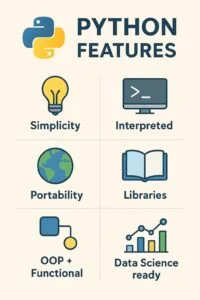 Every field of Python operates under the control of these teeny-weeny yet mighty keywords.
Mini Coding Projects to Implement with Python Keywords
Password Strength Checker (using if-else and while):
while True: pwd = input("Enter password: ") if len(pwd) < 8: print("Too short, try again.") else: print("Password accepted!") breakSimple Calculator (using def, return):
def add(a, b): return a+b def sub(a, b): return a-b print(add(5,3)) print(sub(10,4))To-Do List Manager (using class):
class Todo: def __init__(self): self.tasks = [] def add_task(self, task): self.tasks.append(task) my_list = Todo() my_list.add_task("Learn Python Keywords") print(my_list.tasks)Common Mistakes to Avoid with Python Keywords
Using keywords as identifiers:
def = 10 # ❌ invalidCase sensitivity confusion:
- True is not the same as true.
- Forgetting colons with if, while, def, class.
- Misusing is vs ==. (is checks identity, not equality.)
Troubleshooting Tips
- ust help("keywords") in Python to check the current keyword list.
- IDEs like PyCharm or VS Code highlight keywords automatically.
- If you get a SyntaxError, double-check you didn’t accidentally use a keyword as an identifier.
Comparison with Other Programming Languages
- C/C++: Lot more keywords (~60), less readable syntax.
- Java: Reserved words are case-insensitive; Python is case-sensitive.
- JavaScript: almost similar keywords (if, for, while), but Python-directed toward simplicity.
Why Learn Python Keywords for Career Growth?
Python Keywords are important because they are intertwined with every little thing in Python, be it AI models or Instagram servers. The pay scale in India, for instance, is:- Data Science roles: ₹6–12 LPA
- Web Development: ₹4–10 LPA
- AI/ML Engineering: ₹8–20 LPA
Step-by-Step Learning Roadmap for Python
- Small: Memorize the Python keywords with examples.
- Practice: Daily write mini programs using each keyword.
- Make Projects: Calculator, password checker, mini-game.
- Explore Frameworks: Django, Flask, TensorFlow—see how keywords structure bigger code bases.
- Transition to real-world apps: API, AI projects, and automation scripts.
Why Python Keywords Are Your First Step
Learning Python Keywords may feel ancient-the-alphabet idea in learning a foreign language. But the alphabet makes a sentence, a sentence forms a story, a story wins a movie. These 35 keywords allow you to create everything from chatbots to space simulations. The difference between an amateur and a confident coder often lies in terms of the comfort level with the fundamentals. Master keywords, and you’ve really mastered the heart of Python.Also Read:
- Python Hello World: An Effective 8 Steps Beginner’s Guide to Your First Program
- Install Python on Your System: Step-by-Step Guide for Beginners
- Features of Python: 15 Key Advantages Every Developer Should Know
- Difference between Python 2 and 3: Useful Key Differences Explained Effectively
Supercharge Your PW Skills
Want to learn Python more than keywords? The PW Skills DSA Python Course teaches you from the ground up with hands-on projects, expert mentors, problem-solving, and more. It teaches skills that employers want for jobs today with pricing that won't break the bank and flexible learning .



🔥 Trending Blogs
Python Keywords FAQs
What are Python keywords used for?
Python Keywords define the structure and logic of Python programs, managing flow, variables, and functions.
Can I create my own Python keywords?
No. The Python keywords are predefined. You can use them but can't create new ones.
How to see all keywords in Python?
Import keyword; print(keyword.kwlist) in the Python shell.
Are the Python keywords same for every version?
Mostly, yes, but newly added (async, await) ones may come in later versions. Always check your version.


Talk to a counsellorHave doubts? Our support team will be happy to assist you!



Get Free Counselling Today
and Clear up all your Doubts
Talk to Our Counsellor just by filling out the form.
Join 15 Million students on the app today!
 Live & recorded classes available at easeDashboard for progress trackingLakhs of practice questions

