
Java Assignment Operators
 Aashutosh Dwivedi10 Mar, 2026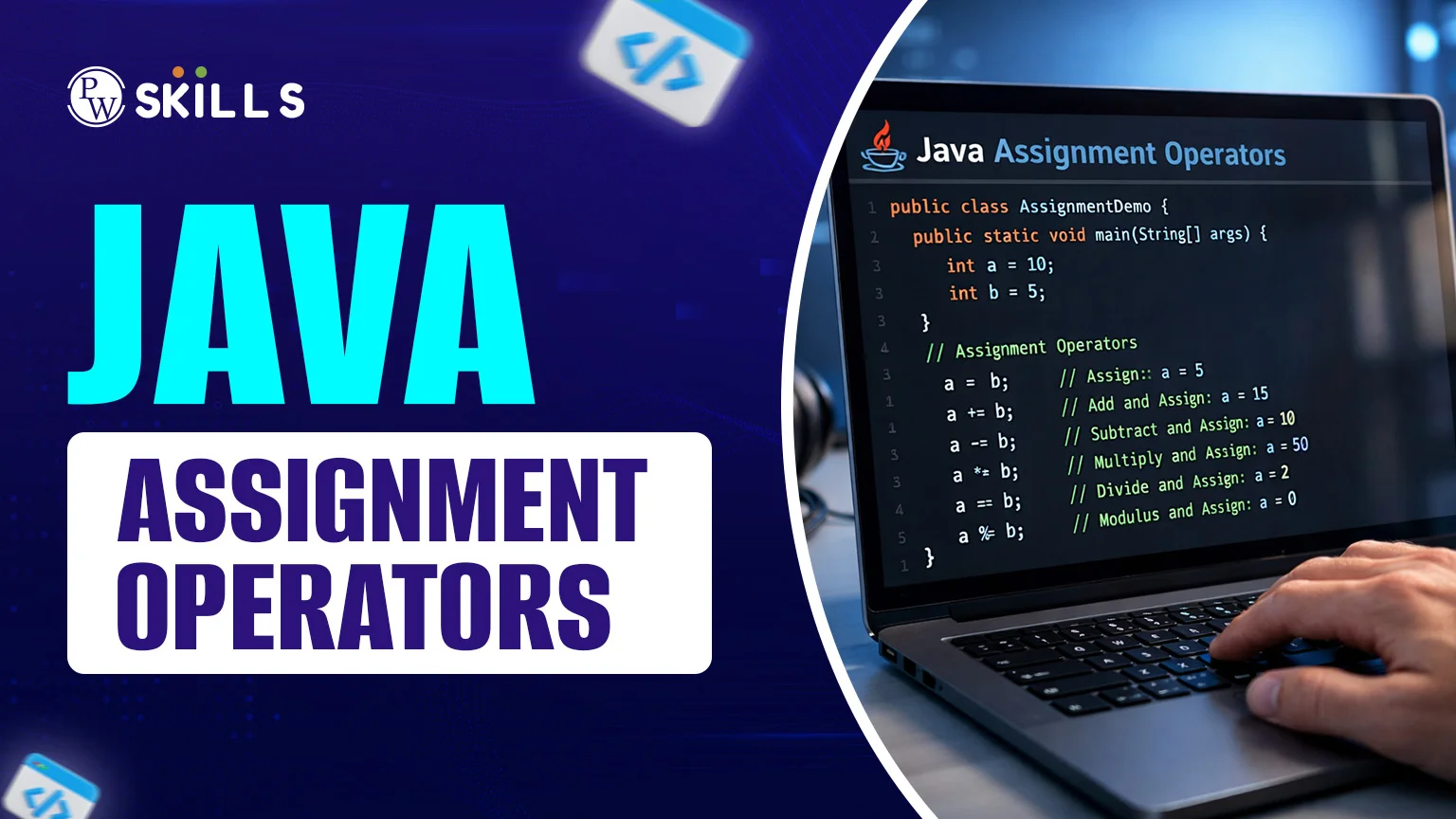
You utilise Java Assignment Operators to give variables values. The simple assignment operator (=) is the most frequent one. Java also has compound assignment operators, including +=, -=, and *=, that do both an arithmetic operation and an assignment in one step. These operators make code shorter and work very well. To manage data flow and update states in any application, you need to know what java assignment operators mean.
In programming, variables are like boxes, and assignment operators are the tools we use to put things in those boxes. You use these operators when you add points to a gaming score or figure out the total cost of items in a shopping basket. We at PW Skills focus on developing clean, professional code. One sign of an experienced developer is that they can handle compound assignments.
Java Assignment Operators Meaning and Types
When we talk about java assignment operators explained, we're talking about how to shift a value from the right side of an expression to the left side variable.The Simple Assignment Operator (=)
This is the simplest operator. It takes the number on the right and puts it in the variable on the left.- Example: int x = 10; (The value 10 is assigned to x).
Compound Assignment Operators
These are "shortcuts." They combine an arithmetic or bitwise operation with an assignment. They are preferred in professional development because they reduce redundancy.Java Assignment Operators Program (Examples)
Let's look at a java assignment operators example program to really comprehend how these function. This code shows how the value of a variable changes when different operators are used.. Also read :- Java Type Casting
- Java Comparison Operators
- DSA in JAVA
- Java Data Types Real-Life Example
- Java Getting Started: Java Starting Code
- Java Syntax: Your Step-by-Step Guide
- Java Cheat Sheet
- Java Identifiers: How to Name Your Code
- Top 30 Java Interview Question and Answers
- Top 60 Java Interview Questions and Answers For Freshers
- Top 5 Java Internships To Apply
Example Code:
Explanation:
- In the += step, the program takes the current value (100), adds 50, and updates the variable to 150.
- In the *= step, it takes 130 and doubles it to 260.
- The %= operator is useful for finding remainders; here, 10 divided by 3 leaves a remainder of 1.
Advanced Bitwise Assignment Operators
For those diving deeper into java assignment operators explained, Java also includes bitwise compound assignments. These are used for low-level programming and performance optimization.- &= (Bitwise AND assignment): x &= 3
- |= (Bitwise OR assignment): x |= 3
- ^= (Bitwise XOR assignment): x ^= 3
- >>= (Right shift assignment): x >>= 3
- <<= (Left shift assignment): x <<= 3
Why Use Compound Assignment Operators?
- Conciseness: total += tax is shorter and easier to read than total = total + tax.
- Performance: In some older compilers, compound operators were slightly faster. In modern Java, the performance is the same, but the readability is the main advantage.
- Type Casting Advantage: This is a "hidden" benefit. Compound operators perform an implicit cast.
- Example: short s = 5; s = s + 10; will cause a compiler error because s + 10 results in an int.
- Example: short s = 5; s += 10; will compile perfectly because += automatically casts the result back to short.
Precedence and Associativity
In a java assignment operators program, you must remember that assignment operators have very low precedence. This means almost every other operation (like addition or multiplication) happens before the assignment takes place.- Associativity: Assignment operators are right-associative. This means they are evaluated from right to left.
- Example: a = b = c = 50;
- First, c becomes 50.
- Then, b becomes the value of c.
- Finally, a becomes the value of b.
Assignment Operators with Different Data Types
One of the most powerful aspects of Java Assignment Operators is how they handle mixed data types through implicit narrowing. In standard Java arithmetic, if you add an int to a double, the result is automatically promoted to a double. If you try to store that result back into an int variable using a simple assignment, the compiler will throw an error because of potential data loss. However, compound assignment operators (like +=, -=, *=) include an internal, invisible cast. This means x += y is technically processed as x = (type of x)(x + y).Example of Implicit Casting:
This feature makes your java assignment operators program much cleaner, as it removes the need for manual casting. However, developers must be careful; because the cast is hidden, you might lose decimal precision without realizing it. For instance, if you multiply an int by 1.9 using *=, the fractional part is simply chopped off, which could lead to logical bugs in financial or scientific applications.Assignment vs. Equality Operator
A common pitfall for beginners is confusing the assignment operator (=) with the equality operator (==). Understanding the java assignment operators meaning is essential to avoid this logic-breaking error.- Assignment (=): Used to "set" or "store" a value. It is an instruction to the computer to change what is inside a variable.
- Equality (==): Used to "check" or "compare" two values. It is a question asked to the computer, which always answers with true or false.
Conclusion
Java Assignment Operators are the most important parts of your code. You may change data with little typing and maximum clarity with these operators, from the simple = to the smart +=. You can make sure your code is up-to-date, easy to read, and fast by learning what the java assignment operators mean and using them in your example application. We at PW Skills want you to use compound operators as much as you can. They help you think about "updating" a variable's status instead than just giving it a new name. Keep practicing, and these shortcuts will eventually become second nature to you as you learn to program!