
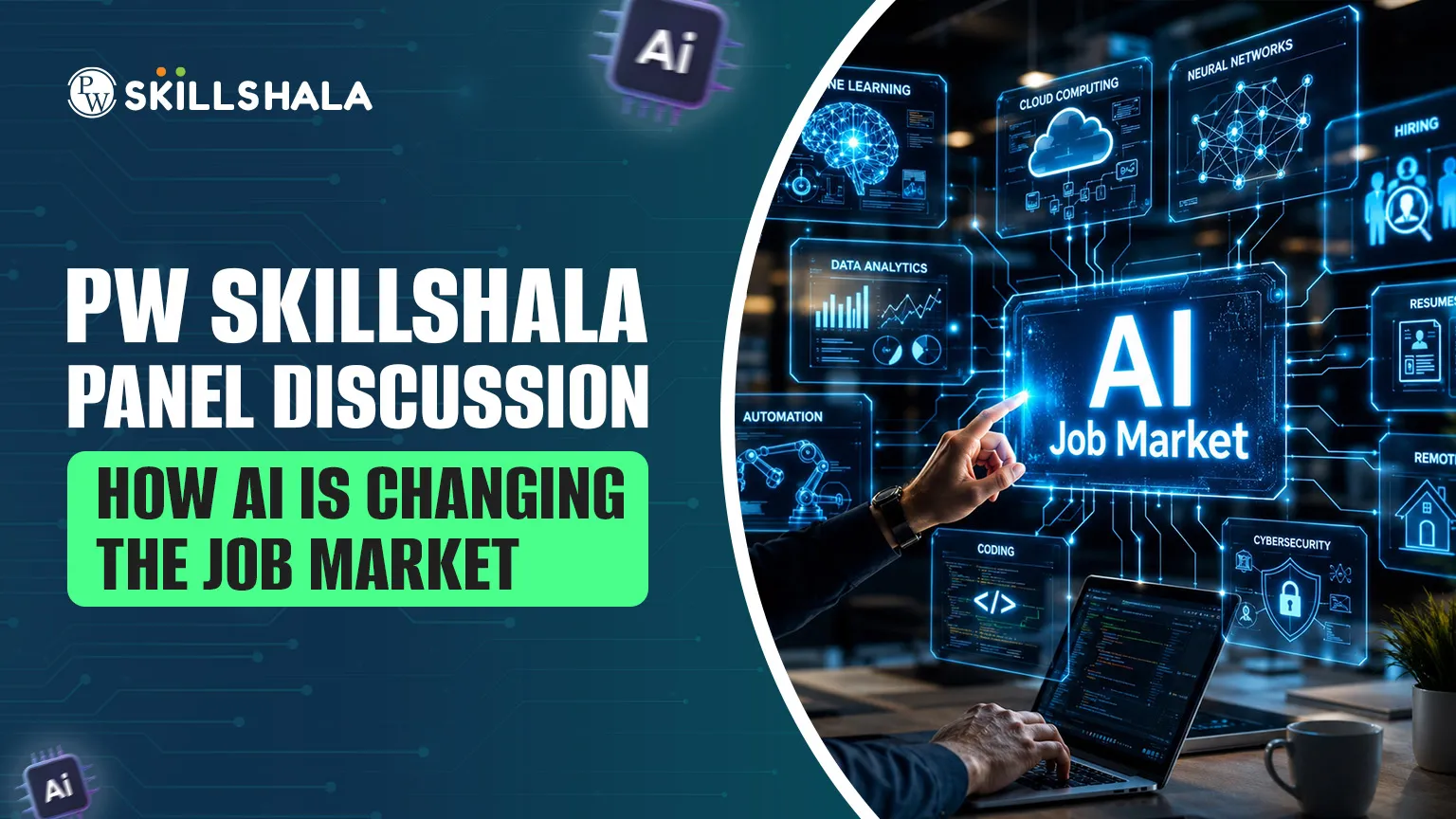
PW Skillshala Panel Discussion: How AI Is Changing the Job Market
 Study Abroad23 May, 2026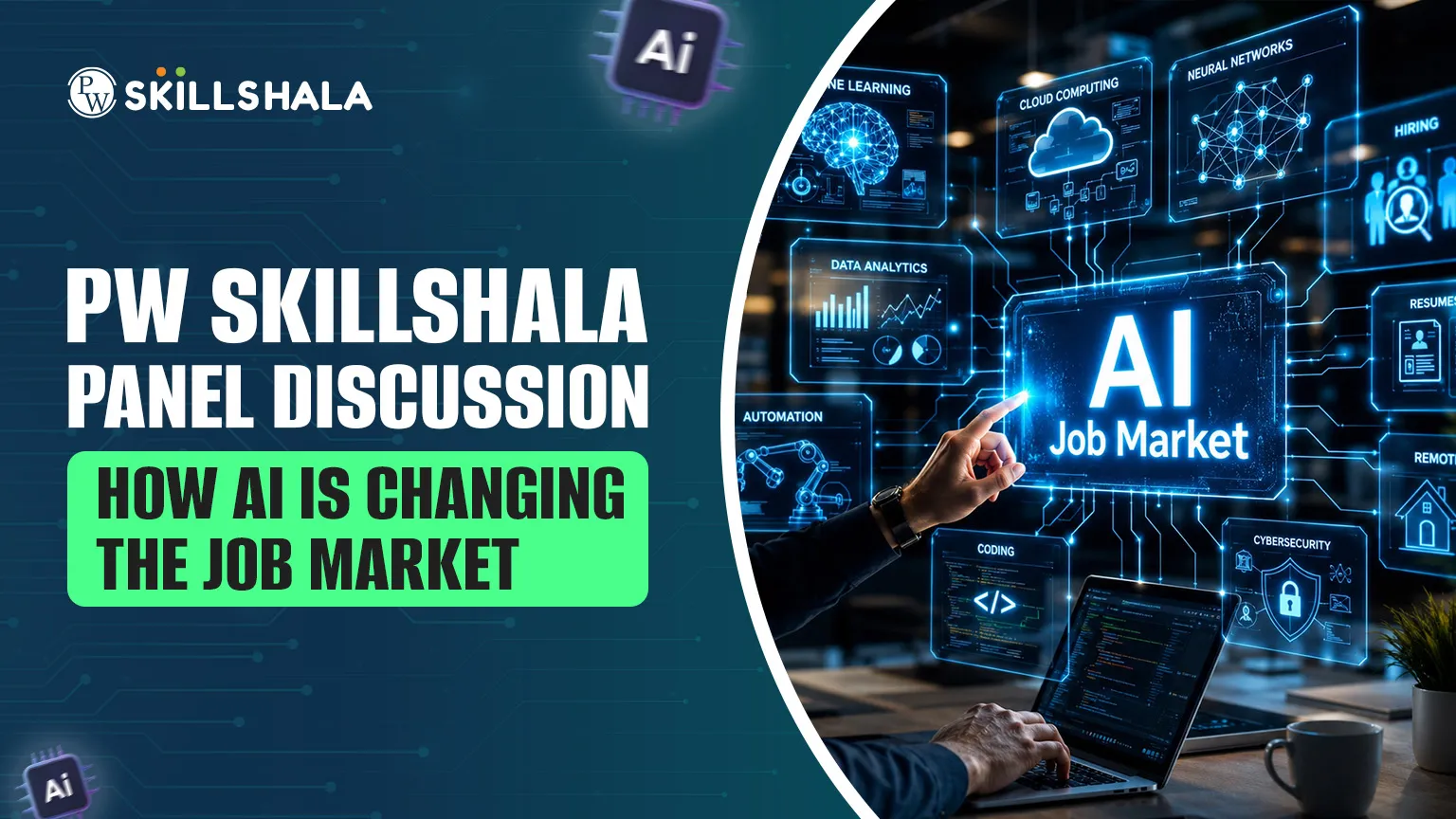
Artificial Intelligence is no longer a future concept that students only read about.
It is already changing the way companies work, hire, analyse data, automate tasks, and build products.
Because of this shift, students are also asking new questions.
-
Will AI replace jobs?
-
Which careers are safe?
-
What skills should students learn now?
-
How should freshers prepare?
These questions became part of the conversation at the PW Skillshala Kaam Ki Baat panel discussion, where the focus was on future tech careers, portfolios, skills, and job readiness. The session explored how the job market is changing and why students need stronger practical skills instead of depending only on degrees or generic resumes.
Overview of PW Skillshala AI Jobs Discussion
The conversation around PW Skillshala AI jobs is important because the hiring landscape is changing quickly.
Companies now use AI tools in:
-
Data analysis
-
Marketing
-
Customer support
-
Product workflows
-
Automation
-
Recruitment processes
-
Content systems
-
Reporting and dashboards
This does not mean all jobs are disappearing.
But it does mean that job roles are evolving.
Students who understand AI-supported workflows may adapt faster than students who avoid them completely.
That is why the panel discussion focused on skills, proof of work, and career readiness instead of fear.
PW Skillshala AI Jobs and the Future Job Market
The future job market is expected to look different from what students saw a few years ago.
Earlier, many learners focused only on getting a degree or learning one technical skill.
Now, companies often look for people who can:
-
Work with tools
-
Solve problems
-
Adapt to technology
-
Learn continuously
-
Build projects
-
Understand workflows
-
Present ideas clearly
AI tools are helping companies automate repetitive work, but human decision-making, creativity, communication, and practical problem-solving still matter.
The panel discussion highlighted that students should focus on becoming more adaptable instead of fearing every technology shift.
PW Skillshala AI Jobs Across Careers
The discussion around AI and careers was not limited to coding.
One of the key points was that career growth now depends on practical capability and portfolio proof.
Students often think AI careers only belong to advanced developers or machine learning engineers.
But AI is affecting multiple fields.
For example:
-
Digital marketers use AI-assisted content and analytics tools
-
Analysts use AI-supported dashboards and automation
-
Product teams use AI insights for decision-making
-
Developers use AI coding assistants
-
Businesses use AI for operations and customer interaction
This means students across domains may need some understanding of AI-supported work environments.
PW Skillshala AI Jobs and AI-Enabled Career Growth
Instead of only talking about jobs being replaced, the panel also focused on the rise of AI-enabled jobs.
These are roles where AI supports the work rather than fully replacing the person.
Examples may include:
-
Data Analysts
-
AI-assisted marketers
-
Automation support roles
-
Business intelligence roles
-
Product analysts
-
Customer experience specialists
-
Operations and reporting roles
-
Prompt and workflow support roles
In many cases, the role changes instead of disappearing.
Students who can learn tools, analyse outputs, and apply insights may stay more relevant in changing industries.
Why AI Skills Matter More Than Claims
One of the strongest themes in the discussion was proof.
Students often write skills on resumes, but companies now expect evidence.
This becomes even more important in an AI-driven hiring environment.
A recruiter may ask:
-
What project did the student build?
-
Can they explain the workflow?
-
Have they worked with real datasets?
-
Can they present insights?
-
Do they understand practical application?
-
Can they adapt to new tools?
This is why the Kaam Ki Baat event included the Resume Reality Check and Data Analytics workshop.
The idea was to show students that learning alone is not enough.
They also need visible proof of learning.
Resume Gaps in the AI Hiring Era
The panel discussion connected AI and hiring trends with resume quality.
Many resumes fail because they:
-
List tools without proof
-
Mention AI without practical work
-
Have no portfolio links
-
Show no projects
-
Use generic summaries
-
Do not explain outcomes clearly
In today’s hiring process, resumes often compete against automated filtering systems and fast recruiter scans.
That means students must write clearly and present relevant work directly.
A project-backed resume usually creates more impact than a long list of claims.
Why AI Jobs Need Project-Based Skills?
One of the biggest changes in the future job market is the growing importance of projects.
A certificate says a student completed a course.
A project shows what the student can actually do.
This is why the PW Skillshala event included a practical Data Analytics workshop where students could understand datasets, clean data, create insights, build dashboards, and package the project for resume use.
Projects help students:
-
Build confidence
-
Improve portfolios
-
Explain skills better
-
Prepare for interviews
-
Show practical understanding
-
Stand out during shortlisting
As AI tools become more common, projects may become one of the strongest ways to prove human problem-solving ability.
Why Human Skills Still Matter Even with AI
Even though AI tools are improving, companies still need people who can:
-
Think critically
-
Ask the right questions
-
Communicate clearly
-
Understand context
-
Make decisions
-
Work with teams
-
Explain insights
-
Solve practical problems
The panel discussion suggested that students should avoid thinking in extremes.
AI is not only replacing jobs.
It is also changing the type of work people do.
Students who combine technical learning with communication, project work, adaptability, and practical thinking may become more employable.
How PW Skillshala Connects With Job Readiness
The event positioned PW Skillshala as an offline career-readiness ecosystem.
The focus was not only on learning content.
The focus was on preparing students for actual career situations.
This included:
-
Practical mentorship
-
Data Analytics projects
-
Resume support
-
Faculty guidance
-
Doubt-solving
-
Community learning
-
Counselling sessions
The panel discussion supported this larger idea.
Students need more than awareness.
They need preparation.
Key Takeaways from PW Skillshala AI Jobs Panel Discussion
The discussion around PW Skillshala AI jobs can be summarised in a few simple points.
AI is changing workflows across industries.
The future job market will reward adaptability.
Projects and portfolios are becoming more important.
Generic resumes are becoming weaker.
AI-enabled jobs are increasing in multiple domains.
Students should focus on practical skills and proof.
Human decision-making and communication still matter.
Career readiness now depends on learning, building, presenting, and adapting together.



FAQs
What was the PW Skillshala panel discussion about?
How is AI changing the job market?
Why are projects important in the future job market?
Does AI mean all jobs will disappear?





Get Free Counselling Today
and Clear up all your Doubts
 Live & recorded classes available at easeDashboard for progress trackingLakhs of practice questions

