

Financial Analyst vs Investment Analyst: Key Differences
 Hardik Gupta15 Jul, 2026
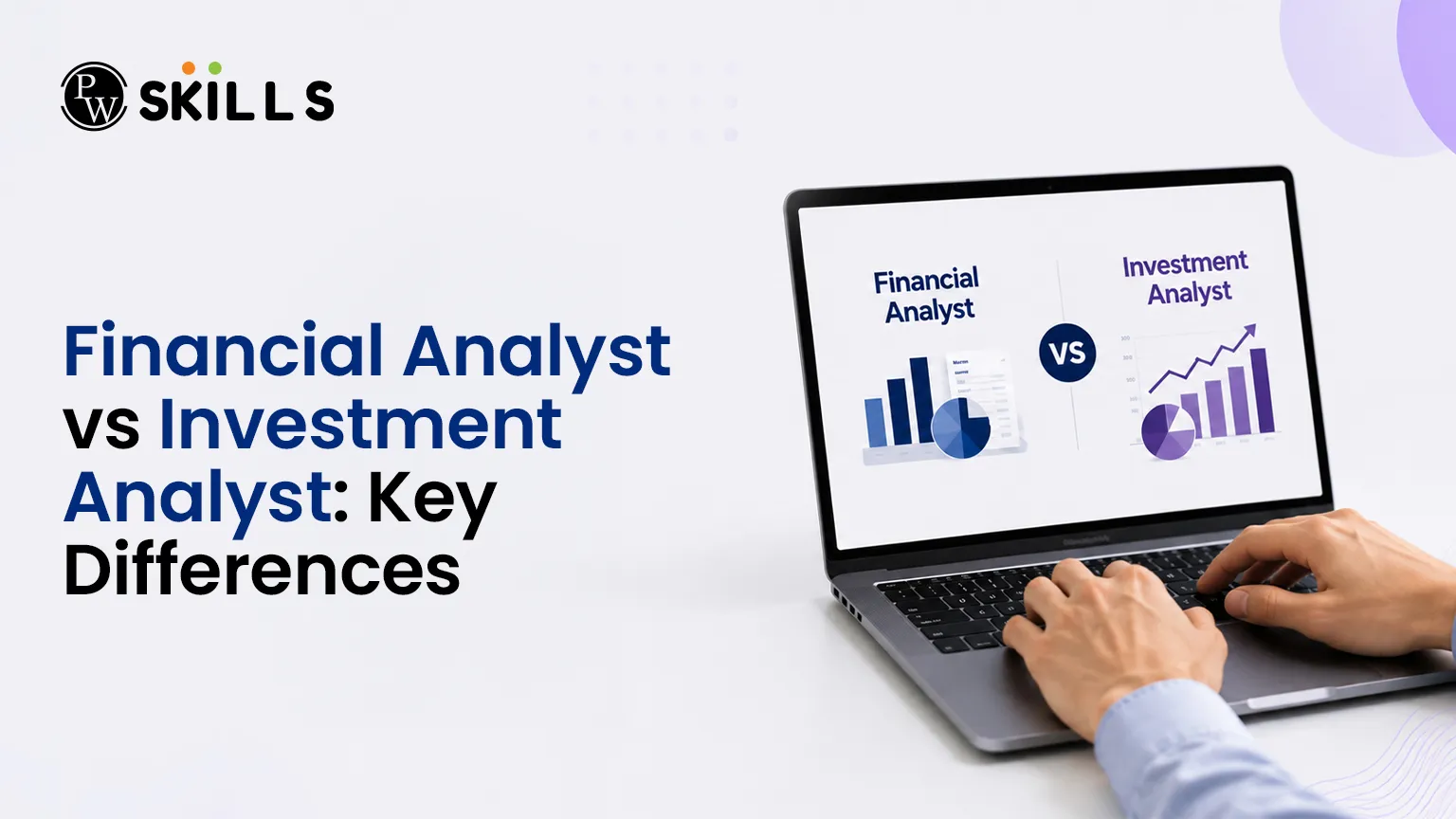
Choosing between a Financial Analyst vs Investment Analyst can be challenging because both roles involve data analysis and financial decision-making, but serve different business objectives.
Understanding how these careers differ in responsibilities, required skills, work environments, and career progression will help you identify the path that best matches your interests and long-term professional goals.
What is a Financial Analyst and an Investment Analyst?
To understand how these professionals spend their days, you have to look at the direction of their focus. Both experts handle massive amounts of data, but they use that data to answer entirely different business questions.
The Internal Focus of Financial Planning Roles
A financial analyst operates like an internal doctor for a specific corporation. They look at budgets, operational costs, and historical performance to guide future business moves.
Their primary duties include:
-
Creating annual budgets and rolling monthly forecasts.
-
Analysing departmental spending to locate inefficiencies.
-
Developing variance reports to compare actual revenue against goals.
-
Supporting executive teams with data during internal restructuring.
The External Focus of Investment Analysis
An investment analyst looks outward at the broader market. They examine external entities, stocks, bonds, and macroeconomic trends to advise clients or funds on where to allocate capital safely.
Their daily responsibilities typically involve:
-
Researching public companies to issue buy, sell, or hold advice.
-
Assessing geopolitical risks and sector trends for asset managers.
-
Monitoring portfolio performance against market benchmarks.
-
Pitching viable asset purchases to fund managers or private clients.
Explore Our Course: Financial Modeling with AI
What is the Job Role of a Financial Analyst and an Investment Analyst?
The day-to-day pressure, hours, and operational styles differ greatly depending on whether you work inside a standard corporate structure or within the fast-paced asset management industry.
Corporate Cubicles vs Trading Floors
Normal businesses have regular corporate hours for financial analysts, but go into overdrive during quarterly reviews or annual budget cycles. They operate in a predictable environment, alongside other internal divisions.
Investment analysts often keep longer, less predictable hours directly tied to global market movements. They have to beat market benchmarks, and so they work closely with traders, portfolio managers, and institutional clients.
What Skills are Needed for Financial Analysts vs Investment Analysts?
Succeeding in these competitive industries requires a distinct mix of technical expertise and behavioral traits tailored to the target audience.
Technical Skill Requirements
Both positions demand high numeracy skills, but the specific toolkits differ significantly in their day-to-day operations.
For internal financial planning roles, professionals must master:
-
Advanced spreadsheet modeling for internal cost allocations.
-
Enterprise Resource Planning tools to harvest departmental data.
-
Cost accounting principles to track inventory and labor overhead.
For those focusing on investment analysis, the mandatory technical skills include:
-
Quantitative valuation techniques like Discounted Cash Flow models.
-
Macroeconomic indicators track inflation, interest rates, and GDP.
-
Deep knowledge of securities regulations and asset classes.
Quick Tip: If you enjoy dissecting how a single company can optimize its internal operations, choose corporate finance. If you prefer tracking global market trends and macroeconomic shifts, look toward investment firms.
How do the Career Growth and Salary Compare for Financial Analysts vs Investment Analysts?
The long-term trajectory for both paths offers excellent upward mobility, though the compensation structures reflect the different levels of risk involved.
Advancing in Corporate Finance
In the corporate world, they generally start as a junior analyst and slowly progress to senior analyst, finance manager, director of finance, and finally Chief Financial Officer. Salary growth is steady, predictable, and well tied to corporate tier structures.
Climbing the Asset Management Ladder
Market professionals begin as research associates and progress to senior analyst, portfolio manager, and managing director. Compensation here is heavily weighted toward performance bonuses, so making successful market calls can mean a big pay cheque.
How to Become a Financial Analyst vs Investment Analyst?
Both fields require a strong business background, with advanced certifications in a particular industry that varies depending on your preference.
Degrees and Initial Qualifications
Both positions usually require a bachelor’s degree in finance, economics, accounting, or business administration. Strong analytical skills and being comfortable with heavy data sets are baseline requirements for entry-level hiring.
Professional Certifications That Matter
To stand out in competitive hiring pools, professionals often pursue specialized credentials:
-
Certified Management Accountant (CMA): Highly valued for internal corporate roles focusing on efficiency.
-
Chartered Financial Analyst (CFA): The gold standard credential for global market analysis and portfolio management.
-
Certified Financial Planner (CFP): Beneficial for those moving into retail wealth management spaces.
What Tools Do Financial Analysts vs Investment Analysts Use?
These positions need specialised platform experience to run successfully. Both rely heavily on spreadsheet software, but the specific uses of data collection and the kind of conclusions drawn depend on whether the goals are internal or external.
Operational Tools for Corporate Planning Teams
Internal finance professionals need programs that can be integrated with enterprise accounting databases to track operational realities. You spend your working hours navigating software that measures performance indicators against fixed corporate budgets.
The primary software stack typically includes:
-
Enterprise Resource Planning (ERP) Systems: Large-scale systems like SAP or Oracle are utilized to extract departmental spend data and track manufacturing or labor costs.
-
Business Intelligence Platforms: Applications such as Power BI or Tableau are heavily utilized to build dynamic, automated dashboards that simplify cost variances for non-finance executives.
-
Specialized Budgeting Software: Cloud tools like Mosaic or Causal help teams escape spreadsheet version-control friction, allowing real-time collaboration on corporate rolling forecasts.
What Financial Models Do Financial Analysts and Investment Analysts Use?
The math in both fields is based on the same ideas, but the actual application is centred on two completely different results of analysis. An analyst’s approach to building a financial model depends on whether they are trying to fix an internal bottleneck or buy a stock.
Internal Variance and Budget Modeling
In corporate financial planning roles, modeling focuses entirely on predicting operational outcomes based on historical internal behavior. Analysts look deep into the fine mechanics of a specific business entity to ensure stability.
Common internal techniques include:
-
Three-Statement Integrated Models: Linking the income statement, balance sheet, and cash flow statement to test how internal spending updates affect overall company liquidity.
-
Variance Analysis: Continually comparing actual operational expenditures against the initial annual budget to isolate exactly which departments are overspending.
-
Capital Budgeting Models: Utilizing Net Present Value (NPV) and Internal Rate of Return (IRR) math to evaluate if purchasing new factory equipment or expanding physical office footprints makes financial sense.
External Valuation and Return Modeling
Market analysts use modelling to find the intrinsic value of an asset versus the price at which it is trading publicly. They forecast future cash flows to see if the market is undervaluing an investment opportunity.
Standard external modeling methods include:
-
Discounted Cash Flow (DCF) Models: Projecting a company's free cash flows far into the future and discounting them back to present value using the Weighted Average Cost of Capital (WACC) formula.
-
Comparable Company Analysis (Comps): Building peer group tracking sheets to contrast enterprise value multiples, such as EV-to-EBITDA or Price-to-Earnings (P/E), against industry competitors.
-
Leveraged Buyout (LBO) Architecture: Constructing complex debt-repayment models to discover if an acquisition target can successfully generate enough cash to pay off transaction debt.





FAQs
Which job is better for work-life balance?
Can a corporate analyst invest in the market?
What is the primary tool the two professionals use to analyse?
Which certifications are best for a financial analyst versus investment analyst?
How do I fix circular references in a financial model?









Get Free Counselling Today
and Clear up all your Doubts
 Live & recorded classes available at easeDashboard for progress trackingLakhs of practice questions

