
Can You Solve These Beginner DSA Challenges?
 Hardik Gupta9 Jul, 2026
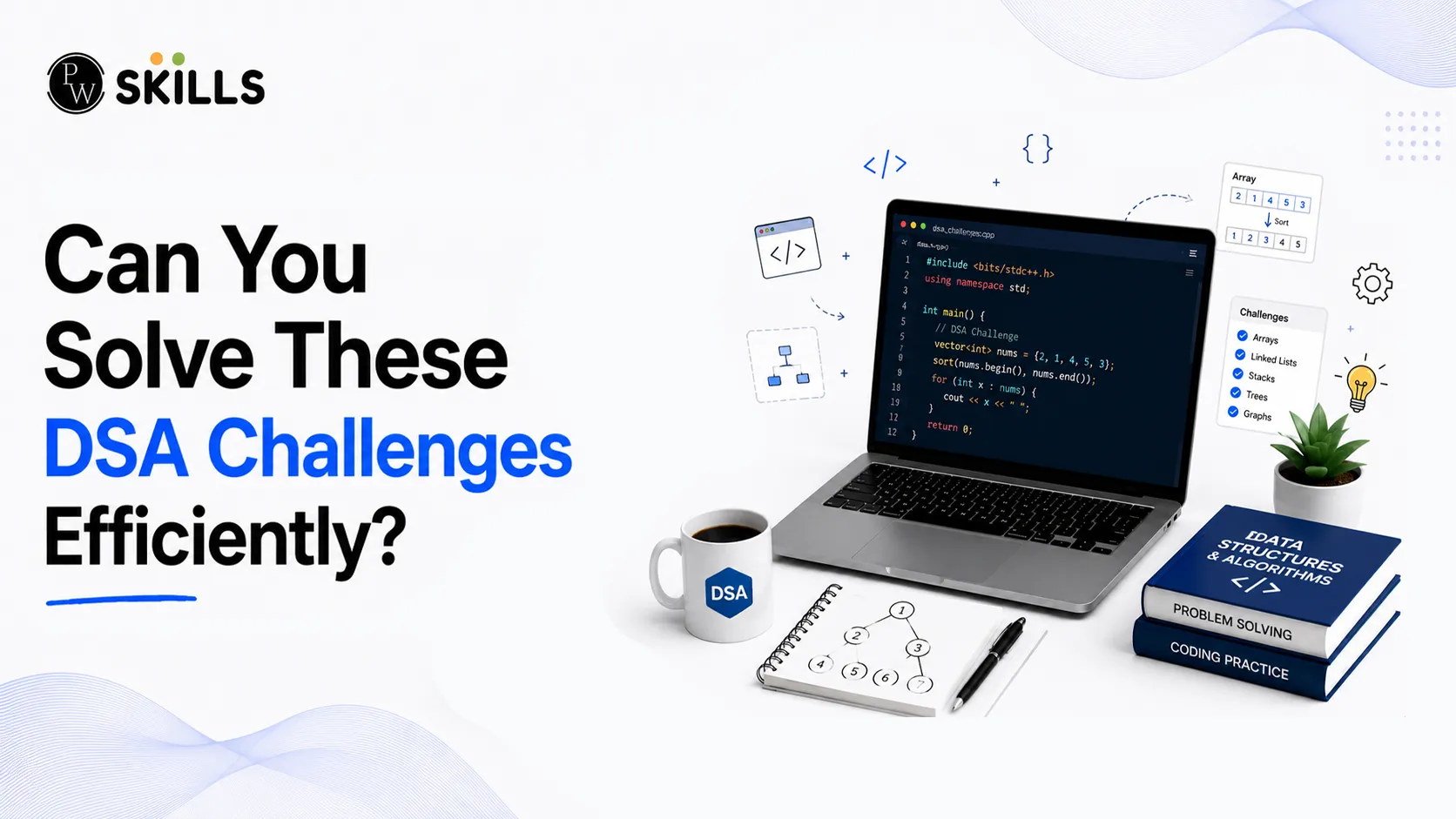
Starting your coding journey can feel overwhelming when confronted with complex logic. Many new programmers struggle to bridge the gap between syntax and problem-solving, which is exactly where learning data structures and algorithms helps. Tackling structured beginner DSA problems is the most effective way to build professional muscle memory, break down complex requirements, and prepare for competitive coding interviews.
Importance of Beginner DSA Problems
Consistency is key when developing software engineering skills. Working through everyday DSA problems trains your brain to spot logical regularities and select the correct storage structures.
-
Logical Growth: Breaking large operations down into smaller phases improves real-world software architecture planning.
-
Interview Preparedness: Technical interview processes rely heavily on standard arrays, loops, and condition-based operations.
-
Resource Efficiency: Writing clean solutions teaches you to conserve memory and execute loops faster.
Building a solid foundation ensures you will not stumble when encountering more advanced algorithmic principles later on.
Read In Detail: How DSA Improves Your Coding Problem-Solving Skills
Important Array and Number Beginner DSA Problems
Arrays and numerical operations form the bedrock of data structures. Learning these foundational items helps you handle basic indices and simple mathematical logic.
1. Count Even and Odd Elements in an Array
This problem requires you to look at every item within an array and determine whether it can be divided equally by two. It helps you practice tracking conditions across multi-element datasets.
-
Logic: Loop through each element, check the remainder when divided by two using the modulus operator, and increment the respective counter.
-
Key Concept: Iteration and modular arithmetic.
2. Find the Average of Elements in an Array
Calculating a dataset average is a frequent operational necessity in production software.
-
Logic: Keep a running sum of all elements as you iterate through the collection, then divide that total by the array size.
-
Key Concept: Cumulative tracking and dynamic type management.
Example Breakdown:
Input Array: [10, 20, 30, 40]
Sum total: 10 + 20 + 30 + 40 = 100
Array Length: 4
Resulting Average: 100 / 4 = 25
3. Check if a Number is a Palindrome
A value is a palindrome if it reads the same forward and backward. This challenge is excellent for learning variable manipulation.
|
Step |
Operation |
Remainder / Current Value |
Accumulated Reverse Value |
|
1 |
Extract last digit |
121 % 10 = 1 |
(0 * 10) + 1 = 1 |
|
2 |
Reduce original number |
121 / 10 = 12 |
1 |
|
3 |
Extract next digit |
12 % 10 = 2 |
(1 * 10) + 2 = 12 |
|
4 |
Reduce original number |
12 / 10 = 1 |
12 |
|
5 |
Extract final digit |
1 % 10 = 1 |
(12 * 10) + 1 = 121 |
If the final reconstructed number matches the original recorded state, the value is a palindrome.
String and Matrix Beginner DSA Problems
Once you feel comfortable handling numbers, moving on to string sequences and multi-dimensional matrices will expand your understanding of data shapes.
4. Count Vowels in a Given String
Text-based programming exercises often require inspecting characters. This problem involves checking a word to count occurrences of 'a', 'e', 'i', 'o', and 'u'.
-
Implementation: Standardise the text inputs to lowercase, cycle through the characters, and check each against a set of valid vowel characters.
5. Find the Maximum Element in a Matrix
A matrix extends regular arrays into a two-dimensional grid consisting of rows and columns. Tracking elements within grids is foundational for graphics engines and spreadsheet tools.
-
Method: Set your initial tracker to the first cell's value. Use nested loops to navigate through each row and column, updating your tracker whenever a larger value is found.
6. Segregate 0s and 1s Within a Binary Array
Sorting messy data arrays is a classic task in data structures. Grouping similar items efficiently teaches you how to optimize memory space.
-
Approach: Count the total number of zeros present in the collection. Re-write the array by placing that exact count of zeros at the start, and fill the remaining spaces with ones.
Mathematical Logic Beginner DSA Problems
Mathematical coding tasks are excellent for refining your control flow logic and ensuring variables are handled accurately.
7. Find the Factorial of a Number
A factorial is the product of all positive integers less than or equal to a target number.
-
Logic: Start an accumulator variable at one, then run a loop that multiplies it by each increasing integer up to your target value.
-
Key Value: Great for exploring basic iterative accumulation limits.
8. Check for Armstrong Numbers
An Armstrong number equals the sum of its digits raised to the power of the total digit count. For instance, 153 has 3 digits: 1 cubed plus 5 cubed plus 3 cubed equals 153.
-
Process: Discover the length of the number, isolate each digit, raise it to the calculated power, and sum the results to check if it matches the original value.
9. Verify if an Array is Fully Sorted
Verifying data status before running a search algorithm prevents logic bugs and saves computational resources.
-
Verification: Compare each item to the one next to it. If any element is larger than the following one, the array is unsorted.
Also Check : DSA Full Form in Programming: Data Structures and Algorithms Explained
Beginner DSA Problems-Solving Tips
Succeeding with DSA practice questions requires a structured approach rather than guessing random code variations.
-
Dry-Run on Paper: Write out variable states step-by-step using a pen and paper before typing your solution into an environment.
-
Analyze Edge Cases: Consider how your program handles empty inputs, negative values, or single-element arrays.
-
Refactor for Clarity: Once your solution passes, look for ways to simplify your loop conditions and remove redundant checks.
Focusing on these habits makes tackling trickier, multi-layered problem architectures much more manageable over time.






FAQs
Q1: What are the best beginner DSA problems to start with?
Q2: How do I transition from programming exercises to advanced structures?
Q3: Why does my logic fail on specific coding challenges?
Q4: How many beginner DSA problems should I solve before moving on?





Get Free Counselling Today
and Clear up all your Doubts
 Live & recorded classes available at easeDashboard for progress trackingLakhs of practice questions

