
DSA Arrays
 Aashutosh Dwivedi30 Mar, 2026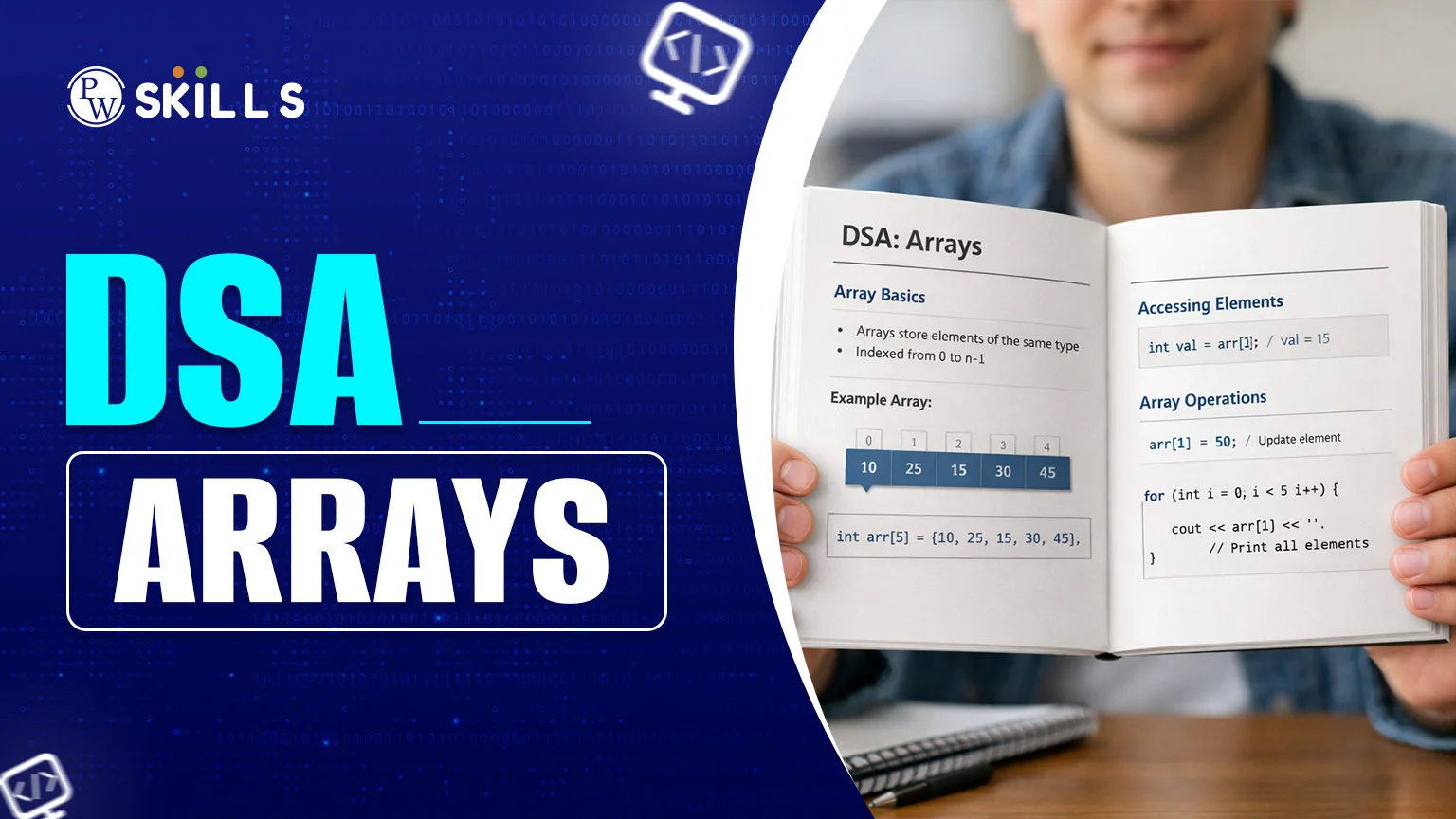
The most basic data structure for storing elements of the same kind in adjacent memory regions is the DSA Arrays. Arrays are the "bricks" that make up your digital house, whether you're making a basic contact list or a complicated image processing engine.
What are DSA Arrays?
An Array is a linear data structure that stores elements of the same type, like numbers or strings, at memory addresses that are next to each other.Key Characteristics of DSA Arrays
- Fixed Size: In many languages, you can't change the size of an array after you make it.
- Indexed Access: Each item in an array has a number that tells you where it is. It's important to note that in practically all programming languages, indexing starts at 0.
- Contiguous Memory: Elements are placed right next to each other in the computer's RAM, which makes accessing them incredibly fast.
Why Use Arrays?
The best thing about dsa arrays is that they let you access data at random. If you know the item's index, the computer can find its exact memory address and get it in a constant amount of time, O(1).Basic Operations on DSA Arrays
To work with arrays effectively, you must understand the five core operations:- Traversal: Going over each item in the array one at a time, commonly with a for loop.
- Insertion: Means putting a new element at a certain index. (Note: This takes a long time because you have to move other things around.)
- Deletion: Removing an element. (Also requires shifting).
- Search: Finding the index of a particular value (Linear Search or Binary Search).
- Update: Changing the value of an element at a given index.
- DSA Insertion Sort
- DSA Counting Sort
- DSA Quicksort
- Data Structures and Algorithms Quiz DSA MCQ Online
- Top 100 DSA Interview Questions
- Arrays in Java
- Array In C++ Programming: Types of Arrays in C++ ( With Examples )
- Array Data Structure
Uses of DSA Arrays
Here are the applications of DSA Arrays:- Digital Imaging: Each digital picture is made up of a 2D array of pixels. At a certain (x, y) coordinate, each pixel holds colour data.
- Leaderboards: Online gaming platforms employ arrays to keep track of and sort player scores in real time.
- Buffer Management: Streaming services use arrays (buffers) to keep video data in chunks so that playback doesn't slow.
- AI/ML: The "tensors" in AI models are basically multi-dimensional arrays (matrices) that hold weights and biases.
DSA Arrays in Java
You have to say what type of array it is and how big it is before you can use it in Java. In Java, DSA arrays are objects that have a length property that tells you how big they are.Implementation Example:
Java public class ArrayExample { public static void main(String[] args) { // Declaration and instantiation int[] numbers = new int[5]; // Initialization numbers[0] = 10; numbers[1] = 20; numbers[2] = 30; // Traversal for (int i = 0; i < numbers.length; i++) { System.out.println("Element at index " + i + ": " + numbers[i]); } } } Pros in Java: Highly memory-efficient and type-safe. Cons in Java: Size is fixed. If you need a dynamic size, you must use ArrayList.DSA Arrays in Python
There is no "native" array type in Python like there is in Java. It utilises Lists instead. Python lists are dynamic, which means they can change size and hold different types of data at the same time. Developers typically utilise the array module or NumPy to make "true" contiguous memory arrays in Python.Implementation Example:
Python # Using a Python List (the common way) fruits = ["Apple", "Banana", "Cherry"] # Adding an element fruits.append("Date") # Traversal for index, fruit in enumerate(fruits): print(f"Index {index}: {fruit}") # Accessing print(fruits[2]) # Output: Cherry Pros in Python: Extremely flexible and easy to use. Cons in Python: Standard lists consume more memory than Java arrays because they store extra information about each object.DSA Arrays and Strings
In many ways, a string is simply an array of characters. To solve coding challenges that involve changing text, like reversing a word or testing for palindromes, you need to know how dsa arrays and strings work together.Key Connections:
- Storage: A string stores characters ('H', 'e', 'l', 'l', 'o') in memory slots in the same way that an array does.
- Indexing: You can get to characters in a string by using indices, like str[0].
- Immutability: Strings are immutable in languages like Java and Python. You can't alter a character in a string directly. Instead, you have to turn the string into an array (or list), update it, and then turn it back into a string.
DSA Array Operations At a Glance
Here is a quick performance analysis of DSA Array operations:| Operation | Time Complexity | Reason |
| Access | O(1) | Direct calculation of memory address via index. |
| Search | O(n) | In the worst case, you must check every element. |
| Insertion | O(n) | Requires shifting all subsequent elements to the right. |
| Deletion | O(n) | Requires shifting all subsequent elements to the left. |
Difference: Java and Python DSA arrays
Here is the difference between java and python DSA arrays:|
Feature |
Java Arrays | Python Lists |
| Size | Fixed |
Dynamic |
|
Data Types |
Homogeneous (Same type) | Heterogeneous (Different types) |
| Memory | Low overhead |
Higher overhead |
|
Syntax |
Verbose/Strict |
Simple/Flexible |






FAQs
Why does the index of an array start at 0?
It shows how far away from the start of the memory block it is. The first element is at offset 0, the second is at offset 1, and so on.
Is it possible for an array to hold distinct kinds of data?
No, not in Java or C++. "Lists" in Python or JavaScript can have different kinds, but for activities that need a lot of processing power, it's best to keep them all the same.
What is a 2D Array?
It is an "array of arrays." Think of it as a table with rows and columns. It is commonly used for grids, maps, and spreadsheets.
How do I decide between an Array and a Linked List?
If you need to find elements by their position often, use an Array. If you need to add and remove a lot of items in the midst of the collection, use a linked list.
What is the most typical error people make with arrays?
The error "Index Out of Bounds." This happens when you try to get to an index that isn't there, such index 5 in an array of size 5. Keep in mind that the last index is always size - 1.


Talk to a counsellorHave doubts? Our support team will be happy to assist you!



Get Free Counselling Today
and Clear up all your Doubts
Talk to Our Counsellor just by filling out the form.
Join 15 Million students on the app today!
 Live & recorded classes available at easeDashboard for progress trackingLakhs of practice questions

