

How To Create A Digital Marketing Plan (Digital Marketing Planning)
Digital Marketing Planning is your roadmap to a successful online business. Learn how to create a digital marketing plan with the right approach, goals, and strategies.
 Varun Saharawat30 Oct, 2025
Planning is a must for expanding your business online or for driving results. A goal gives you a direction and a path to walk on. Without a clear plan, it is difficult to make your online initiatives effective. Digital marketing planning is only complete when your plan includes SEO, analytics, strategies, social media marketing, clear goals, and metrics to ensure that nothing is missed.
If you are wondering how to put the pieces together for a perfect digital marketing plan, then this article is for you. In this blog, we will talk in detail about how to create a digital marketing plan.
What Is A Digital Marketing Plan?
Before we dive into understanding how to create a digital marketing plan, it is essential that we understand what a digital marketing plan actually is. A marketing plan is a document that tells about the campaigns you wish to run, your goals, and the strategies that you need to adopt for the successful accomplishment of these goals.- It includes short-term, medium-term, and long-term goals of a business.
- It includes the strategies that you will implement for growth.
- It includes your budget.
- It also includes the time frame, a complete timeline, and a roadmap for a successful result from the plan.
How to Create a Digital Marketing Plan?
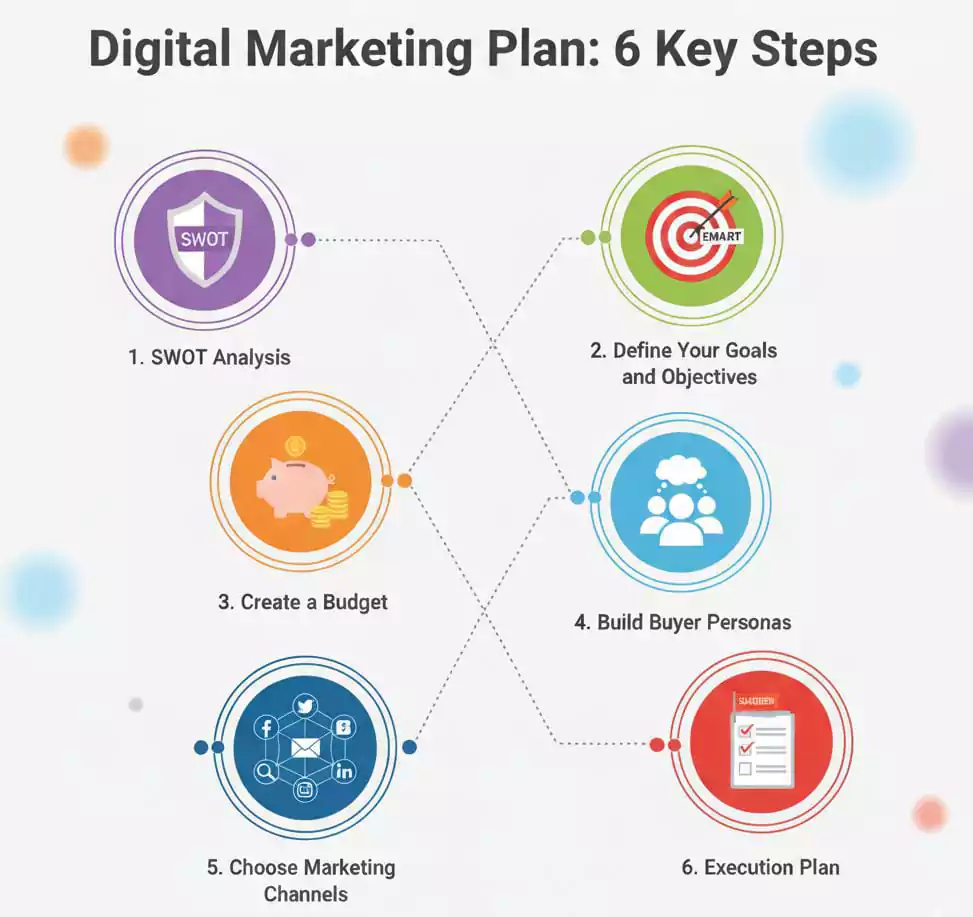 Creating a successful plan for Digital Marketing is not rocket Science. You can craft a successful and effective digital marketing plan by following the below steps.
1. SWOT Analysis
 Identify your strengths, weaknesses, opportunities, and threats that you may have from your leading or emerging competitors. Keep in mind both internal next Arnold factors analysing the SWOT position of your company.
You must know what you are offering and what your consumer demands. The analysis is both qualitative and quantitative as it focuses on factors, like digital habits of users, intermediaries, influences, etc.
Identify your strengths, weaknesses, opportunities, and threats that you may have from your leading or emerging competitors. Keep in mind both internal next Arnold factors analysing the SWOT position of your company.
You must know what you are offering and what your consumer demands. The analysis is both qualitative and quantitative as it focuses on factors, like digital habits of users, intermediaries, influences, etc.
2. Define your Goals and Objectives
 The most important part of the digital marketing planning process is to define your goals correctly. The list of your goals should include your short-term and long-term goals to help you get a clear picture of what you want in the future.
It also provides you with a path and a direction to walk. Defining goals also helps in keeping you and your team on the same page. You can opt for the most famous technique, 'SMART' to define your goals correctly without missing anything. The SMART framework actually stands for:
The most important part of the digital marketing planning process is to define your goals correctly. The list of your goals should include your short-term and long-term goals to help you get a clear picture of what you want in the future.
It also provides you with a path and a direction to walk. Defining goals also helps in keeping you and your team on the same page. You can opt for the most famous technique, 'SMART' to define your goals correctly without missing anything. The SMART framework actually stands for:
- Specific
- Measurable
- Achievable
- Relevant
- Time-bound
3. Create a Budget
 The next step in the process of digital marketing planning is to create a budget based on your marketing goals. The budget is one of the most important and crucial aspects that must be clearly prepared in the early stage of the process because it helps you to take decisions according to what your pocket allows.
If you know your budget clearly, then you can spend where it's required and control the expenditure on non-performing campaigns. When you are deciding your budget, make sure to allocate it to each of your campaigns. Have a look at the key areas where you must allocate the budget.
The next step in the process of digital marketing planning is to create a budget based on your marketing goals. The budget is one of the most important and crucial aspects that must be clearly prepared in the early stage of the process because it helps you to take decisions according to what your pocket allows.
If you know your budget clearly, then you can spend where it's required and control the expenditure on non-performing campaigns. When you are deciding your budget, make sure to allocate it to each of your campaigns. Have a look at the key areas where you must allocate the budget.
- Search Engine Optimization
- Influencer Marketing
- Paid Ads
- Social Media Marketing
- Email Marketing, etc.
4. Build Buyer personas
 You know, the main goal of approximately 21% of marketers is to get a better understanding of what their audience wants. After you have planned your goals and budget, creating buyer personas should be your next step.
Buyer personas
Buyer persona means to create a fictional profile of your ideal customers based on the research and past trends, with their age, gender, location, income level, education level, occupation, etc. This will help you to get an understanding of who your customers are, and thus you will be able to provide better results.Read More: Persona Development: Types & Importance of Persona In Product Design [2025]
5. Choose Marketing Channels
 In digital marketing planning, the channels refer to SEO, content marketing, social media marketing, influencer marketing, email marketing, paid ads, etc. In short, channels are the areas that you use to market your content or to attract people to your website.
Choose the channel that is most suitable for your audience and your goals. For example:
In digital marketing planning, the channels refer to SEO, content marketing, social media marketing, influencer marketing, email marketing, paid ads, etc. In short, channels are the areas that you use to market your content or to attract people to your website.
Choose the channel that is most suitable for your audience and your goals. For example:
- Use social media marketing to create UGC (User-generated Content)
- Use Content Marketing for publishing your articles or blog posts.
6. Execution Plan
The last and most important step in the digital marketing planning process is to execute the marketing plan. Strategies your content and campaigns, group your strategies into similar categories based on the target audience and behavioral patterns.
Distribute the budget accordingly across all the channels you are using based on return on investment (ROI) and other factors. You can use management tools to avoid missing deadlines and reduce pressure.
Become a Pro in Digital Marketing With PW Skills
Build your career in Digital Marketing with an AI powered Digital Marketing Course offered by PW Skills. This course is suitable for newcomers, self learners, and business owners looking for digital growth of their business and building online presence. Get in demand skills designed for today’s AI driven landscape with optimised SEO, social media strategy, content creation, analytics and more to build your career in digital marketing.Looking for More?
- Get industry led live sessions with professionals in digital marketing
- Build a fully job optimised project portfolio which demonstrates your skills, and strengthens with projects.
- Get opportunities for full time jobs or freelance clients for different digital marketing tasks.
- Get personalised career assistance to prepare for interviews and land your dream job
- Get industry recognised certifications from PW Skills
- Enhance your job readiness with practical skills and expert career guidance.






🔥 Trending Blogs
Digital Marketing Plan FAQs
Q1. For how long should I prepare a digital marketing plan?
Ans: A digital marketing plan should cover around the next 6 to 12 months of your business. You can break your plans on a quarterly or half-yearly basis.
Q2. Is it necessary to include all the marketing channels in my plan?
Ans: No, not at all. You must choose the channels which are appropriate according to your goals and audience. There is no need to include all of the channels in just one plan. You can use any two to three
Q3. How to allocate the budget for plans?
Ans: You can reserve 10-20% of your total budget for experiments and distribute the rest for different channels that you will be using for digital marketing. This will allow you to test new ideas without worrying about a low budget.
Q4. What can I do if my plans aren’t giving results?
Ans: Even if your plans aren’t working, don’t panic. You can revisit and refine your plans according to the latest trends. Check what's not working and change your approach and strategies if required. Remember to consider your failure a feedback not a setback.


Talk to a counsellorHave doubts? Our support team will be happy to assist you!



Get Free Counselling Today
and Clear up all your Doubts
Talk to Our Counsellor just by filling out the form.
Join 15 Million students on the app today!
 Live & recorded classes available at easeDashboard for progress trackingLakhs of practice questions

