

How Content Marketing From Digital Marketing with AI Course Applies on the Job



Entry-level content roles are changing rapidly due to generative tools and dynamic target metrics. Many aspiring professionals wonder how a Digital Marketing with AI Course helps them transition into daily execution as a Content Marketing Associate.
Early career marketers often struggle with manually producing varied ad copy, keeping up with relentless social calendars, and proving real campaign value to performance teams. By mastering core concepts like AI-driven content generation, full-funnel strategy, and multi-channel analytics, you learn to move past guesswork.
What is Digital Marketing with AI Course?
AI Digital Marketing Course is a practical training program that teaches learners how to use digital marketing strategies along with AI tools. It covers important areas such as SEO, content marketing, social media strategy, paid advertising, web analytics, and campaign automation. The course helps learners understand how to attract the right audience, create useful content, manage campaigns, and measure marketing results.
The course also focuses on practical AI applications in daily marketing work. Learners can use AI for content ideas, keyword research, audience analysis, social media planning, ad copy creation, and campaign reporting. This helps reduce repetitive work and allows marketers to spend more time on strategy and creative tasks.
How Does a Digital Marketing with AI Course Teach Social Media Strategy?
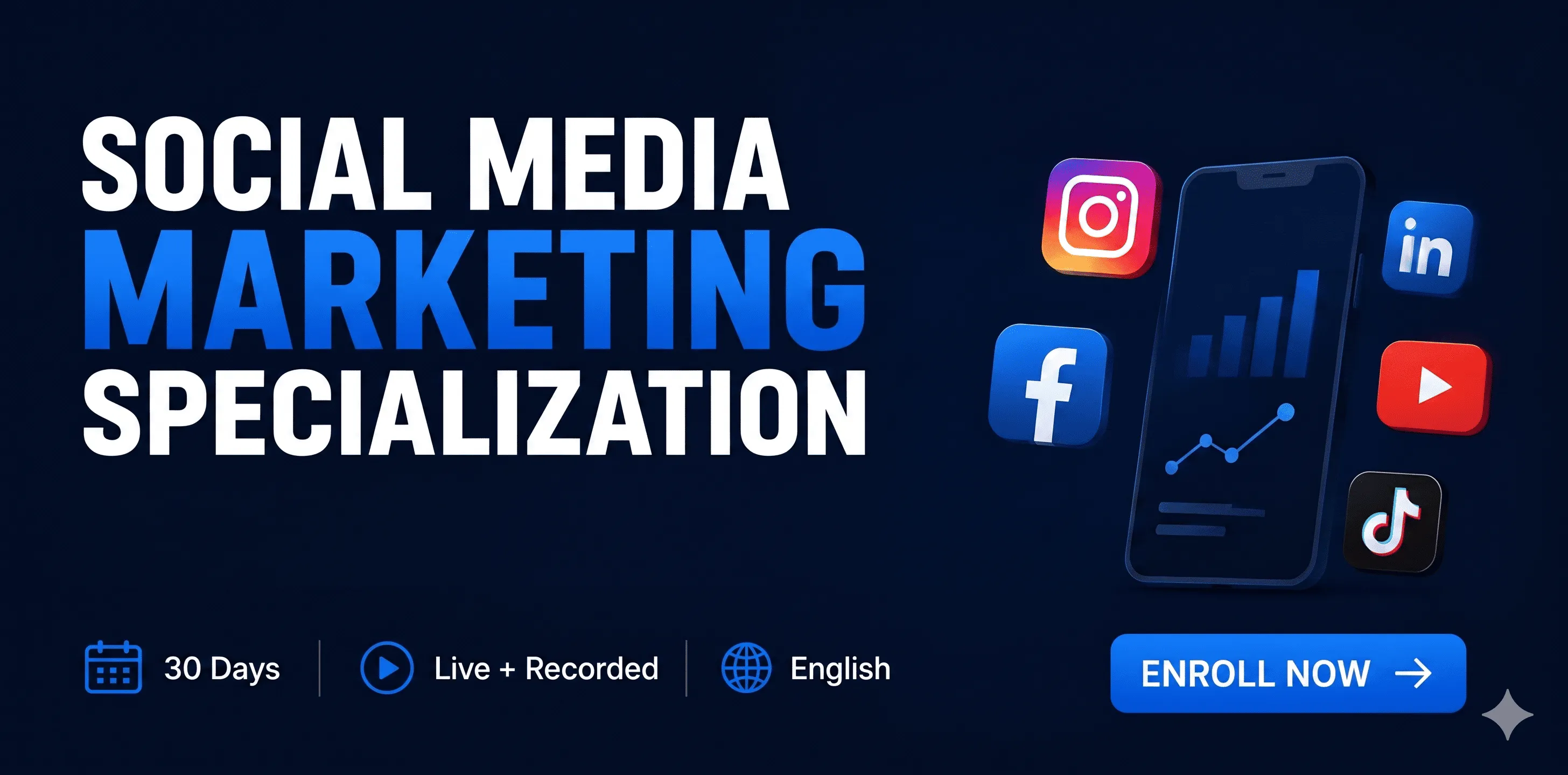
A major component of modern brand building involves maintaining an active, target-focused digital presence across channels like LinkedIn, Instagram, and YouTube. Enrolling in a Digital Marketing with AI Course + Social Media Strategy module teaches associates how to transition from posting randomly to executing structured 30-day publication blueprints.
|
Marketing Phase |
Traditional Manual Method |
AI-Assisted Modern Approach |
|
Ideation |
Brainstorming topics manually for hours |
Generating multi-angle prompt matrices in minutes |
|
Drafting |
Writing individual captions line by line |
Producing tailored variations across multiple platforms instantly |
|
Scheduling |
Manual posting on individual apps |
Automated scheduling guided by optimal timing insights |
|
Audience Mapping |
Basic demographic guessing |
Intent-driven segment mapping using dynamic data |
Building a 30-Day Execution Calendar
-
Define Funnel Stages: Divide your content calendar into Top-of-Funnel (awareness), Middle-of-Funnel (consideration), and Bottom-of-Funnel (conversion) stages.
-
Develop Prompt Frameworks: Create structured prompt templates to produce platform-specific captions, carousel slides, and short video scripts efficiently.
-
Map Audience Segments: Tailor copy angles to resolve specific user pain points across distinct buyer personas.
-
Automate Output Workflows: Use automated productivity tools to review tone, check grammar, and schedule content blocks seamlessly.
How Does a Digital Marketing with AI Course Prepare You for Performance Marketer Jobs?
Content creators rarely work in isolation. To drive predictable acquisition, associates must regularly feed organic messaging insights into paid media campaigns. Studying Digital Marketing with AI Course + Performance Marketer Jobs integration teaches writers how to draft high-converting assets for paid search, display, and social ads.
ORGANIC CONTENT TO PAID CAMPAIGN INTEGRATION
|
Stage |
Key Activities |
|
Organic Channel Testing |
Identify high-performing blog topics and social hooks |
|
↓ |
|
|
Content & AI Optimization |
Generate ad copy variants using prompt frameworks |
|
↓ |
|
|
Performance Paid Media |
Supply optimised assets to performance marketer jobs; run responsive search and display campaigns |
|
↓ |
|
|
Data & Metrics Feedback Loop |
Analyse CPA, CTR, and ROAS data in GA4; refine messaging for future organic and paid content |
Supporting Paid Media Workflows
-
Ad Copy Variation: Writing multiple versions of Responsive Search Ads (RSAs) to assist performance teams with continuous A/B testing.
-
Landing Page Alignment: Matching ad headlines directly to landing page copy to maximize quality scores and reduce cost-per-click.
-
Retargeting Sequences: Designing nurture emails and retargeting ads that guide past visitors back into the buying funnel.
How Does a Digital Marketing with AI Course Help on the Job?
Understanding theory is helpful, but employers hire associates who know how to execute tasks on day one. Completing practical modules from a Digital Marketing with AI Course + How to build real-world marketing projects bridges the gap between study and daily performance.
Practical Industry Projects vs On-the-Job Tasks
-
Building an AI-Powered Content Engine: Learning structured prompting in a course directly translates to managing weekly publishing schedules without burnout.
-
Google Ads Campaign Architecture: Setting up responsive search ad structures in training teaches you how to draft search-intent copy for paid channels.
-
GA4 Event Setup & Analytics: Configuring conversion goals in training ensures you can measure traffic quality and attribution accurately at work.
-
Integrated Growth Strategies: Designing end-to-end funnels prepares you to contribute to broader company revenue goals right from the start.
What AI Tools Does a Digital Marketing with AI Course Teach
To maintain high productivity, associates must understand how to integrate specialised AI tools into their daily creation and research workflows.
ESSENTIAL AI TOOL STACK
|
Research & Strategy |
Creation & Copywriting |
Analytics & SEO |
|
Consumer Insights |
Long-Form Drafts |
GA4 Insights |
|
Intent Clustering |
Social Copy Variants |
Rank Tracking |
|
Competitive Analysis |
Ad Headline Testing |
CRO Metrics |
-
Large Language Models: Used for quick topic outlining, drafting initial copy variations, and summarizing complex research papers.
-
Generative Visual Tools: Used to produce blog header images, social graphics, and visual mockups rapidly.
-
SEO & Analytics Engines: Used to uncover long-tail keyword opportunities, evaluate page readability, and analyze competitor content gaps.
-
Workflow Automation Tools: Used to connect creation databases with scheduling platforms to streamline campaign rollouts.





FAQs
What entry-level roles can I apply for after completing this training?
How does learning AI tools improve my daily career growth?
Do content associates need to know about paid performance marketing?
How long does it take to learn these practical marketing skills?
Is coding required to use AI tools in digital marketing?





Get Free Counselling Today
and Clear up all your Doubts
 Live & recorded classes available at easeDashboard for progress trackingLakhs of practice questions

