
How Generative AI Engineers Build Real-World AI Applications
 Hardik Gupta27 Aug, 2026
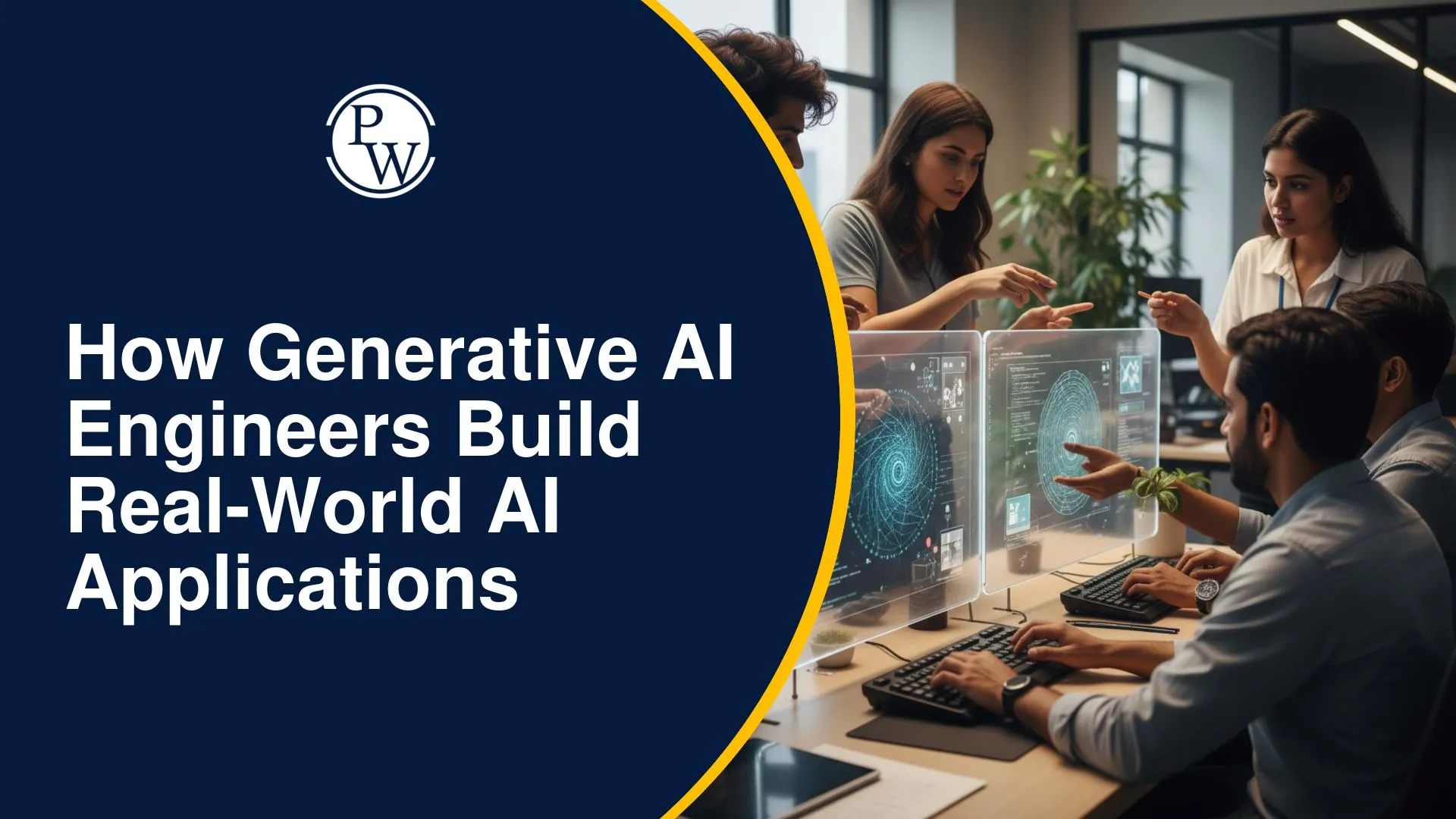
Many software developers and data enthusiasts struggle to move beyond simple prompt wrappers to build reliable software. Building production-ready Generative AI Applications requires more than sending text prompts to an API; it demands clear system architecture, low latency, and robust data management.
Software engineers face challenges like hallucinated outputs, high latency, complex model evaluation, and rising operational costs. Understanding how skilled engineers overcome these hurdles is essential if you want to transition into modern AI engineering.
What is Generative AI Applications?
Generative AI Applications are software solutions that use AI models such as Large Language Models (LLMs) to create text, code, images, audio, and other content. These applications combine AI models with APIs, databases, vector databases, and tools to solve real-world problems. Developers use techniques such as Retrieval-Augmented Generation (RAG), prompt engineering, and fine-tuning to improve accuracy and provide useful results. GenAI Applications can support areas such as customer service, content creation, data analysis, software development, research, and business automation.
How Generative AI Applications Architecture Works?
Modern GenAI Applications rely on multi-tier architectures rather than isolated models. AI engineers design robust systems that wrap foundation models inside security, orchestration, and storage layers.
RAG & FOUNDATION MODEL ARCHITECTURE
|
Layer / Component |
Technology / Role |
|
User Interface |
User Requests & Model Responses |
|
Orchestration Layer |
LangChain / LlamaIndex |
|
Vector Database |
Pinecone / ChromaDB — Stores and Retrieves Relevant Context |
|
Foundation Models |
LLMs / Fine-Tuned Models — Generate Responses Using the Retrieved Context |
-
User Interface and API Gateway: The front-end accepts user inputs, sanitizes data, and handles authorization.
-
Orchestration Engine: Frameworks manage prompts, chain multiple tasks, and coordinate external tools.
-
Data Retrieval and Vector Storage: High-dimensional vector databases retrieve context-relevant enterprise data.
-
Foundation Models: Text, code, or image models generate outputs based on the structured prompt.
-
Guardrails and Evaluation Layer: Automated verification tools filter out unsafe responses, check accuracy, and enforce output schemas.
How to Build Generative AI Applications?
Building enterprise systems requires structured engineering workflows. Engineers follow clear technical steps to turn early concepts into deployed production code.
-
Problem Definition and Metric Setup: Engineers identify the core business goal and choose specific success metrics, such as context relevance, response time, and cost per query.
-
Data Preparation and Embedding: Unstructured business documents (PDFs, docs, tables) are cleaned, split into distinct chunks, and converted into mathematical vector embeddings.
-
Prompt Engineering and Structuring: Developers craft prompts with explicit role framing, few-shot examples, and strict JSON output formats to reduce unpredictable answers.
-
Retrieval Pipeline Integration: Teams integrate Retrieval-Augmented Generation (RAG) pipelines to feed company knowledge to the model in real time.
-
Deployment and Monitoring: The solution is packaged using Docker, hosted on cloud services, and monitored for latency, drift, and costs.
What Tech Stack Is Used for Generative AI Applications?
Building reliable systems requires a specialized software stack designed for real-time model interaction. The table below breaks down the key technology layers used by AI application development teams:
|
Stack Layer |
Primary Tools and Technologies |
Core Role in Development |
|
Programming Language |
Python, TypeScript |
Writing orchestration scripts and managing asynchronous API requests. |
|
Orchestration Frameworks |
LangChain, LlamaIndex |
Connecting models, external software APIs, and database tools. |
|
Vector Databases |
Pinecone, ChromaDB, Qdrant |
Storing embeddings for fast, semantic context searching. |
|
Model Hosting Platforms |
Hugging Face, Azure OpenAI, AWS Bedrock |
Serving base base models securely at scale. |
|
Observability and Guardrails |
LangSmith, Guardrails AI, Arize |
Tracking token costs, latency, and toxic or incorrect outputs. |
How to Improve Generative AI Applications With RAG and Fine-Tuning?
Engineers rarely deploy off-the-shelf models for specialized corporate tasks. Standard models lack knowledge of private corporate documents and can output confident falsehoods. Developers use two primary methods to supply domain context: Retrieval-Augmented Generation (RAG) and Fine-Tuning.
KNOWLEDGE INTEGRATION: RAG VS FINE-TUNING
|
Feature |
RAG |
Fine-Tuning |
|
Purpose |
Uses Dynamic External Data |
Adapts Static Internal Behaviour |
|
Data Access |
Connects to External Databases & Documents |
Trains the Model on Specific Data |
|
Main Benefit |
Easy to Update with New Information |
Changes Model Behaviour, Tone & Style |
|
Factual Updates |
Supports Quick Updates to Knowledge |
Requires New Training for Major Updates |
|
Cost & Maintenance |
Generally Easier to Update & Maintain |
More Costly and Requires Model Training |
RAG keeps information current by retrieving relevant document snippets before sending a query to the model. This approach gives the system access to dynamic context without requiring costly retrainings. Fine-tuning adjusts model parameters directly, helping it adopt a specific output style, tone, or internal syntax.
In practice, teams often combine both techniques. Fine-tuning helps the model learn specialized output formats, while RAG provides real-time facts to maintain high accuracy.
What Are the Challenges of Generative AI Applications?
Deploying GenAI Applications to production presents challenges that traditional web software development rarely encounters. Engineers address these unique risks early in the development lifecycle.
Managing Latency and API Costs
Base model APIs are priced per processing token, making unoptimized queries expensive at scale. Large prompts also increase user wait times. Engineers address this by setting up response caching, streaming text tokens to the UI in real time, and routing simple tasks to smaller, lower-cost models.
Preventing Hallucinations and Bad Output
Generative models generate text based on statistical probabilities, which means they can produce plausible but inaccurate details. Engineers mitigate hallucinations by using RAG pipelines to ground responses in verified documents, restricting output formats with JSON schemas, and enforcing strict input validation guardrails.


