

How Deployment & DevOps basics From Full Stack Development with AI Course Applies on the Job
 Hardik Gupta20 Jul, 2026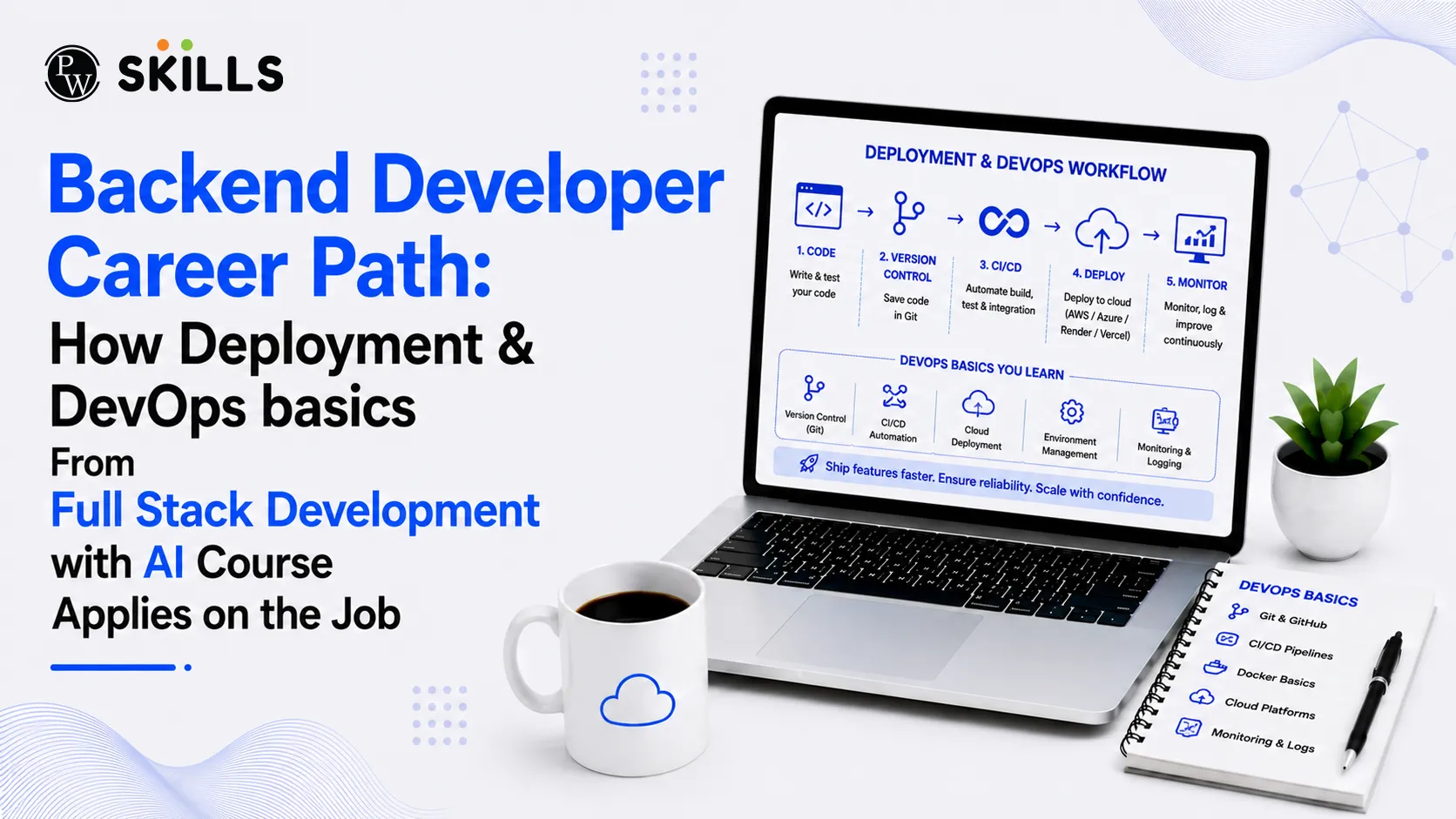
Starting a career in backend development involves more than just writing clean code on a local machine. Many self-taught coders struggle when their applications fail to work in production environments. Learning code architecture alongside cloud infrastructure solves this exact gap. Taking a comprehensive program like a Full Stack Development with AI Course helps aspiring backend engineers understand how modern cloud tools, automated pipelines, and server management apply directly to daily engineering tasks.
Importance of Full Stack Development with AI Course
AI full-stack development course is important because it teaches learners how to build complete applications using frontend, backend, databases, and cloud technologies while using AI tools to improve productivity. It helps students automate repetitive tasks, speed up development, and gain industry-ready skills required for modern software engineering roles such as Full Stack Developer, Backend Developer, and MERN Stack Developer.
Importance of Deployment in a Full Stack Development Course
Writing code that runs on your personal computer is only the first step of software engineering. The real challenge begins when thousands of users try to access that application simultaneously. Software programs must move from a private workspace to a live cloud server where anyone can reach them.
Understanding deployment prevents the classic issue where software functions perfectly for a single developer but crashes when launched publicly. A modern AI full-stack development course teaches developers how to package applications so they behave predictably on any cloud provider.
Learning infrastructure management also helps backend engineers collaborate effectively with systems administrators. When you understand how a server processes requests, you write better database queries and design more efficient application interfaces. This foundational knowledge shifts your focus from simply writing isolated code blocks to building resilient web systems.
Server Setup and Cloud Infrastructure in a Full Stack Development with AI Course
Backend professionals spend significant time managing the environments where their applications live. Relying on manual setups often causes configuration errors across different development phases.
Modern teams use virtual private servers and container services to build stable environments. Instead of manually installing software libraries on a computer, engineers write configuration files that launch identical environments automatically.
-
Virtual Servers: Cloud instances provide scalable computing power that adjusts based on traffic.
-
Container Systems: Tools isolate application dependencies so software runs identically on a laptop and a live server.
-
Process Managers: Background tools keep backend scripts running continuously and restart them automatically if errors occur.
CI CD Pipelines in a AI Full Stack Development Course
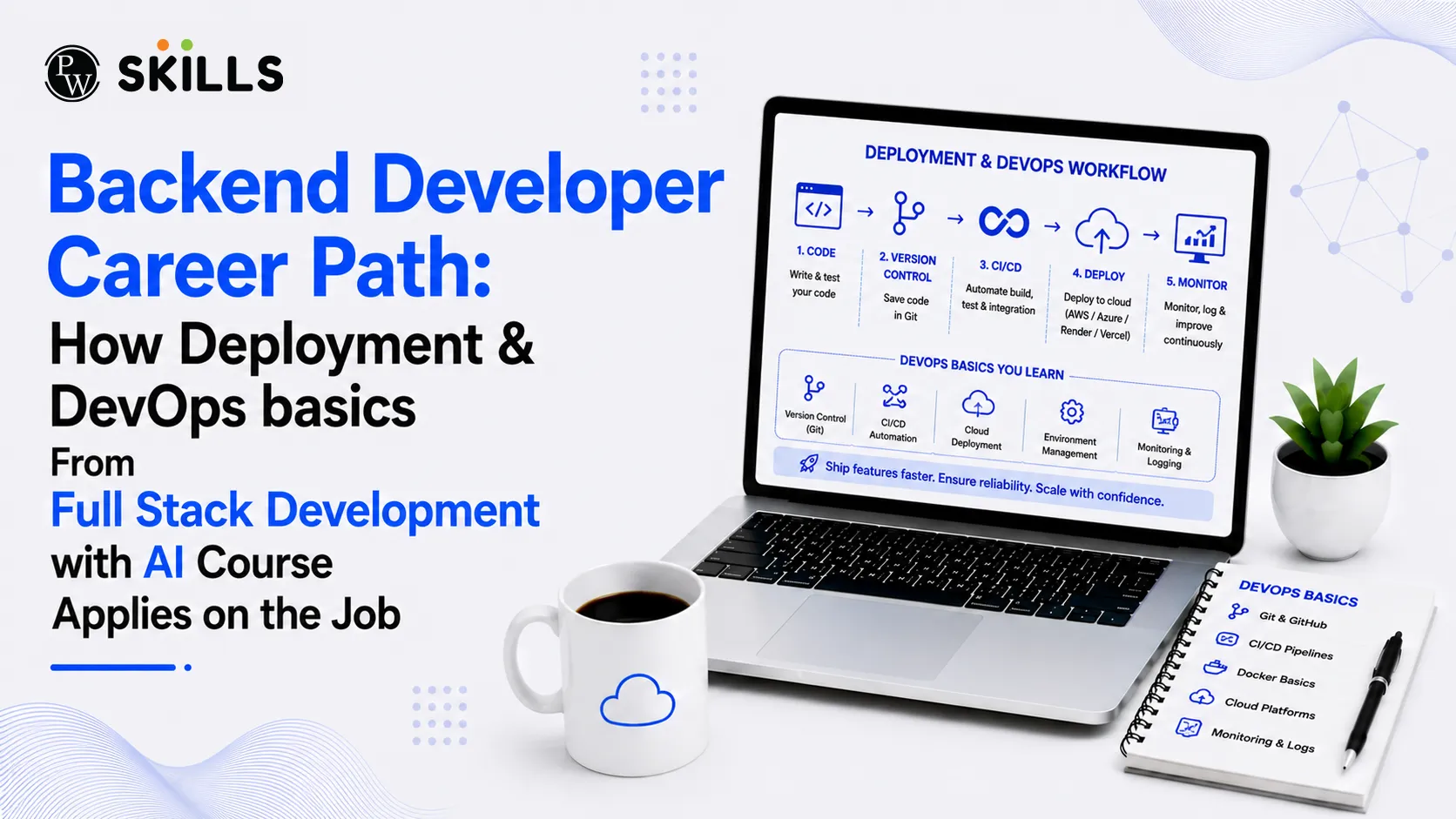
Manual deployment involves logging into servers, pulling recent code updates, and restarting processes by hand. This approach increases the risk of human error during urgent updates. Full Stack Development with AI Course + How systems operate in professional environments relies heavily on continuous integration and continuous deployment (CI CD).
A CI CD pipeline acts as an automated conveyor belt for code changes. When an engineer updates a feature, the automated pipeline instantly runs a suite of quality checks. If the tests pass, the system automatically builds the new version and pushes it to production servers without disrupting active users.
|
Pipeline Stage |
Purpose |
Primary Output |
|
Code Integration |
Combines developer updates into a central repository |
Verified source code repository |
|
Automated Testing |
Runs unit and integration tests to catch bugs early |
Test success or failure report |
|
Build Generation |
Packages code into a clean, deployable unit |
Runnable software container |
|
Production Launch |
Updates live cloud servers with zero downtime |
Live feature available to users |
AI-assisted Coding in a Full Stack Development with AI Course
The daily responsibilities of a backend engineer have evolved with the introduction of smart development assistants. Utilizing a Full Stack Development with AI Course + AI-assisted coding methodologies allows developers to automate repetitive script writing and configuration tasks.
Artificial intelligence tools help generate boilerplate server setups, draft database migration scripts, and write complex network configuration files. Instead of spending hours looking up specific syntax for deployment manifests, developers can use conversational prompts to build functional initial layouts.
Quick Tip: While automated assistants speed up configuration generation, always manually verify network settings and security rules before applying them to live environments.
Using these tools effectively requires strong foundational knowledge. An engineer must understand what the generated script does to debug it when issues arise. AI handles the repetitive formatting, leaving the developer free to focus on system architecture and logic.
Monitoring and Logging in a AI Full Stack Development Course
Launching a backend application is not the final step in the software lifecycle. Once software is live, systems must be tracked to maintain optimal speed and catch internal runtime errors before clients notice them.
Monitoring tools provide real-time metrics on server health, tracking memory usage, central processing unit strain, and network response times. High memory usage often alerts engineers to potential code inefficiencies before a complete system crash occurs.
-
Centralised Logs: System applications print continuous operational data that helps engineers trace the exact cause of runtime errors.
-
Alerting Systems: Automatic notifications ping engineering teams via communication channels if error rates spike unexpectedly.
-
Performance Metrics: Tracking response times ensures database queries remain fast as user traffic increases over time.
AI Full Stack Development Course for MERN Stack Developer Jobs
The current technology market highly values backend engineers who possess comprehensive operational skills. Candidates seeking Full Stack Development with AI Course + MERN Stack Developer Jobs stand out when they demonstrate practical cloud deployment capabilities alongside standard database proficiency.
Companies want to hire developers who can build an application, containerise it, design an automated testing pipeline, and launch it to a cloud environment independently. Possessing these operational skills reduces the need for constant oversight from senior infrastructure teams.
When interviewing for modern engineering positions, discussing personal project deployment workflows is highly effective. Explaining how you configured an automated delivery pipeline or managed cloud resource scaling proves you possess practical skills that apply directly to enterprise software environments.
Database Scaling and Security in a Full Stack Development with AI Course
As software applications grow, the underlying databases face immense pressure from constant read and write requests. Backend engineers must implement scaling strategies to maintain speed during high traffic periods.
Implementing data caching strategies reduces the direct load on primary databases by storing frequently requested information in temporary, high-speed memory. Additionally, creating database replicas allows teams to distribute read traffic across multiple instances efficiently.
Security remains a foundational element of server infrastructure. Engineers must configure firewalls, manage secure communication certificates, and hide sensitive environment variables like API keys from public source repositories. Protecting data at rest and during network transmission is a core responsibility of every professional backend developer.




FAQs
What is the primary benefit of completing AI full-stack development course for backend roles?
How does an AI-powered full stack development course help me secure MERN stack developer jobs?
Why is understanding CI CD pipelines important for entry level backend engineers?
How do engineers use AI-assisted coding safely during application deployment?
What is the difference between application hosting and DevOps infrastructure management?




 Live & recorded classes available at easeDashboard for progress trackingLakhs of practice questions

