

Backend Developer Salary in India : What Full Stack Development with AI Course Adds to Your Resume
 Hardik Gupta22 Jul, 2026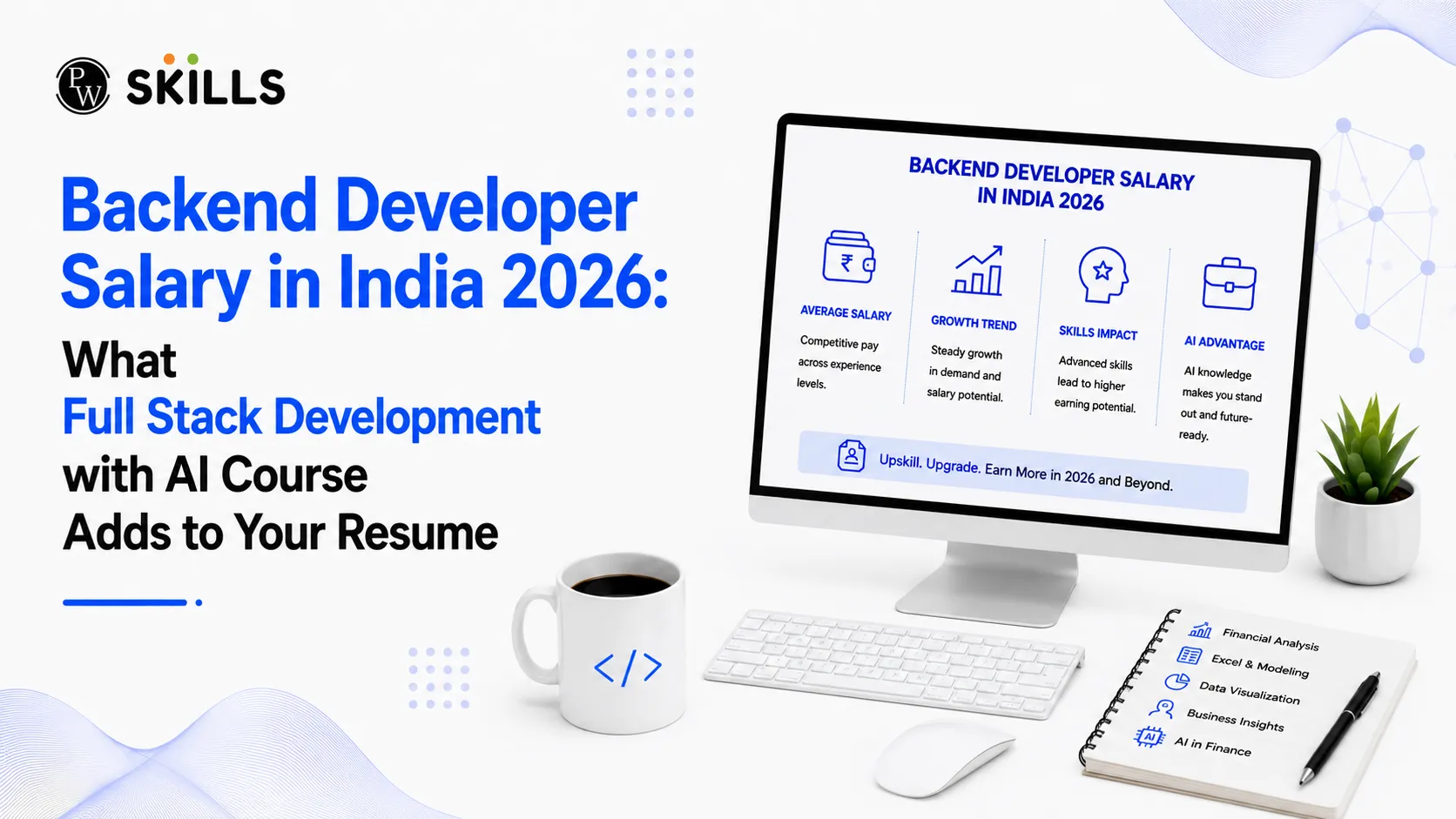
Building a successful software career requires more than learning basic programming languages. Employers increasingly seek developers who can combine backend development with AI-powered tools and automation. A Full Stack Development with AI Course helps you build these in-demand skills, preparing you to work on scalable applications, improve productivity, and qualify for high-growth software engineering roles.
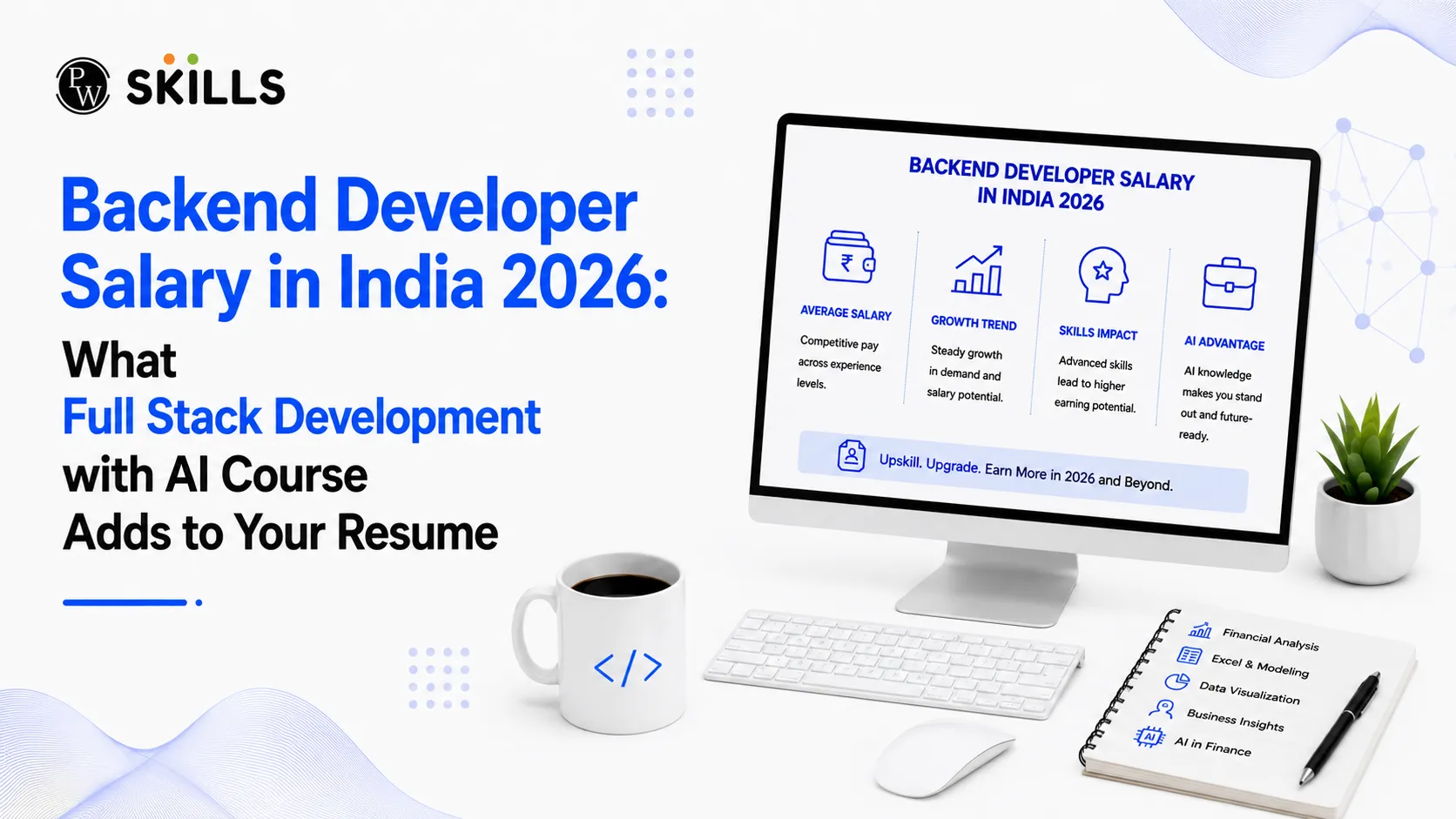
Backend Developer Salary in India
Full Stack Development with AI Course + What determines backend developer salary is a common question among aspiring developers. Backend developer salaries in India vary based on experience, location, employer, and technical expertise. Professionals with strong skills in backend development, databases, cloud technologies, and AI-powered development tools often have access to better career opportunities and higher salary packages. The table below provides an estimated overview of backend developer salary ranges in India.
|
Experience Band |
Estimated Salary Range (LPA)* |
Core Technical Expectations |
|
Fresher / Junior (0 to 2 Years) |
Approximately ₹4 Lakhs to ₹10 Lakhs |
Writing basic server scripts, handling straightforward web requests, and simple debugging. |
|
Mid-Level (2 to 5 Years) |
Approximately ₹10 Lakhs to ₹25 Lakhs |
Managing microservices architectures, handling server-side caching, and improving web speeds. |
|
Senior / Lead (5 to 8+ Years) |
Approximately ₹25 Lakhs to ₹60+ Lakhs |
Enterprise system design, multi-server data sync, scaling infrastructures, and structural planning. |
*Salary ranges are approximate and may vary depending on factors such as company, location, technical skills, and industry demand.
Full Stack Development with AI Course Impact
Integrating predictive modeling, automated pipelines, and intelligent interfaces directly into the server architecture shifts an engineer from a standard coder to an elite architectural asset. Enrolling in a structured course transforms your professional trajectory by teaching you how to build applications that learn, adapt, and process data intelligently.
Modern businesses require applications that go far beyond standard input and output responses. They need systems that can analyze user actions, provide dynamic recommendations, and automate back-end data processing without heavy human intervention.
Enrolling in an advanced learning program delivers distinct advantages to your day-to-day software development tasks:
-
Automated code optimization: Learn how to utilize advanced machine learning tools to review server logic, identify performance flaws, and automate routine script maintenance.
-
Intelligent system monitoring: Discover how to create self-healing backend architectures that predict traffic spikes and automatically allocate server resources smoothly.
-
Smart data pipelines: Gain the technical knowledge required to build data ingestion systems that parse, clean, and classify large amounts of data automatically.
Backend Developer Job Opportunities after Full Stack Development Course
The current technology employment sector shows a massive rise in specialized hybrid positions that bridge the gap between traditional engineering and automated machine systems. Companies are actively consolidating their hiring budgets to recruit flexible professionals who can easily own the entire lifecycle of an application.
Acquiring these specialized capabilities gives you an immediate competitive advantage when applying for premier server-side vacancies. It proves to prospective hiring managers that you possess the exact modern tools required to scale their digital services effectively.
The distinct corporate domains offering high-paying backend developer jobs require clear strategic skill sets:
-
Product-driven software corporations: These firms focus heavily on deep system scalability, real-time user data streams, and automated system logic, often offering premium starting packages.
-
Financial technology entities: Secure banking apps demand automated fraud detection, instant data validations, and bulletproof microservices that process transactions without delays.
-
Enterprise service firms: Large-scale cloud operations need migration experts who can embed autonomous algorithms directly into legacy corporate databases.
Full Stack Development with AI Course for Database Design
An application is only as efficient as its underlying storage mechanism. A major pillar of any elite Full Stack Development with AI Course + Database design module is teaching engineers how to construct robust, high-performance data architectures that process millions of queries smoothly.
Traditional data storage methods often fall short when handling massive unstructured datasets generated by modern automated systems. Understanding the exact mechanical behavior of structured and non-structured data stores ensures your applications remain rapid and responsive under heavy production loads.
Focusing deeply on modern data architecture principles unlocks several key operational capabilities:
-
Vector data management: Learn the process of storing complex mathematical representations of data to power real-time semantic search and intelligent recommendations.
-
Autonomous index optimization: Learn how to implement automated scripts that monitor database health, adjust indexes dynamically, and eliminate slow query times.
-
Distributed storage partitioning: Discover how to split massive corporate datasets across global server networks to guarantee maximum availability and fault tolerance.
Backend Developer Skills You Learn in a Full Stack Development with AI Course
While generic coding knowledge is widespread, specific advanced specializations remain rare and highly valued by enterprise employers. Focusing your energy on these specific areas will directly influence your ability to command top-tier compensation packages during salary discussions.
High-throughput system architecture
Employers look for engineers who can confidently design software structures capable of managing thousands of requests every single second. This requires a deep practical grasp of load balancers, asynchronous message queues, and horizontal server scaling strategies.
Cloud-native platform engineering
Modern systems are built directly inside cloud environments like AWS or GCP. Developing a strong working familiarity with container tools like Docker and deployment orchestrators like Kubernetes ensures your apps run flawlessly across any digital infrastructure.
How to Choose the Right Full Stack Development with AI Course
When searching for the ultimate training program, look for options that balance deep theoretical computing concepts with intensive practical assignments. Avoid courses that focus exclusively on simple coding syntax without explaining real-world production challenges or system limitations.
A premium educational curriculum must provide comprehensive modules covering modern framework implementations, database scaling techniques, and direct API constructions. Building tangible, production-ready projects ensures you are fully prepared to tackle actual enterprise assignments immediately upon joining a new team.




FAQs
What is the primary benefit of enrolling in an AI-powered full stack development course?
How does specialized database design training impact backend developer jobs?
Can a fresher secure a high backend developer salary in India after this course?
What programming languages are focused on during modern full-stack training?
Is system design included in an AI-powered full stack development course?




 Live & recorded classes available at easeDashboard for progress trackingLakhs of practice questions

