

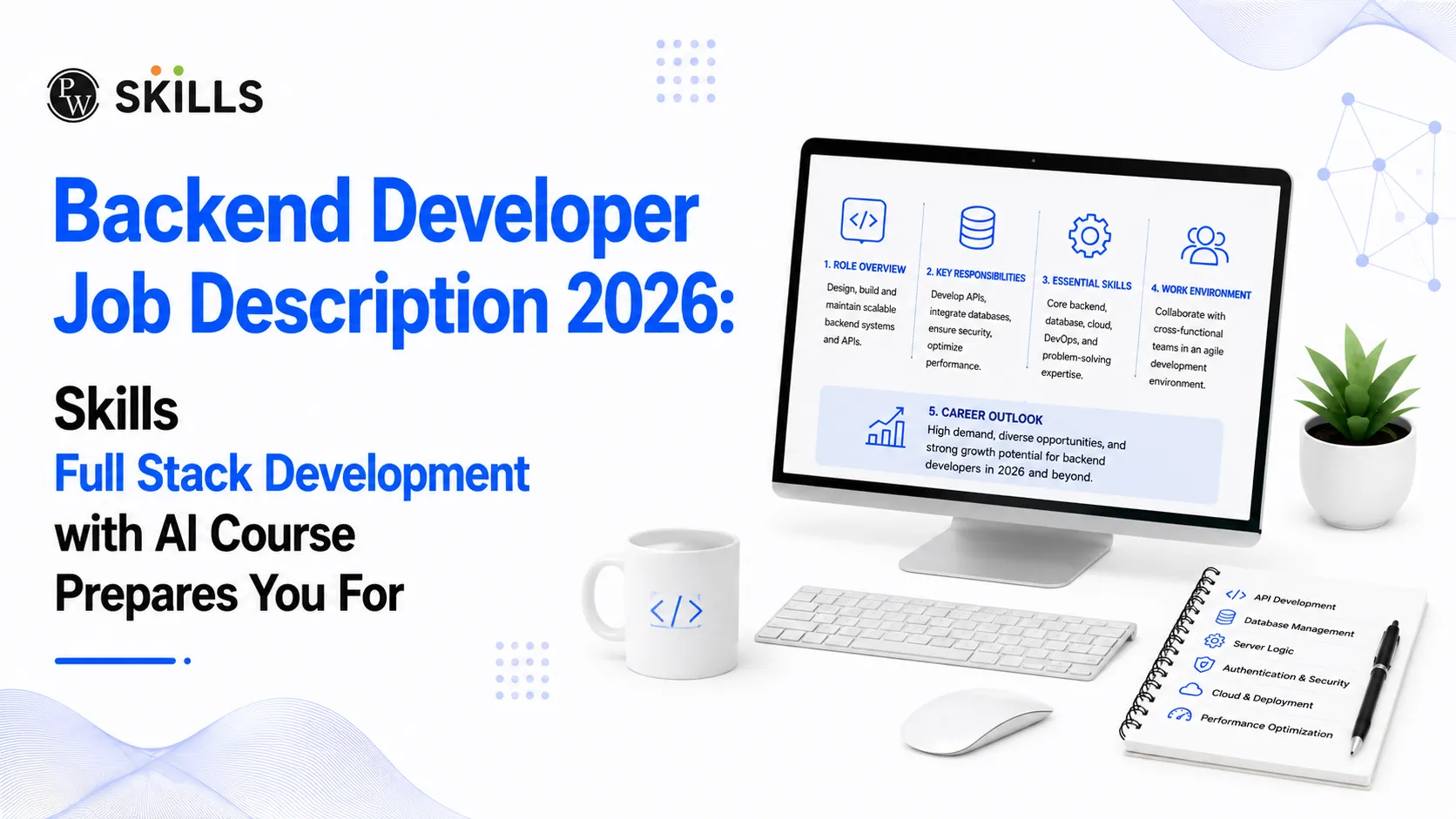
Backend Developer Job Description: Skills Full Stack Development with AI Course Prepares You For
 Hardik Gupta20 Jul, 2026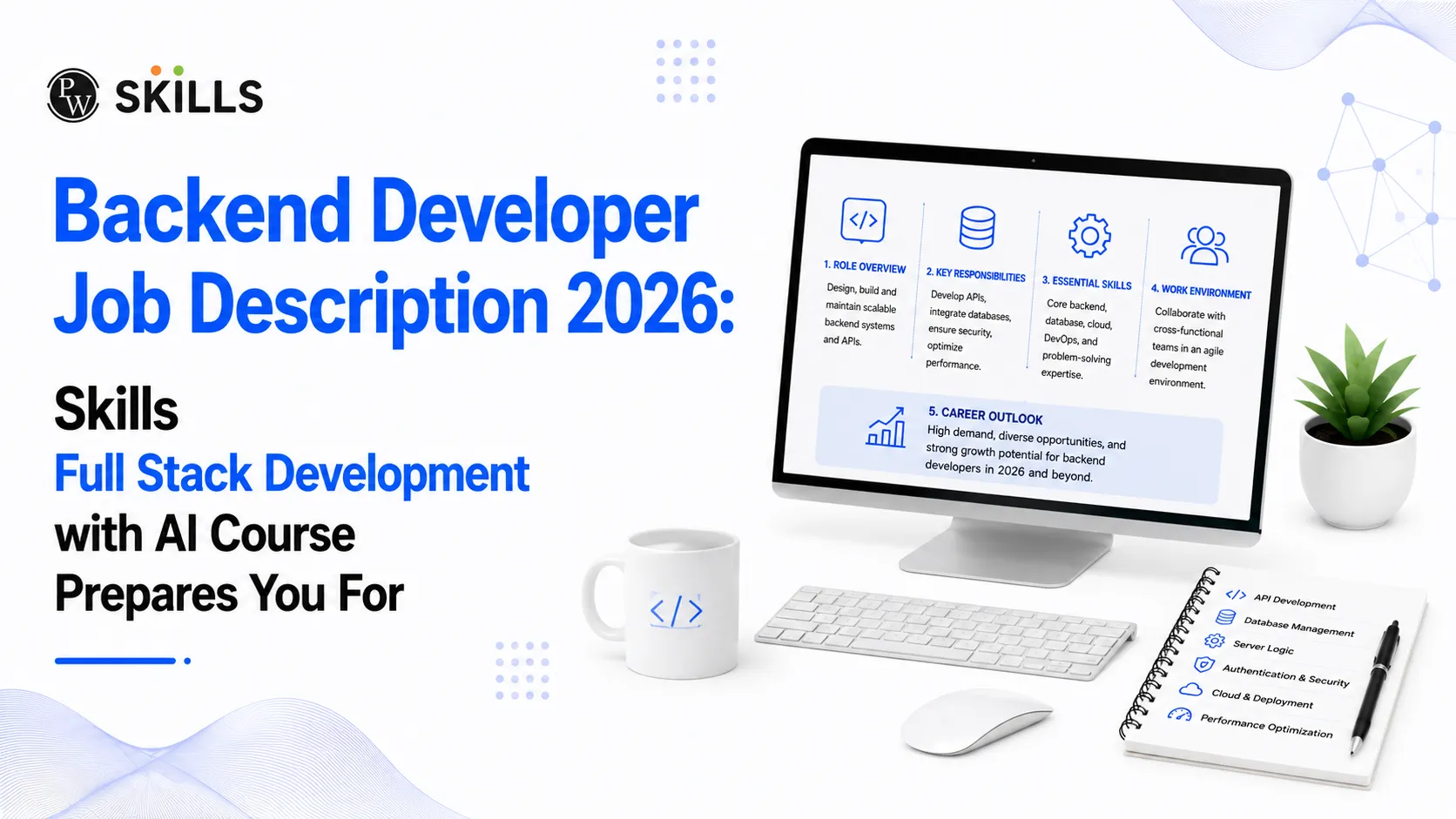
The technology industry is evolving rapidly, and employers now expect developers to combine strong coding skills with AI-powered workflows. A Full Stack Development with AI Course helps you build expertise in backend development, scalable architectures, and intelligent automation. By learning these in-demand skills, you can stay competitive and prepare for modern software engineering roles across industries.
Backend Developer Role in 2026
The server-side ecosystem has evolved far beyond simple database management and basic routing systems. Today, corporate teams require specialized engineers who can design self-healing architectures and manage complex automated workflows.
A modern developer manages the underlying system logic, data storage systems, and application programming interfaces (APIs) that power consumer platforms. In 2026, this responsibility includes deploying machine learning models directly into the server pipeline, optimizing cloud infrastructure for cost efficiency, and maintaining robust security standards against automated cyber threats. Understanding what the industry expects helps you align your learning path with actual market needs.
Core Architectural Responsibilities
-
System Design: Designing microservices architectures that allow independent components to scale fluidly during peak traffic periods.
-
API Management: Creating secure, well-documented RESTful and GraphQL endpoints for data exchange across different services.
-
Database Administration: Managing both relational databases like PostgreSQL and non-relational systems like MongoDB for optimal data retrieval speeds.
Importance of Full Stack Development with AI Course
Traditional coding bootcamps often overlook the profound impact that automated tools and machine learning have on daily engineering operations. Choosing a stack development with an AI Course ensures you learn how to collaborate with intelligent systems rather than being replaced by them.
These programs teach you to use automated code generation tools to speed up your workflow, allowing you to focus on high-level system architecture and problem-solving. By understanding the underlying logic of these advanced tools, you position yourself as a highly efficient engineering asset.
Meeting the Demands of Modern Technical Teams
-
Accelerated Code Production: Learning how to leverage automated prompts to generate boilerplate code, reducing initial development cycles by half.
-
Intelligent Debugging: Using predictive systems to isolate runtime errors and patch system vulnerabilities before code reaches production servers.
-
Advanced System Optimization: Deploying algorithmic models that analyze system performance metrics and automatically reallocate server resources.
Full Stack Development with AI Course Skills for Backend Developers
Building a sustainable engineering career requires a balanced mix of fundamental programming knowledge and modern automation skills. The right training program structures these complex topics into manageable learning modules.
The following checklist highlights the definitive technical capabilities that top-tier companies look for when screening engineering candidates in 2026.
|
Technical Domain |
Core Skills Taught |
Business Value Delivered |
|
Server-Side Coding |
Node.js, Python, advanced asynchronous programming architectures |
High-performance application foundations |
|
Database Engineering |
Query optimization, database sharding, data caching with Redis |
Fast data retrieval and minimal latency |
|
AI Implementation |
Large Language Model (LLM) integration, vector database management |
Context-aware application features |
|
Cloud Infrastructure |
Docker containerization, Kubernetes orchestration, AWS deployment |
Scalable and resilient system deployments |
Advanced Server Programming
Mastering languages like Python, Java, or Go is vital, but understanding asynchronous runtime environments like Node.js is what sets you apart. You will learn to handle thousands of concurrent server requests without causing system slowdowns or hardware crashes.
Intelligent Data Management
Modern applications handle massive amounts of unstructured data daily. A comprehensive full-stack development with AI Course teaches you to implement vector databases like Pinecone, which are essential for storing the data embeddings that power modern machine learning applications.
Full Stack Development with AI Course and Frontend Developer Jobs
The boundary between server management and client-side presentation is becoming increasingly blurred in modern software teams. Backend developers must design reliable systems that directly support and enhance Frontend Developer Jobs across various digital platforms.
When backend engineers build clean, predictable data pipelines, frontend teams can build smooth user interfaces without worrying about data inconsistencies. This collaborative dynamic speeds up product deployment and minimizes integration errors during final launch phases.
Team Performance Across Technical Roles
-
Clean Contract Definitions: Establishing precise API blueprints so frontend teams can build interface components independently.
-
Real-Time Communication: Implementing WebSocket systems to deliver instant data updates to client applications without constant page refreshes.
-
State Synchronization: Designing server architectures that perfectly match the state management systems used on the frontend.
Full Stack Development Course for Responsive UI Development
Modern web applications must perform flawlessly on devices ranging from low-powered smartphones to high-end desktop monitors. While visual layout is handled by client-side code, the server plays a critical role in supporting Responsive UI development through smart asset delivery.
By setting up smart content delivery networks (CDNs) and dynamic image optimization pipelines, the backend ensures the client side receives perfectly sized assets instantly. This drastically reduces page load times and improves mobile user experiences worldwide.
[User Request] ➔ [Edge Server / CDN] ➔ [Dynamic Image Optimization] ➔ [Responsive UI Delivery]
Server Techniques for Enhanced Interface Responsiveness
-
Conditional Asset Serving: Detecting user device profiles on the server to deliver optimally compressed media files automatically.
-
Server-Side Rendering (SSR): Generating initial HTML structures on the server to ensure immediate page visibility on slower mobile connections.
-
Predictive Data Prefetching: Using historical user patterns to load data into the server cache before the client explicitly requests it.
Full Stack Development with AI Course for DevOps and Cloud Skills
Writing high-quality code is only half the battle; ensuring that code deploys smoothly to millions of global users is equally crucial. Contemporary engineering roles require a deep familiarity with automated deployment pipelines and cloud platforms.
You will learn to package your applications into isolated containers using tools like Docker, ensuring your software runs perfectly across different computing environments. This eliminates the classic "it works on my machine" dilemma entirely.
Core Cloud Infrastructure Competencies
-
Container Infrastructure: Writing clean configuration files to manage isolated runtime environments for diverse microservices.
-
Continuous Integration (CI/CD): Setting up automated testing sequences that check code health before merging it into primary repositories.
-
Monitoring and Alerting: Configuring live tracking systems like Prometheus to spot memory leaks and unusual traffic spikes instantly.



FAQs
What skills are emphasized in an AI-powered full stack development course?
How do backend architectures affect Frontend Developer Jobs globally?
How does a Full Stack Development with AI Course + Frontend Developer Jobs pathway help career growth?
Full Stack Development with AI Course + What does it teach students?
Why is Full Stack Development with AI Course + Responsive UI development important?




 Live & recorded classes available at easeDashboard for progress trackingLakhs of practice questions

